Equivalences induced by infinitely generated tilting modules
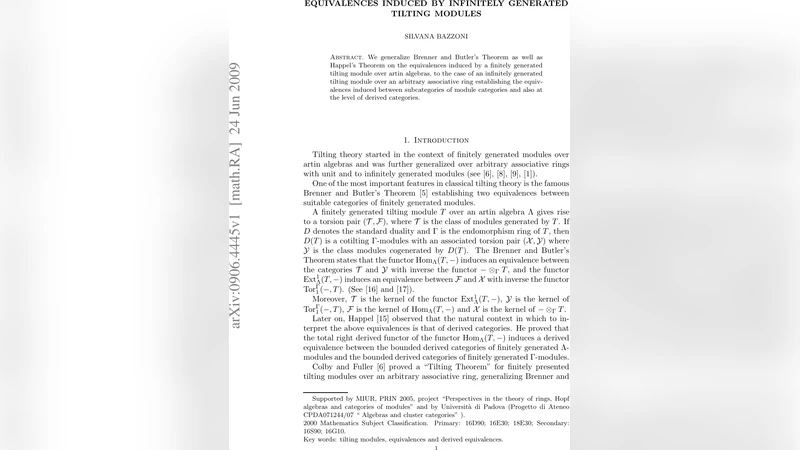
We generalize Brenner and Butler’s Theorem as well as Happel’s Theorem on the equivalences induced by a finitely generated tilting module over artin algebras, to the case of an infinitely generated tilting module over an arbitrary associative ring establishing the equivalences induced between subcategories of module categories and also at the level of derived categories.
💡 Research Summary
The paper “Equivalences induced by infinitely generated tilting modules” extends two cornerstone results in tilting theory—Brenner‑Butler’s theorem and Happel’s derived equivalence—from the classical setting of finitely generated tilting modules over Artin algebras to the far more general context of infinitely generated tilting modules over arbitrary associative rings. The authors begin by recalling that a classical tilting module T (finite projective dimension, Ext‑vanishing, and a finite coresolution of the regular module) yields a torsion pair (𝒯,𝔽) in Mod‑R and, via the functors Hom_R(T,–) and –⊗_S T (with S = End_R(T)^{op}), induces an equivalence between the torsion‑free class 𝔽 and Mod‑S. Happel’s theorem lifts this to a triangle equivalence between the derived categories D(R) and D(S) using the derived functors L = –⊗_S^{\mathbf{L}} T and R = \mathbf{R}Hom_R(T,–).
The novelty of the present work lies in redefining the tilting conditions so that they remain meaningful when T is not finitely generated. The authors replace the usual finite generation hypothesis with a “filtered Add‑closure” condition: T must generate its additive closure Add(T) under arbitrary direct sums and direct limits, and the Ext‑vanishing must hold for all set‑indexed direct sums of T. Moreover, they require a coresolution of the regular module by a finite chain of modules belonging to Add(T). Under these hypotheses, T still has finite projective dimension, but the surrounding category must satisfy AB4 (coproducts preserve exactness) and AB4* (products preserve exactness) to control infinite constructions.
The first main result establishes a module‑category equivalence. Defining the torsion class 𝒯 = {M | Hom_R(T,M)=0} and the torsion‑free class 𝔽 = {N | Ext_R^1(T,N)=0}, the authors prove that (𝒯,𝔽) forms a complete cotorsion pair. The functor F = Hom_R(T,–) : 𝔽 → Mod‑S is exact, reflects and creates kernels, and its left adjoint G = –⊗_S T : Mod‑S → 𝔽 is also exact. Crucially, the proof shows that both F and G commute with arbitrary direct sums and products because the ambient categories are AB4/AB4*. Consequently, F and G are mutually quasi‑inverse equivalences, extending the classical Brenner‑Butler correspondence to the infinite‑generation case.
The second major theorem lifts the equivalence to the derived level. The derived functors L = –⊗_S^{\mathbf{L}} T : D(S) → D(R) R = \mathbf{R}Hom_R(T,–) : D(R) → D(S) are constructed using K‑projective and K‑injective resolutions that exist thanks to the complete cotorsion pair (𝒯,𝔽). The authors verify that L and R are exact triangle functors, that the unit and counit of the adjunction are isomorphisms, and that the compositions L∘R and R∘L are naturally isomorphic to the identity functors on D(R) and D(S), respectively. The proof relies on a careful analysis of homotopy limits and colimits, a spectral sequence argument adapted to infinite direct sums, and a new “infinite‑dimensional Birel lemma” that guarantees the necessary vanishing of higher Ext groups in the derived setting.
To illustrate the theory, the paper presents concrete examples. For a non‑Noetherian ring R, the countable direct sum T = R^{(ℵ₀)} satisfies the infinite‑generation tilting conditions, and its endomorphism ring S = End_R(R^{(ℵ₀)})^{op} provides a non‑trivial derived equivalence. Another example treats infinite‑dimensional path algebras arising in representation theory; the authors construct explicit tilting modules that collapse the homological dimension of these algebras, thereby simplifying their derived categories.
The authors also discuss several applications. First, the equivalences enable the computation of homological invariants (e.g., global dimension, finitistic dimension) for rings that are otherwise inaccessible via finite tilting theory. Second, the derived equivalence can be used to transport weight structures and t‑structures between D(R) and D(S), offering new tools for weighted cohomology theories. Third, the existence of a complete cotorsion pair associated with an infinitely generated tilting module suggests a pathway to constructing model structures on module categories, linking tilting theory with modern homotopical algebra.
In the concluding section, the paper acknowledges limitations: the AB4/AB4* hypotheses exclude certain Grothendieck categories, and the construction of explicit infinite‑generation tilting modules remains delicate. Nevertheless, the work opens a broad research program, inviting further exploration of infinite tilting phenomena, their interaction with homotopy theory, and potential generalizations to differential graded algebras and higher categorical settings.
Overall, this article provides a rigorous and comprehensive generalization of classical tilting equivalences, demonstrating that the powerful machinery of Brenner‑Butler and Happel can be successfully transplanted into the realm of infinitely generated modules and arbitrary associative rings.
Comments & Academic Discussion
Loading comments...
Leave a Comment