Atomic Embeddability, Clustered Planarity, and Thickenability
We study the atomic embeddability testing problem, which is a common generalization of clustered planarity (c-planarity, for short) and thickenability testing, and present a polynomial-time algorithm for this problem, thereby giving the first polynomial-time algorithm for c-planarity. C-planarity was introduced in 1995 by Feng, Cohen, and Eades as a variant of graph planarity, in which the vertex set of the input graph is endowed with a hierarchical clustering and we seek an embedding (crossing free drawing) of the graph in the plane that respects the clustering in a certain natural sense. Until now, it has been an open problem whether c-planarity can be tested efficiently, despite relentless efforts. The thickenability problem for simplicial complexes emerged in the topology of manifolds in the 1960s. A 2-dimensional simplicial complex is thickenable if it embeds in some orientable 3-dimensional manifold. Recently, Carmesin announced that thickenability can be tested in polynomial time. Our algorithm for atomic embeddability combines ideas from Carmesin’s work with algorithmic tools previously developed for weak embeddability testing. We express our results purely in terms of graphs on surfaces, and rely on the machinery of topological graph theory. Finally, we give a polynomial-time reduction from atomic embeddability to thickenability thereby showing that both problems are polynomially equivalent, and show that a slight generalization of atomic embeddability to the setting in which clusters are toroidal graphs is NP-complete.
💡 Research Summary
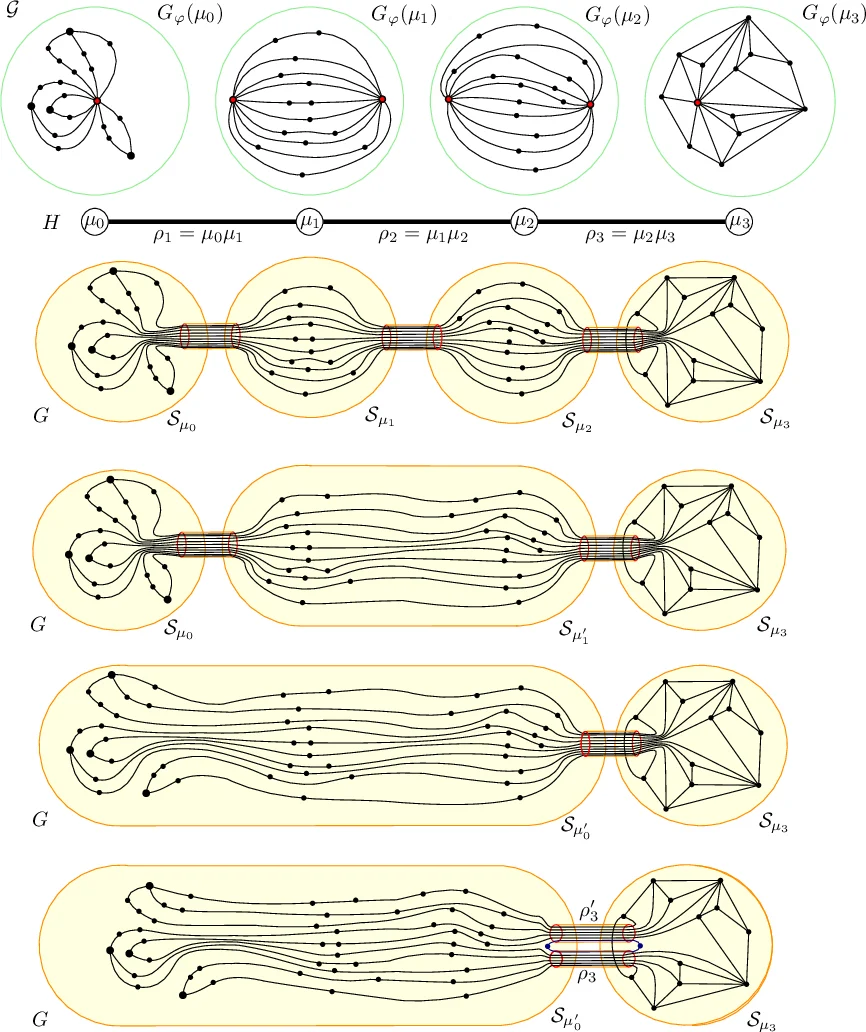
The paper introduces “atomic embeddability” as a unifying framework that simultaneously generalizes the long‑standing clustered planarity (c‑planarity) problem and the thickenability testing problem for 2‑dimensional simplicial complexes. An instance consists of two loop‑free multigraphs G and H together with a simplicial map ϕ : G → H that sends vertices of G to “atoms” (vertices of H) and edges of G either to atoms or to “pipes” (edges of H). For each atom ν∈V(H) a surface S(ν) is built by taking a sphere and removing deg(ν) disjoint open discs (holes); each hole is associated with an incident pipe. By gluing the holes of adjacent atoms via orientation‑reversing homeomorphisms, a 2‑dimensional thickening H of the graph H is obtained. An atomic embedding of G with respect to ϕ places every vertex of G inside the corresponding sphere S(ϕ(v)) and every edge of G as a Jordan arc that either stays inside a single sphere or traverses exactly one pipe, intersecting the corresponding hole in a single transversal point.
The key combinatorial object is the family of local graphs G_ϕ(ν). Vertices of G_ϕ(ν) correspond to ordinary vertices of G mapped to ν together with virtual vertices representing the incident pipes. Edges of G_ϕ(ν) encode the adjacency of ordinary vertices as well as the connections to virtual vertices. An atomic embedding exists iff every local graph is planar and, for each pipe μν∈E(H), the two virtual vertices representing that pipe in G_ϕ(μ) and G_ϕ(ν) have compatible rotations – i.e., their cyclic orders of incident edges are either identical or opposite. This “rotation compatibility” condition captures precisely the global topological constraints imposed by the surface gluing.
The algorithm proceeds in several stages. First, the input is transformed into a normal form that simplifies the structure of the local graphs. Then the algorithm repeatedly applies two elementary operations that preserve the existence of an atomic embedding:
-
Stretch(v, ·) – splits a vertex v of a local graph into two vertices of smaller degree, redistributing incident edges while preserving the pipe incidences. When v is a virtual vertex, the operation also modifies H by adding a handle, thereby increasing the genus of the underlying surface by one.
-
Contract(·) – contracts a pipe (edge of H), merging the two incident atoms and simplifying the corresponding local graphs.
These operations are applied to vertices of maximum degree Δ≥4. Each Stretch reduces the degree, and each Contract reduces the number of pipes. The process continues until all local graphs become sub‑cubic (maximum degree ≤3) or toroidal (both G and H are 2‑regular). In the sub‑cubic case, planarity of the local graphs together with rotation compatibility can be checked in linear time using standard planar embedding algorithms. In the toroidal case, the problem reduces to testing embeddability of a collection of cycles on a torus, which is also linear‑time solvable.
If at any point a local graph is found to be non‑planar, the algorithm immediately declares the instance negative. Otherwise, after a polynomial number of Stretch and Contract steps, the instance is reduced to one of the tractable special cases, yielding a positive answer. The overall running time is polynomial in the size of the input.
A crucial contribution is the demonstration that atomic embeddability and thickenability are polynomial‑time equivalent. Given a 2‑dimensional polyhedron P = (H, F) (where H is the 1‑skeleton and F a set of facet cycles), one constructs an atomic embeddability instance (G, H) by letting G be the vertex‑disjoint union of the cycles in F. Conversely, from an atomic embeddability instance (G, H, ϕ) one obtains a thickenability instance by taking H as the underlying graph and letting the facets be the cycles of G. Both transformations are performed in linear time, establishing that the two decision problems lie in the same complexity class.
Finally, the paper investigates a natural generalization where each atom’s surface S(ν) may have higher genus (e.g., a torus with handles). It proves that this generalized atomic embeddability problem is NP‑complete even when every S(ν) is a torus. The reduction exploits the fact that rotation compatibility on a torus encodes a known NP‑hard surface‑graph coloring problem. Thus, while the original atomic embeddability problem is polynomial‑time solvable, allowing higher‑genus atom surfaces immediately yields computational intractability.
In summary, the authors provide the first polynomial‑time algorithm for c‑planarity by embedding it into the atomic embeddability framework, show that thickenability of 2‑dimensional complexes can also be decided in polynomial time, and delineate the boundary between tractable and intractable variants of the problem. This work resolves a three‑decade‑old open question in graph drawing and opens new avenues for algorithmic topology and constrained graph embedding.
Comments & Academic Discussion
Loading comments...
Leave a Comment