The topology of ultrafilters as subspaces of $2^omega$
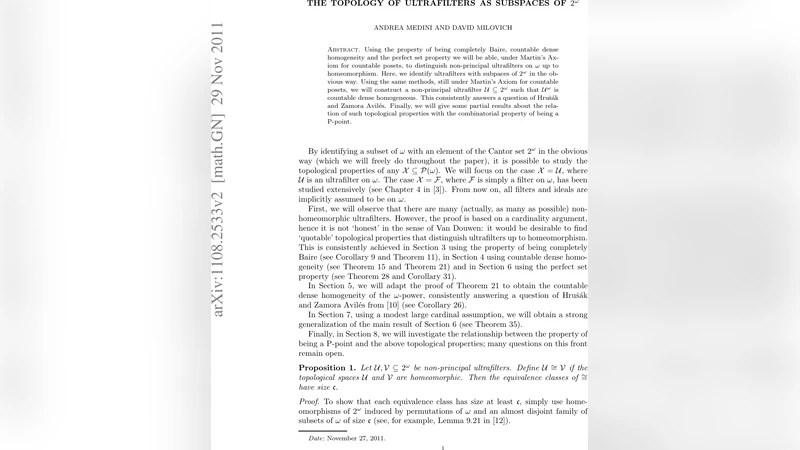
Using the property of being completely Baire, countable dense homogeneity and the perfect set property we will be able, under Martin’s Axiom for countable posets, to distinguish non-principal ultrafilters on $\omega$ up to homeomorphism. Here, we identify ultrafilters with subpaces of $2^\omega$ in the obvious way. Using the same methods, still under Martin’s Axiom for countable posets, we will construct a non-principal ultrafilter $\UU\subseteq 2^\omega$ such that $\UU^\omega$ is countable dense homogeneous. This consistently answers a question of Hru\v{s}'ak and Zamora Avil'es. Finally, we will give some partial results about the relation of such topological properties with the combinatorial property of being a $\mathrm{P}$-point.
💡 Research Summary
The paper investigates the topology of non‑principal ultrafilters on ω by identifying each ultrafilter with a subspace of the Cantor space 2^ω. The author’s central goal is to distinguish ultrafilters up to homeomorphism using concrete topological properties rather than abstract cardinality arguments. Three main properties are examined: being completely Baire, countable dense homogeneity (CDH), and the perfect set property. All results are obtained under Martin’s Axiom for countable posets (MA(countable)), which provides the necessary combinatorial control.
First, the author studies completely Baire spaces—those in which every closed subspace is a Baire space. By Hurewicz’s characterization, a space fails to be completely Baire precisely when it contains a closed copy of the rationals Q. Using this, the paper constructs, under MA(countable), a non‑principal ultrafilter U that does not contain any closed copy of Q, thereby making U completely Baire. The construction proceeds by a transfinite recursion of families F_ξ with the finite‑intersection property, carefully adding points either from the complement of a candidate Q‑copy or from its closure but outside the copy itself. Lemma 12 shows how MA(countable) yields a generic filter that supplies the needed point at each stage. Theorem 11 concludes that a completely Baire ultrafilter exists consistently.
Second, the paper turns to countable dense homogeneity. A space X is CDH if any two countable dense subsets can be carried onto each other by a homeomorphism of X. The author first builds, again under MA(countable), a countable independent family D dense in 2^ω and splits it into two disjoint dense parts D₁ and D₂. Lemma 14 then constructs an independent family A ⊇ D with the additional feature that for every possible G_δ‑homeomorphism f mapping D₁ onto D₂, there is a point x such that both x and its complement ω\f(x) belong to A. This forces any ultrafilter U containing A to fail CDH, because any homeomorphism that would map D₁ to D₂ would necessarily move a point outside U, contradicting the ultrafilter’s closure under complements. Theorem 15 formalizes this, giving a consistent example of a non‑CDH ultrafilter.
Third, the paper answers a question of Hrušák and Zamora Avilés concerning the ω‑power of an ultrafilter. Using the same machinery, the author constructs an ultrafilter U such that the product space U^ω (the countable product of U with itself) is countable dense homogeneous. The key observation is that the CDH property can be lifted to the ω‑power when the underlying ultrafilter is built with enough “flexibility” in its dense subsets. Corollary 26 records this result, providing a consistent positive answer to the aforementioned question.
Fourth, the perfect set property is examined. A space has the perfect set property if every non‑empty closed set either contains a perfect subset or is countable. Theorem 28 and Corollary 31 show that, under MA(countable), one can separate ultrafilters according to whether they satisfy this property, yielding further non‑homeomorphic examples.
Finally, the relationship between these topological properties and the combinatorial notion of a P‑point is explored. The paper presents partial results: while some completely Baire ultrafilters can be P‑points, the existence of a P‑point that also has the perfect set property remains independent of ZFC. The author outlines several open problems concerning the interaction of P‑points with complete Baireness and CDH.
Overall, the work demonstrates that under a modest set‑theoretic hypothesis (MA for countable posets) one can systematically construct ultrafilters with prescribed topological behavior, thereby providing a rich taxonomy of ultrafilters up to homeomorphism. The techniques blend forcing‑style genericity arguments, classical descriptive set theory (Baire category, perfect sets), and combinatorial constructions of independent families, offering a template for further investigations into the fine structure of ultrafilter spaces.
Comments & Academic Discussion
Loading comments...
Leave a Comment