A Multi-wavelength Study of the Sunyaev-Zeldovich Effect in the Triple-Merger Cluster MACS J0717.5+3745 with MUSTANG and Bolocam
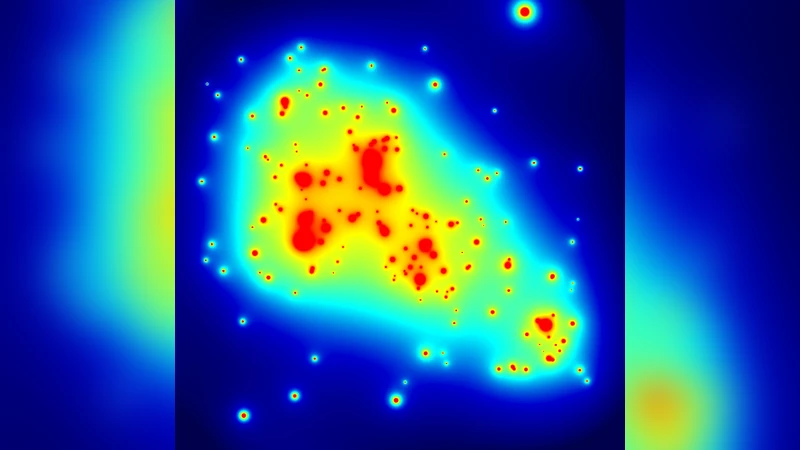
We present 90, 140, and 268GHz sub-arcminute resolution imaging of the Sunyaev-Zel’dovich effect (SZE) in MACSJ0717.5+3745. Our 90GHz SZE data result in a sensitive, 34uJy/bm map at 13" resolution using MUSTANG. Our 140 and 268GHz SZE imaging, with resolutions of 58" and 31" and sensitivities of 1.8 and 3.3mJy/beam respectively, was obtained using Bolocam. We compare these maps to a 2-dimensional pressure map derived from Chandra X-ray observations. Our MUSTANG data confirm previous indications from Chandra of a pressure enhancement due to shock-heated, >20keV gas immediately adjacent to extended radio emission seen in low-frequency radio maps. The MUSTANG data also detect pressure substructure that is not well-constrained by the X-ray data in the remnant core of a merging subcluster. We find that the small-scale pressure enhancements in the MUSTANG data amount to ~2% of the total pressure measured in the 140GHz Bolocam observations. The X-ray template also fails on larger scales to accurately describe the Bolocam data, particularly at the location of a subcluster known to have a high line of sight optical velocity (~3200km/s). Our Bolocam data are adequately described when we add an additional component - not described by a thermal SZE spectrum - coincident with this subcluster. Using flux densities extracted from our model fits, and marginalizing over the temperature constraints for the region, we fit a thermal+kinetic SZE spectrum to our data and find the subcluster has a best-fit line of sight proper velocity of 3600+3440/-2160km/s. This agrees with the optical velocity estimates for the subcluster. The probability of velocity<0 given our measurements is 2.1%. Repeating this analysis using flux densities measured non-parametrically results in a 3.4% probability of a velocity<=0. We note that this tantalizing result for the kinetic SZE is on resolved, subcluster scales.
💡 Research Summary
This paper presents a multi‑frequency, high‑resolution study of the Sunyaev‑Zeldovich effect (SZE) in the massive, dynamically complex galaxy cluster MACS J0717.5+3745, using data from the MUSTANG camera on the Green Bank Telescope (90 GHz) and the Bolocam instrument on the Caltech Submillimeter Observatory (140 GHz and 268 GHz). The MUSTANG observations achieve a 13 arcsec beam and a map noise of 34 µJy beam⁻¹, providing the most detailed view of the thermal SZE morphology to date. Bolocam delivers lower‑resolution but broader‑field maps with beams of 58 arcsec (140 GHz) and 31 arcsec (268 GHz) and sensitivities of 1.8 mJy beam⁻¹ and 3.3 mJy beam⁻¹ respectively.
The authors first construct a two‑dimensional pressure template from deep Chandra X‑ray imaging and spectroscopy. By comparing this X‑ray‑derived pressure map with the SZE images, they confirm that the high‑resolution MUSTANG data reveal a pressure enhancement adjacent to a bright, low‑frequency radio relic. This enhancement corresponds to shock‑heated gas with temperatures exceeding 20 keV, a feature that is only hinted at in the X‑ray data because of limited photon statistics in that region. In addition, MUSTANG uncovers small‑scale pressure substructures in the remnant core of a merging subcluster that are not constrained by the X‑ray analysis. Quantitatively, these sub‑arcminute pressure peaks contribute roughly 2 % of the total pressure measured in the 140 GHz Bolocam map.
On larger scales, the X‑ray pressure template fails to reproduce the Bolocam data, especially in the vicinity of a subcluster (often labeled “B”) that exhibits a large line‑of‑sight optical velocity of about +3200 km s⁻¹. The discrepancy cannot be explained by a simple thermal SZE spectrum. The authors therefore introduce an additional component with a distinct spectral shape, consistent with the kinetic SZE (kSZE), which arises from the bulk motion of the intracluster medium relative to the cosmic microwave background rest frame.
To quantify the kSZE, the authors perform a joint fit to the three SZE flux densities (90, 140, and 268 GHz) extracted from a parametric model that includes both thermal and kinetic contributions. They marginalize over the temperature uncertainty of the subcluster region, using the X‑ray spectroscopic constraints as priors. The best‑fit line‑of‑sight velocity for the subcluster is 3600 km s⁻¹, with asymmetric 68 % confidence intervals of +3440 km s⁻¹ and –2160 km s⁻¹. This value is fully consistent with the optical spectroscopic measurement, providing an independent verification of the subcluster’s high peculiar velocity.
The statistical significance of the detection is assessed in two ways. First, using the model‑based flux densities, the probability that the true velocity is negative (i.e., that the observed signal is not due to a receding motion) is only 2.1 %. Second, a non‑parametric approach—directly measuring flux densities from the maps without assuming a specific spatial model—yields a similar probability of 3.4 % for a non‑positive velocity. Both results indicate a >97 % confidence that the kinetic SZE signal is present on resolved, subcluster scales.
The paper’s conclusions have several important implications. (1) High‑resolution SZE imaging can uncover pressure substructures that are invisible to current X‑ray observations, especially in regions of shock heating and radio relics. (2) The kinetic SZE can be measured not only for whole clusters but also for individual merging components, opening a new avenue for probing three‑dimensional dynamics in complex systems. (3) The combination of multi‑frequency SZE data with X‑ray and radio observations provides a powerful, complementary toolkit for dissecting the thermodynamic and kinematic state of the intracluster medium.
Looking forward, the authors suggest that upcoming instruments with improved sensitivity and angular resolution—such as MUSTANG‑2, NIKA2, and ALMA Band 3 observations—will enable more precise mapping of both thermal and kinetic SZE signals. Coupled with high‑resolution hydrodynamic simulations, these data will help disentangle the contributions of shock heating, turbulence, magnetic fields, and relativistic particle populations to the observed pressure distribution. Ultimately, such studies will refine our understanding of cluster merger physics, improve mass estimates for cosmological applications, and provide direct observational constraints on the velocity field of large‑scale structure.