Addict Free -- A Smart and Connected Relapse Intervention Mobile App
It is widely acknowledged that addiction relapse is highly associated with spatial-temporal factors such as some specific places or time periods. Current studies suggest that those factors can be utilized for better relapse interventions, however, there is no relapse prevention application that makes use of those factors. In this paper, we introduce a mobile app called “Addict Free”, which records user profiles, tracks relapse history and summarizes recovering statistics to help users better understand their recovering situations. Also, this app builds a relapse recovering community, which allows users to ask for advice and encouragement, and share relapse prevention experience. Moreover, machine learning algorithms that ingest spatial and temporal factors are utilized to predict relapse, based on which helpful addiction diversion activities are recommended by a recovering recommendation algorithm. By interacting with users, this app targets at providing smart suggestions that aim to stop relapse, especially for alcohol and tobacco addiction users.
💡 Research Summary
The paper presents “Addict Free,” a mobile application designed to help individuals recovering from alcohol and tobacco addiction by leveraging spatial‑temporal data to predict relapse and deliver personalized diversion activities. The authors begin by highlighting the public‑health burden of alcohol and tobacco use in the United States and noting that most existing relapse‑prevention tools focus on static consumption metrics, ignoring the dynamic context of where and when cravings occur.
Addict Free is built around three core components. The front‑end collects user‑entered data (amount of alcohol or cigarettes consumed, timestamps, self‑defined “alcohol spots”) and automatically gathers GPS coordinates to create geofences around high‑risk locations. Users can manually add places they associate with relapse, allowing the system to tailor interventions to each person’s unique risk map.
The back‑end houses a relapse‑prediction engine based on a Long Short‑Term Memory (LSTM) neural network. The model ingests a 30‑day history of multi‑dimensional inputs: drinking/smoking times, quantities, location identifiers, and user profile attributes such as preferred activities or stress levels. Training minimizes mean‑squared error, and the network outputs an hourly probability of relapse. When the predicted probability exceeds a predefined threshold, the app triggers two types of notifications: (1) real‑time alerts when the user enters a geofenced “danger zone,” offering nearby alternative activities (e.g., a gym, café, or shopping venue) that match the user’s interests; and (2) pre‑emptive alerts about 10 minutes before a high‑risk time window, giving the user a brief period to engage in a diversion. These alerts are fully personalized, drawing on the user’s interest profile stored in the system’s database.
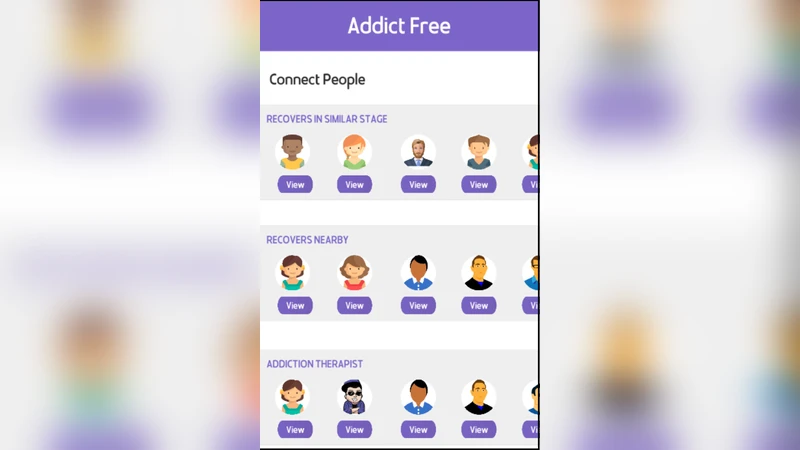
The third component is a community module that groups users and professional therapists by recovery stage and geographic proximity. It provides a forum‑like interface where members can post questions, share experiences, and receive peer or expert advice. All shared data are anonymized to protect privacy, while still enabling meaningful social support.
Addict Free also visualizes daily, weekly, and monthly consumption trends and a “soberness” score (scaled 1‑10) to give users a clear picture of their progress. A short daily survey captures stress levels and feedback, which are fed back into the prediction model to improve accuracy over time.
While the system architecture and algorithmic details are well described, the paper lacks quantitative evaluation. No performance metrics (e.g., ROC‑AUC, precision, recall) are reported, and the user study appears limited to a prototype stage without long‑term adherence data. The authors acknowledge these gaps and suggest future work involving large‑scale clinical trials, A/B testing of notification strategies, and enhanced privacy controls.
In summary, Addict Free integrates geofencing, LSTM‑based relapse prediction, personalized diversion recommendations, and a supportive community into a single platform. By moving beyond static consumption tracking to incorporate real‑world spatial‑temporal context, the app aims to intervene before cravings translate into relapse, thereby improving the likelihood of sustained recovery for alcohol and tobacco users.
Comments & Academic Discussion
Loading comments...
Leave a Comment