SAR Analysis of Directive Antenna on Anatomically Real Breast Phantoms for Microwave Holography
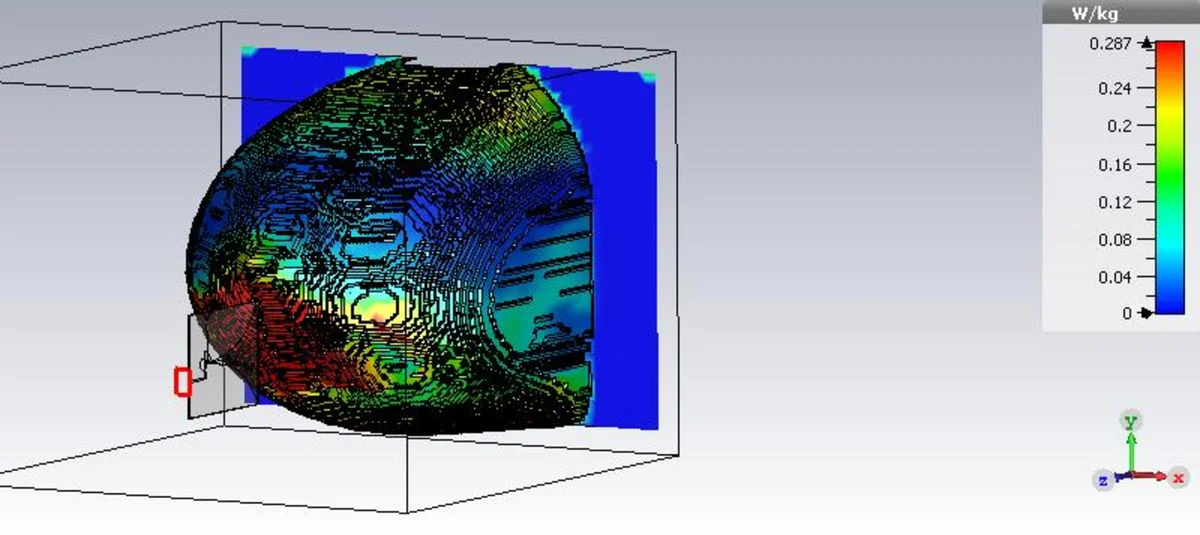
Microwave imaging is emerging as a promising substitution diagnostic tool, for breast cancer detection. It has ignited the interest in the interaction of the microwaves with biological tissues and their respective effects on the human body which requires the investigation of safety issues on human health under the exposure of antenna’s microwave radiation. In this work a specifically designed directive and ultra-wideband antenna is developed for microwave holographic system. A detailed simulation analysis of Specific Absorption Rate (SAR) and temperature variation due to the radiation exposure of the designed antenna on self-designed anatomically real breast phantoms and Computer Simulation Technology (CST) voxel breast models are done in CST environment. Thereafter, the antenna and anatomical phantom are fabricated for the experimental verification of the simulation analysis of SAR. It is found that the SAR due to the radiation of the designed antenna lies in the permissible limit and the variation in temperature is only 0.096%. Hence, the antenna can be used in microwave holography for breast cancer detection.
💡 Research Summary
This paper presents a comprehensive safety assessment of a directive antenna intended for use in a microwave holography system for breast cancer detection. The core objective is to evaluate the Specific Absorption Rate (SAR) and thermal effects induced by the antenna’s radiation on anatomically realistic breast models, ensuring compliance with international human exposure limits.
The study addresses a critical prerequisite for biomedical microwave imaging: verifying that the diagnostic radiation exposure remains within safe thresholds. The authors designed and fabricated a custom Ultra-Wideband (UWB) Vivaldi antenna operating from 4 to 16 GHz, featuring a peak directivity of 3.53 dB at 45 degrees. Its compact, microstrip-fed design makes it suitable for integration into an imaging array.
A significant methodological strength is the use of highly realistic breast phantoms. Numerical models were first created based on MRI datasets from 160 real patients, assigning accurate dielectric properties to simulate adipose and fibroglandular tissues. Physical phantoms were then fabricated using 3D-printed ABS plastic structures (mimicking adipose tissue) filled with a gelatin-water mixture (mimicking glandular tissue), closely replicating the anatomical and dielectric properties of real breasts. For broader analysis, pre-defined voxel breast models from the CST software library were also utilized.
The SAR analysis was conducted through both detailed electromagnetic simulation (using CST Microwave Studio’s FDTD solver) and experimental measurement. Key parameters were varied systematically: the distance between the antenna and the breast phantom (from 5 mm to 30 mm) and the input power level (from 1 mW to 0.5 W). The simulations calculated both 1g-average and 10g-average SAR values according to IEEE and ICNIRP guidelines, respectively.
The results consistently demonstrated that the proposed system operates safely within recommended limits. SAR values increased with higher input power and decreased with greater antenna-to-tissue distance. Crucially, for input power levels at or below 0.1 W, the SAR remained well under the safety limits (1.6 W/kg for 1g, 2.0 W/kg for 10g) across all tested distances. Experimental measurements on the fabricated phantoms showed excellent agreement with simulation results, falling within a ±10% error margin, thereby validating the simulation models. Furthermore, thermal analysis predicted a negligible temperature rise of only 0.096% after 2 hours of continuous exposure, indicating minimal heating risk. An additional analysis using CST voxel models of different age groups suggested that SAR values vary with breast density and age, though without a strict symmetrical pattern, highlighting individual variability.
In conclusion, the research confirms that the specifically designed directive Vivaldi antenna, when used within defined power constraints, poses no safety hazard in terms of localized SAR or temperature increase for microwave holographic breast imaging. The work provides a robust framework for safety evaluation, combining advanced simulation with experimental validation on anatomically accurate phantoms, thereby contributing a essential step towards the safe clinical translation of microwave holography technology.
Comments & Academic Discussion
Loading comments...
Leave a Comment