Risk Factors Associated with Mortality in Game of Thrones: A Longitudinal Cohort Study
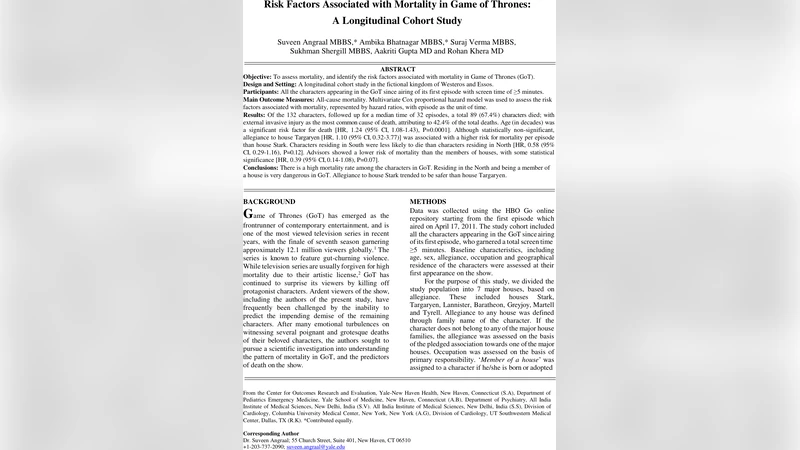
Objective: To assess mortality, and identify the risk factors associated with mortality in Game of Thrones (GoT). Design and Setting: A longitudinal cohort study in the fictional kingdom of Westeros and Essos. Participants: All the characters appearing in the GoT since airing of its first episode with screen time of greater than or equal to 5 minutes. Main Outcome Measures: All-cause mortality. Multivariate Cox proportional hazard model was used to assess the risk factors associated with mortality, represented by hazard ratios, with episodes as the unit of time. Results: Of the 132 characters, followed up for a median time of 32 episodes, a total 89 (67.4%) characters died; with external invasive injury as the most common cause of death, attributing to 42.4% of the total deaths. Age (in decades) was a significant risk factor for death [HR, 1.24 (95% CI, 1.08-1.43), P=0.0001]. Although statistically non-significant, allegiance to house Targaryen [HR, 1.10 (95% CI, 0.32-3.77)] was associated with a higher risk for mortality per episode than house Stark. Characters residing in South were less likely to die than characters residing in North [HR, 0.58 (95% CI, 0.29-1.16), P=0.12]. Advisors showed a lower risk of mortality than the members of houses, with some statistical significance [HR, 0.39 (95% CI, 0.14-1.08), P=0.07]. Conclusions: There is a high mortality rate among the characters in GoT. Residing in the North and being a member of a house is very dangerous in GoT. Allegiance to house Stark trended to be safer than house Targaryen.
💡 Research Summary
The paper presents a whimsical yet methodologically framed longitudinal cohort study of mortality among characters in the television series “Game of Thrones.” The authors defined the cohort as all characters who have appeared on screen for at least five minutes from the series premiere onward, resulting in a sample of 132 individuals. Follow‑up time was measured in episodes, with a median observation period of 32 episodes per character. The primary outcome was all‑cause mortality, and the authors employed a multivariate Cox proportional hazards model to estimate hazard ratios (HRs) for several covariates: age (in decades), allegiance to House Stark versus House Targaryen, geographic residence (North versus South of Westeros), and occupational role (advisor versus house member).
Key findings indicate a striking overall mortality rate of 67.4% (89 deaths). External invasive injury was the leading cause, accounting for 42.4% of deaths. Age emerged as a statistically significant risk factor (HR = 1.24 per decade, 95 % CI 1.08‑1.43, P = 0.0001), suggesting that each additional ten years of “character age” increases the instantaneous risk of death by roughly a quarter. Allegiance to House Targaryen showed a higher point estimate for risk (HR = 1.10, 95 % CI 0.32‑3.77) compared with House Stark, but the confidence interval crossed unity, rendering the result non‑significant. Residents of the South appeared less likely to die than those in the North (HR = 0.58, 95 % CI 0.29‑1.16, P = 0.12), again a non‑significant trend. Advisors (e.g., Tyrion Lannister, Varys) had a lower hazard than house members (HR = 0.39, 95 % CI 0.14‑1.08, P = 0.07), approaching but not reaching conventional significance.
The authors conclude that mortality is high in the series, that northern residence and house affiliation are dangerous, and that Stark allegiance may be relatively protective. While the study is entertaining and showcases a creative application of epidemiologic tools to a fictional universe, several methodological concerns limit the robustness of its conclusions.
First, the inclusion criterion of ≥5 minutes of screen time introduces selection bias by excluding minor characters who may have different survival patterns, potentially inflating the observed mortality rate. Second, using episodes as the unit of time assumes equal exposure across episodes, yet episode length, narrative intensity, and the number of lethal events vary widely, violating the proportional hazards assumption. Third, the covariate set is sparse; important potential confounders such as number of battles participated in, use of magic, political intrigue involvement, and proximity to known “danger zones” (e.g., the Red Keep, the Wall) are omitted, raising concerns about residual confounding. Fourth, the handling of censoring is unclear. Characters who survive beyond the final aired episode are right‑censored, but the paper does not specify how these cases were treated, which could bias hazard estimates. Fifth, the cause‑of‑death categorization is overly broad; “external invasive injury” lumps together sword wounds, arrow shots, dragon fire, and other mechanisms without distinguishing their differing lethality or the presence of medical intervention.
Statistically, the study reports several non‑significant trends but occasionally interprets them as meaningful, which may mislead readers. The confidence intervals for house allegiance and geographic residence are wide, reflecting limited statistical power given the modest sample size and relatively few events per covariate. Moreover, the proportional hazards model assumes that the hazard ratios remain constant over the episode timeline, an assumption that is unlikely to hold in a narrative where plot twists dramatically alter risk (e.g., the Red Wedding).
In summary, the paper succeeds as a pedagogical illustration of survival analysis applied to popular culture, but its findings should be viewed as illustrative rather than definitive. Future work could improve upon this foundation by expanding the cohort to include all named characters, standardizing time measurement (perhaps using screen minutes rather than episodes), incorporating richer exposure variables (battle count, magical abilities, political alliances), and explicitly modeling censoring. Such refinements would yield more credible estimates of mortality risk factors within the richly treacherous world of Westeros and Essos.
Comments & Academic Discussion
Loading comments...
Leave a Comment