Groupoid cocycles and K-theory
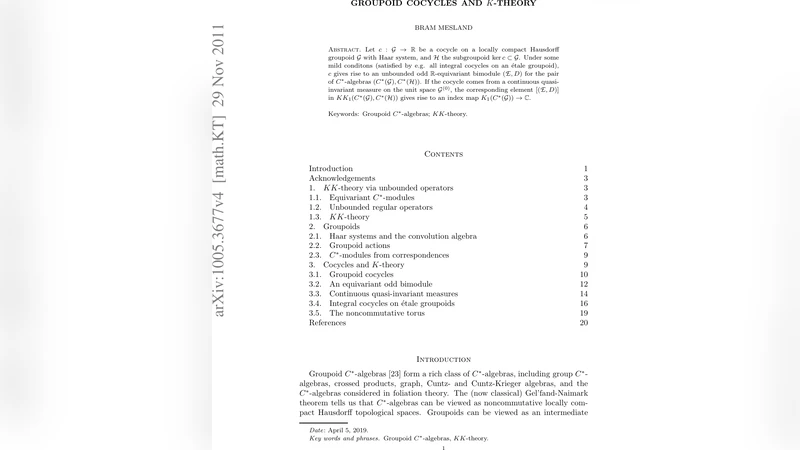
Let $c:\mathcal{G}\to\R$ be a cocycle on a locally compact Hausdorff groupoid $\mathcal{G}$ with Haar system. Under some mild conditions (satisfied by all integer valued cocycles on '{e}tale groupoids), $c$ gives rise to an unbounded odd $\R$-equivariant bimodule $(\mathpzc{E},D)$ for the pair of $C^{}$-algebras $(C^{}(\mathcal{G}),C^{}(\mathcal{H}))$. If the cocycle comes from a continuous quasi-invariant measure on the unit space $\mathcal{G}^{(0)}$, the corresponding element in $KK_{1}^{\R}(C^{}(\mathcal{G}),C^{}(\mathcal{H}))$ gives rise to an index map $K_{1}^{\R}(C^{}(\mathcal{G}))\to \C$.
💡 Research Summary
The paper investigates how a real‑valued cocycle c on a locally compact Hausdorff groupoid 𝔊 equipped with a Haar system can be used to construct an unbounded odd ℝ‑equivariant Kasparov bimodule (𝔈, D) for the pair of C⁎‑algebras (C⁎(𝔊), C⁎(ℍ)), where ℍ denotes the subgroupoid given by the kernel of c. The authors first lay out two mild hypotheses on c. The first is automatically satisfied when c takes integer values; this covers all integer‑valued cocycles on étale groupoids. The second requires that c be associated with a continuous quasi‑invariant Radon measure μ on the unit space 𝔊⁽⁰⁾, i.e. μ must be c‑regular. Under these assumptions the Hilbert C⁎‑module 𝔈 = L²(𝔊, μ) is defined in the usual way, and the unbounded operator D is given by pointwise multiplication (Df)(g) = c(g) f(g). D is self‑adjoint, has dense domain, and its spectrum is the whole real line, making the pair (𝔈, D) a genuine unbounded Kasparov module. Moreover, D is ℝ‑equivariant: the natural ℝ‑action on the module shifts D by a scalar, preserving the Kasparov class.
The authors prove that (𝔈, D) defines a class
Comments & Academic Discussion
Loading comments...
Leave a Comment