Tableau-based decision procedure for full coalitional multiagent temporal-epistemic logic of linear time
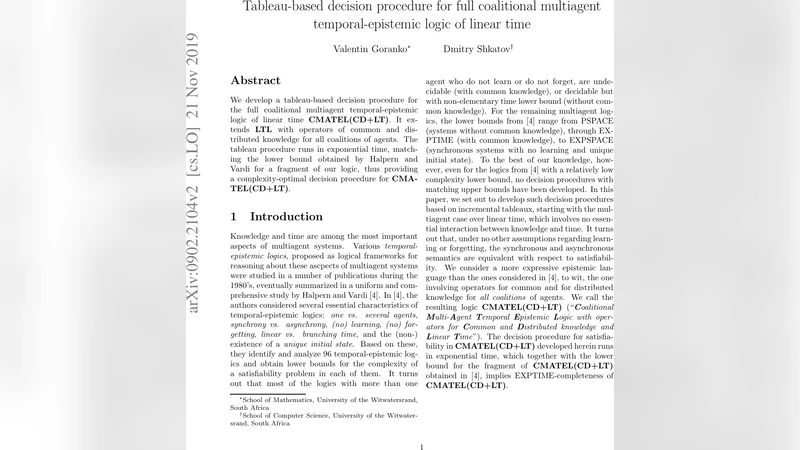
We develop a tableau-based decision procedure for the full coalitional multiagent temporal-epistemic logic of linear time CMATEL(CD+LT). It extends LTL with operators of common and distributed knowledge for all coalitions of agents. The tableau procedure runs in exponential time, matching the lower bound obtained by Halpern and Vardi for a fragment of our logic, thus providing a complexity-optimal decision procedure for CMATEL(CD+LT).
💡 Research Summary
The paper introduces a tableau‑based decision procedure for CMATEL(CD+LT), a logic that extends linear‑time temporal logic (LTL) with epistemic operators for common knowledge (C_Γ) and distributed knowledge (D_Γ) for every non‑empty coalition Γ of agents. The authors first formalize the syntax and semantics of the logic. Formulas are built from propositional atoms, the usual LTL modalities (X, U, G, etc.), and the epistemic modalities C_Γ and D_Γ. Semantically, models are linear Kripke‑time structures: a discrete time line ℕ together with, for each time point t, a family of accessibility relations R_i(t) for each agent i. Common knowledge C_Γ ψ holds at (t,w) iff ψ holds at all worlds reachable from w by any finite sequence of Γ‑accessibility steps; distributed knowledge D_Γ ψ holds iff ψ is true in all worlds that are simultaneously reachable by each agent in Γ. This combination allows one to reason about how knowledge evolves along a temporal execution while agents cooperate in arbitrary coalitions.
The core technical contribution is a tableau construction that decides satisfiability of any CMATEL(CD+LT) formula φ. The procedure proceeds as follows:
- Pre‑processing – φ is transformed into negation normal form and its closure (the set of all sub‑formulas) is computed.
- Node creation – each tableau node is a pair (t, L) where t is a temporal label (a natural number) and L ⊆ Cl(φ) is a set of formulas that must hold at that time point.
- Expansion rules – standard LTL rules handle X, U, G, etc. For epistemic operators, two specialized rules are introduced:
- Common‑knowledge rule: when C_Γ ψ appears in L, the tableau forces a loop condition that guarantees ψ persists along every Γ‑path. This is realized by generating a successor node that repeats the current label and checking that ψ is present in all nodes of the loop.
- Distributed‑knowledge rule: D_Γ ψ is expanded by intersecting the accessibility relations of all agents in Γ, producing a new node whose label contains ψ together with the appropriate epistemic constraints.
- Clash detection – if a node’s label contains both p and ¬p for some propositional atom p, the branch closes.
- Loop detection and acceptance – an open branch that contains a repeating pair (t, L) is examined; if every C_Γ‑formula in the loop is satisfied throughout the cycle, the branch is declared accepting and corresponds to a model.
Soundness (if the tableau closes, φ is unsatisfiable) and completeness (if φ is satisfiable, there exists an open accepting branch) are proved. For completeness, the authors construct a canonical model from an accepting branch: the infinite sequence of temporal labels yields the time line, while the epistemic constraints extracted from the labels define the accessibility relations at each point. The loop condition guarantees that common‑knowledge requirements are met in the limit, using a Barwise‑style construction for infinite paths.
Complexity analysis shows that the tableau size is bounded by O(2^{|Cl(φ)|}), i.e., exponential in the size of the input formula. Each expansion step runs in polynomial time, so the overall algorithm runs in exponential time. This matches the lower bound proved by Halpern and Vardi for a fragment of the logic, establishing that the presented decision procedure is complexity‑optimal for the full CMATEL(CD+LT).
The paper concludes with a comparison to related work. Prior approaches either handled only LTL, only epistemic logics, or combined them for a single agent or a fixed small coalition, often resulting in 2‑EXPTIME procedures. By allowing all coalitions and providing a single exponential‑time tableau, the authors achieve both expressive power and optimal computational complexity. The result opens the way for automated verification of systems where multiple agents cooperate over time, such as distributed protocols, multi‑robot teams, and security policies that depend on evolving knowledge states.
Comments & Academic Discussion
Loading comments...
Leave a Comment