Multi-Scale Theory of Elasticity for Geomaterials
The modern theory of elasticity and the first law of thermodynamics are cornerstones of engineering science that share the concept of reversibility. Engineering researchers have known for four decades that the modern theory violates the first law of thermodynamics when applied to the more commonly accepted empirical models of geomaterial stiffness. This paper develops a cross-scale theory of elasticity that is compatible with the empirical models and the first law of thermodynamics. This theory includes a material sample’s total-volume to solid-volume ratio as an independent internal variable, distinguishes deformation into uniform and contraction-swelling components, introduces a uniformity surface that partitions stress space into contraction and swelling sub-domains, couples the macroscopic properties to the volume ratio and extrapolates the accepted empirical models to states that include shear stress. This paper broadens the scope of the theory of elasticity to include soft condensed matter.
💡 Research Summary
The paper addresses a long‑standing inconsistency between the classical theory of elasticity, which assumes reversible, energy‑conserving behavior, and the empirical stiffness models widely used in geotechnical engineering. Those empirical models describe bulk and shear moduli of soils, sands, powders and other geomaterials as distinct power‑law functions of effective pressure and specific volume, and it has been shown that such formulations violate the first law of thermodynamics when interpreted through the traditional elastic framework.
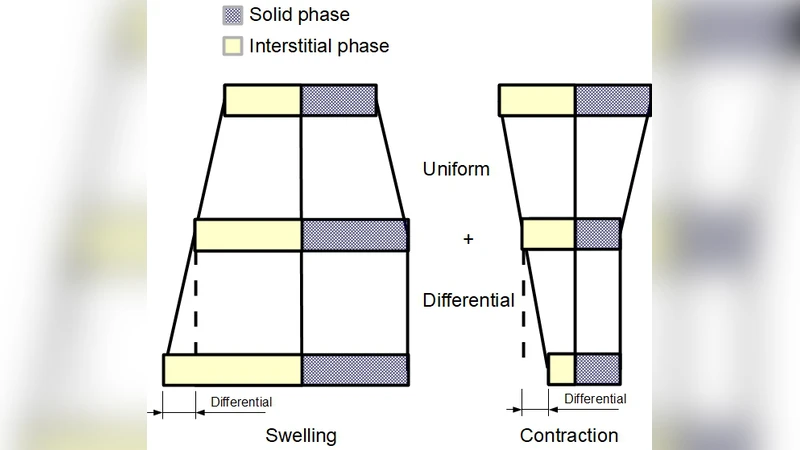
To resolve this, the author develops a multi‑scale elasticity theory that introduces the total‑to‑solid volume ratio (specific volume, ν = V/Vₛ) as an independent internal state variable. The deformation of a representative element is decomposed into two parts: a uniform component that occurs at constant ν (identical strain of solid and pore phases) and a differential component associated with changes in ν, i.e., contraction or swelling of the particle packing.
A mesoscopic “packing pressure” φ is defined as the internal pressure that maintains the average distance between particle centroids. φ is independent of the externally applied macroscopic stress and is linked to ν through an equilibrium curve β(φ, ν)=0. The curve partitions the (φ, ν) plane into contraction (β>0) and swelling (β<0) regimes. Work done by φ during a change of ν leads to a packing‑energy potential P(ν) = −∫φ dν, which vanishes at a chosen reference state (φᵣ, νᵣ).
At the macroscopic level, the stress–strain relation is written as ε = C(ν):σ, where the compliance tensor C depends on ν. Differentiation yields a uniform strain increment C(ν):δσ and a differential term σ:∂C/∂ν δν. The differential term is expressed as ω(σ, ν) δμ, where ω is a normalized coupling tensor and δμ is a scalar measure of contraction (positive) or swelling (negative).
To distinguish contraction from swelling in stress space, a “uniformity surface” b(σ, ν)=0 is introduced. Its unit normal n = ∂b/∂σ/‖∂b/∂σ‖ defines the direction in stress space that changes ν. Stress increments tangent to the surface produce purely uniform deformation, while the normal component changes ν. The relation n:δσ = S δμ defines the contraction‑swelling modulus S, which quantifies the material’s resistance to packing changes. Low‑S materials (e.g., loose sands, tire‑derived aggregates) exhibit large volumetric changes, whereas high‑S materials (dense rocks) show little.
Energy consistency is demonstrated by constructing internal energy potentials that combine the packing energy P(ν) with the elastic strain energy. The resulting elasticity and compliance tensors satisfy major symmetry, guaranteeing that closed loading cycles are energetically conservative even when the bulk and shear moduli have different pressure exponents (α ≠ β).
Two solution families are presented. The first illustrates the conceptual framework with simplified forms of b(σ, ν) and S. The second calibrates the theory to the empirical relationships used in geotechnical practice, preserving the observed power‑law exponents while embedding them in a thermodynamically admissible structure.
Experimental validation is provided for Ottawa sand, tire‑derived aggregates, and selected porous solids. Measured packing‑pressure versus specific‑volume curves align with the proposed β(φ, ν) relationship, and the theory reproduces observed bulk and shear modulus trends across a range of effective pressures.
Finally, the paper compares the new formulation with Critical State Soil Mechanics (CSSM). While CSSM assumes a single critical state line, the multi‑scale theory predicts a continuum of natural free states parameterized by ν, offering a more flexible description of limit behavior. The author suggests refinements to CSSM based on the uniformity surface concept and highlights that, at the limit of zero packing‑energy, the two theories converge.
In summary, the multi‑scale elasticity theory reconciles empirical geomaterial stiffness models with the first law of thermodynamics by introducing specific volume as an internal variable, separating uniform and packing‑related deformation, and defining a uniformity surface that governs contraction‑swelling behavior. This framework extends classical elasticity to soft condensed matter, provides a thermodynamically sound basis for geotechnical constitutive modeling, and opens avenues for further extensions to visco‑elasticity, rate effects, and coupled hydro‑mechanical processes.
Comments & Academic Discussion
Loading comments...
Leave a Comment