iGateLink: A Gateway Library for Linking IoT, Edge, Fog and Cloud Computing Environments
In recent years, the Internet of Things (IoT) has been growing in popularity, along with the increasingly important role played by IoT gateways, mediating the interactions among a plethora of heterogeneous IoT devices and cloud services. In this paper, we present iGateLink, an open-source Android library easing the development of Android applications acting as a gateway between IoT devices and Edge/Fog/Cloud Computing environments. Thanks to its pluggable design, modules providing connectivity with a number of devices acting as data sources or Fog/Cloud frameworks can be easily reused for different applications. Using iGateLink in two case-studies replicating previous works in the healthcare and image processing domains, the library proved to be effective in adapting to different scenarios and speeding up the development of gateway applications, as compared to the use of conventional methods.
💡 Research Summary
The paper introduces iGateLink, an open‑source Android library designed to simplify the development of gateway applications that connect heterogeneous IoT devices with Edge, Fog, and Cloud computing environments. The authors begin by outlining the rapid growth of IoT deployments and the consequent data deluge, which have exposed the limitations of pure cloud‑centric architectures. They argue that lightweight containers and decentralized processing at the network edge (Fog/Edge computing) are essential for reducing latency, deployment costs, and improving robustness. In this context, the gateway device—whether a small embedded board, a smart router, or a smartphone—plays a pivotal role as the mediator between sensors/actuators and higher‑level compute resources. Existing works either treat gateways as simple routers or provide domain‑specific frameworks that lack a generic, reusable software layer for Android devices.
iGateLink addresses this gap with a modular, publish/subscribe‑inspired architecture consisting of three core concepts: Providers, Stores, and Triggers. A Provider encapsulates any component that produces data (e.g., a Bluetooth sensor reader or a camera capture module). When a Provider generates a Data object, it stores it in a Store identified by a unique key. Stores act as topics; they retain the data and notify all associated Triggers whenever new data arrives. Triggers are observer‑style callbacks that can launch other Providers, update the UI, or perform any custom logic. This decoupling enables independent development, testing, and replacement of each piece. To handle scenarios where multiple Providers can satisfy the same Store (for example, different Fog/Cloud back‑ends), a Chooser component selects the appropriate Provider based on runtime conditions such as load, failure, or policy preferences. The ExecutionManager orchestrates the entire flow, exposing a clean API for starting Providers, retrieving data, and managing the lifecycle of the system. For Android‑specific concerns, the library provides an AsyncProvider that leverages AsyncTask and runs within a foreground Service, ensuring that long‑running background tasks are not prematurely killed by the OS.
The implementation is split into three layers: a platform‑independent core written in Java, an Android‑specific extension that handles threading and service management, and a set of optional modules that add concrete functionality (Bluetooth LE, camera access, integration with the Aneka cloud middleware, FogBus, etc.). All modules conform to the Provider interface, making them plug‑and‑play. The source code is publicly available on GitHub.
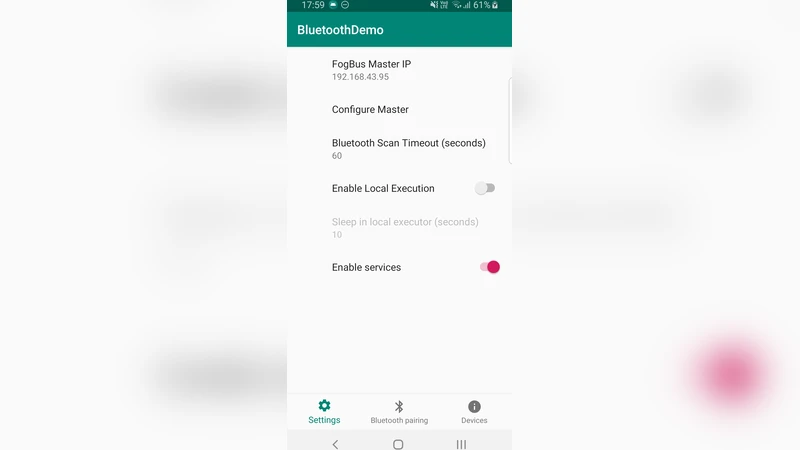
To validate iGateLink, the authors recreated two previously published applications using the library. The first case study is a healthcare monitoring app that connects to a Bluetooth Low Energy oximeter, streams real‑time SpO₂ data, and forwards it to the FogBus framework for analysis. The UI displays live measurements and alerts the user if hypoxia is detected. By using iGateLink, the developers reduced the amount of boilerplate code required for Bluetooth communication, data handling, and HTTP interaction with FogBus, achieving a more maintainable and extensible solution. The second case study is an object‑detection app that captures a photo with the device camera, then sends the image to either EdgeLens (an edge‑based deep‑learning service) or Aneka (a cloud task‑oriented platform). The workflow involves a CameraProvider, a BitmapProvider for UI rendering, and either an EdgeLensProvider or AnekaProvider for remote inference. The library abstracts away the details of image encoding, FTP upload, REST calls, and polling for task completion, allowing the application logic to remain concise.
The experimental results demonstrate that iGateLink significantly shortens development time, promotes code reuse across disparate use‑cases, and provides a consistent programming model for Android gateway developers. The authors acknowledge current limitations: support is presently limited to Bluetooth Low Energy (no classic Bluetooth or other profiles), built‑in smartphone sensors (accelerometer, gyroscope, magnetometer, ambient light) are not yet wrapped as Providers, and security/authentication mechanisms are left to the application developer. Future work will focus on expanding the catalog of sensor modules, integrating additional Fog/Cloud platforms, and embedding standardized security primitives to make the library a truly plug‑and‑play solution for the broader IoT‑Edge‑Fog‑Cloud ecosystem.
Comments & Academic Discussion
Loading comments...
Leave a Comment