Uncovering the Social Interaction in Swarm Intelligence with Network Science
Swarm intelligence is the collective behavior emerging in systems with locally interacting components. Because of their self-organization capabilities, swarm-based systems show essential properties for handling real-world problems such as robustness, scalability, and flexibility. Yet, we do not know why swarm-based algorithms work well and neither we can compare the different approaches in the literature. The lack of a common framework capable of characterizing these several swarm-based algorithms, transcending their particularities, has led to a stream of publications inspired by different aspects of nature without a systematic comparison over existing approaches. Here, we address this gap by introducing a network-based framework—the interaction network—to examine computational swarm-based systems via the optics of the social dynamics of such interaction network; a clear example of network science being applied to bring further clarity to a complicated field within artificial intelligence. We discuss the social interactions of four well-known swarm-based algorithms and provide an in-depth case study of the Particle Swarm Optimization. The interaction network enables researchers to study swarm algorithms as systems, removing the algorithm particularities from the analyses while focusing on the structure of the social interactions.
💡 Research Summary
The paper addresses a long‑standing gap in swarm intelligence research: the lack of a unified, algorithm‑independent framework for comparing and understanding the myriad bio‑inspired optimization methods that exist today. While many swarm‑based algorithms (e.g., ant colony optimization, particle swarm optimization, artificial bee colony, fish school search) share the core idea of locally interacting agents, their analyses have traditionally been tied to the specific natural metaphor (pheromone trails, velocities, etc.) that inspired them. This metaphor‑centric approach obscures the common underlying mechanism—social interaction—and makes systematic comparison difficult.
To overcome this, the authors introduce the Interaction Network (I(t)), a dynamic, directed, weighted graph whose nodes represent individual agents and whose edges Iij(t) quantify the influence of agent i on agent j at iteration t. By extracting only the influence structure, the Interaction Network lives in an “interaction space” that is agnostic to the particular algorithmic rules or the problem being solved. The network therefore serves as a meta‑level representation that can be applied uniformly across disparate swarm paradigms.
The paper first situates this idea within a broader information‑processing view of swarms (definition, usage, flow) and then details how to construct I(t) for four well‑known algorithms: Artificial Bee Colony (ABC), Ant Colony Optimization (ACO), Particle Swarm Optimization (PSO), and Fish School Search (FSS). For each method the authors identify the notion of “success” (e.g., quality of a food source, pheromone concentration, best particle position, fish fitness) and translate it into a normalized influence weight. The resulting networks are then examined using classic network‑science metrics—degree centrality (hubs), betweenness (bridges), clustering coefficient (sub‑communities), density, and average path length.
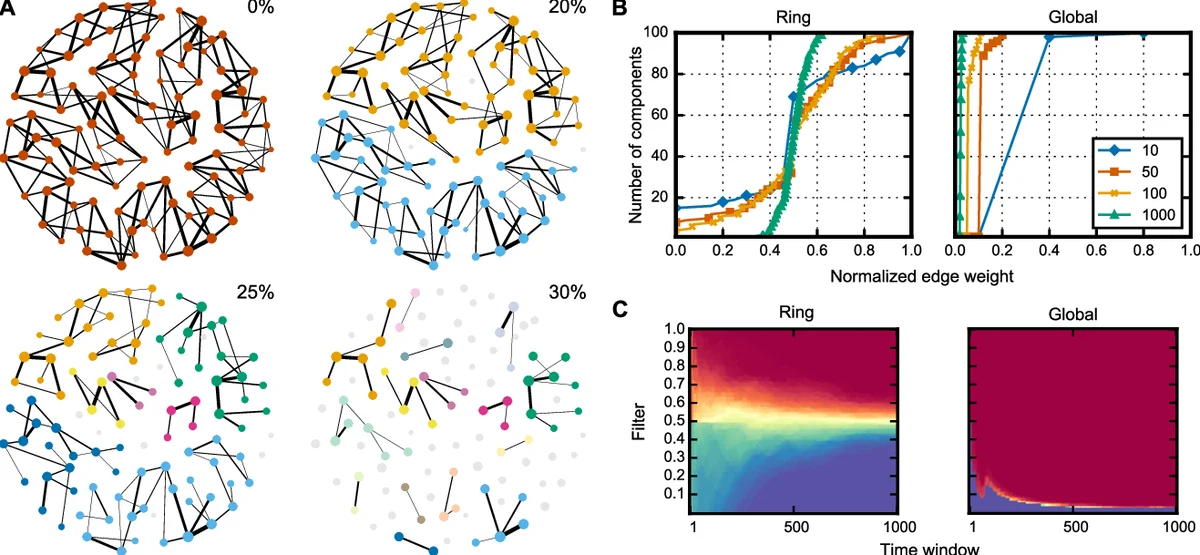
A particularly detailed case study focuses on PSO. By tracking the evolution of network density, average shortest‑path length, and clustering over time, the authors reveal a clear exploration‑to‑exploitation transition: early iterations exhibit a dense, highly connected network reflecting strong global exploration, whereas later stages become sparser with a few dominant hub particles guiding rapid convergence. This mesoscopic view captures dynamics that standard performance curves or trajectory plots miss, highlighting how the social structure itself drives algorithmic behavior.
Comparative analysis across the four algorithms shows that, despite different inspirations, they all generate interaction networks with similar qualitative features—successful agents exert disproportionate influence, sub‑networks (niches) emerge, and bridges connect these niches. However, quantitative differences in hub prevalence, bridge density, and clustering reflect the distinct ways each algorithm propagates information (pheromone diffusion vs. velocity alignment vs. best‑solution broadcasting).
The authors argue that the Interaction Network provides three major benefits: (1) a common language for algorithm comparison, decoupled from metaphor‑specific jargon; (2) a set of measurable structural descriptors that can predict or explain exploration‑exploitation balance; and (3) a foundation for designing new swarm methods by deliberately shaping network properties (e.g., controlling hub formation to improve robustness). They suggest future work on automated parameter tuning via network metrics, generation of novel meta‑heuristics guided by desired network topologies, and real‑time monitoring of physical robot swarms using the same framework.
In summary, the paper demonstrates that viewing swarm intelligence through the lens of network science—specifically via the dynamic Interaction Network—offers a powerful, unifying perspective that clarifies why different swarm algorithms work, how they differ, and how their social interaction structures can be harnessed for improved design and analysis.
Comments & Academic Discussion
Loading comments...
Leave a Comment