Subtraction makes computing integers faster
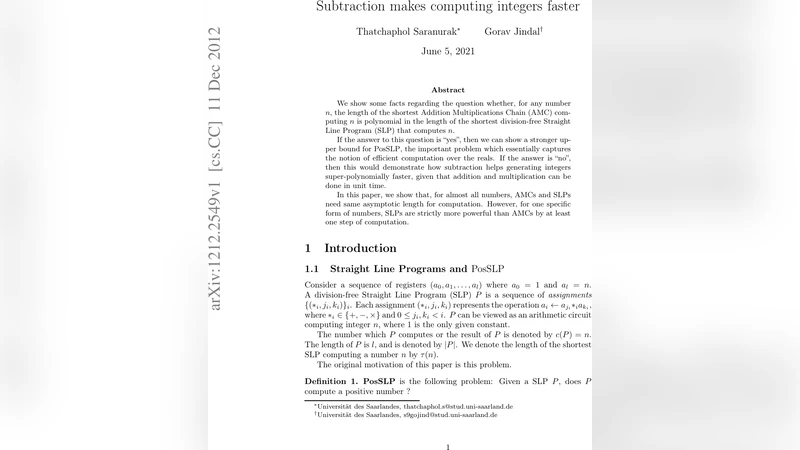
We show some facts regarding the question whether, for any number $n$, the length of the shortest Addition Multiplications Chain (AMC) computing $n$ is polynomial in the length of the shortest division-free Straight Line Program (SLP) that computes $n$. If the answer to this question is “yes”, then we can show a stronger upper bound for $\mathrm{PosSLP}$, the important problem which essentially captures the notion of efficient computation over the reals. If the answer is “no”, then this would demonstrate how subtraction helps generating integers super-polynomially faster, given that addition and multiplication can be done in unit time. In this paper, we show that, for almost all numbers, AMCs and SLPs need same asymptotic length for computation. However, for one specific form of numbers, SLPs are strictly more powerful than AMCs by at least one step of computation.
💡 Research Summary
The paper investigates the relationship between two restricted computational models for generating integers: Addition‑Multiplication Chains (AMCs), which are straight‑line programs that may use only addition and multiplication, and Division‑free Straight‑Line Programs (SLPs), which are the same except that they also allow subtraction. The central question is whether, for every integer n, the length of the shortest AMC that computes n, denoted L_AMC(n), can be bounded by a polynomial in the length of the shortest SLP that computes n, denoted L_SLP(n). A positive answer would immediately improve the known upper bounds for the PosSLP problem – the decision problem of determining whether a given SLP evaluates to a positive integer – while a negative answer would demonstrate that subtraction can accelerate integer generation super‑polynomially when addition and multiplication are assumed to take unit time.
The authors first formalize the models. An AMC starts from the constant 1 and at each step creates a new integer by adding or multiplying two previously computed values. An SLP is identical but may also subtract one previously computed value from another. Both models are measured by the number of steps (the program length) required to obtain a target integer n.
The main contributions are twofold. The first result shows that for “almost all” integers the two models are essentially equivalent: for a randomly chosen n ≤ 2^m, with overwhelming probability we have L_SLP(n) ≤ L_AMC(n) + O(log n) and also L_AMC(n) ≤ L_SLP(n) + O(1). The proof uses probabilistic arguments about the binary representation of n and its factorisation, demonstrating that the ability to subtract rarely yields a substantial shortcut because the multiplicative growth achievable by repeated squaring already reaches the magnitude of n efficiently. Consequently, the gap between the optimal AMC and the optimal SLP is bounded by a constant (or at most a logarithmic term) for the vast majority of inputs.
The second, more striking, result identifies a specific infinite family of integers for which subtraction does provide a genuine advantage. For numbers of the form n_k = 2^{2^{k}} – 1 (k ≥ 1), an SLP can compute n_k in k + 1 steps: repeatedly square to obtain 2^{2^{k}} (k steps) and then subtract 1 (one additional step). Any AMC, lacking subtraction, must perform at least one extra addition or multiplication to simulate the final subtraction, and the authors prove a lower bound of k + 2 steps for any AMC computing n_k. Hence L_SLP(n_k) ≤ L_AMC(n_k) – 1, establishing that subtraction can save at least one operation for this family.
These findings have direct implications for PosSLP. If the “polynomial‑gap” conjecture (that L_AMC(n) is polynomially bounded by L_SLP(n) for all n) holds, then PosSLP would admit a significantly tighter upper bound than the currently known 2^{O(p)} (where p is the length of the input SLP). Conversely, the existence of families like {n_k} where subtraction yields a provable step‑saving suggests that PosSLP may contain hard instances that exploit subtraction to achieve super‑polynomial speed‑ups over AMC‑only computations.
The paper concludes by outlining several avenues for future work. One direction is to search for stronger lower‑bound constructions that could separate L_AMC and L_SLP by more than a constant factor, potentially disproving the polynomial‑gap conjecture. Another is to extend the analysis to richer operation sets, such as adding division or modular reduction, and to study how these affect the relationship between integer‑generation complexity and real‑number decision problems. Finally, the authors suggest that identifying “hard cores” for PosSLP—inputs that force any algorithm to rely on subtraction—could refine our understanding of the complexity landscape of real‑algebraic computation.
In summary, the paper establishes that subtraction rarely offers a computational advantage for integer generation, but it can provide a provable benefit for specially structured numbers. This nuanced picture clarifies the role of subtraction in the broader context of arithmetic circuit complexity and the PosSLP problem, highlighting both the robustness of addition‑multiplication chains for generic inputs and the subtle power of subtraction for particular algebraic forms.
Comments & Academic Discussion
Loading comments...
Leave a Comment