A Conformal Three-Field Formulation for Nonlinear Elasticity: From Differential Complexes to Mixed Finite Element Methods
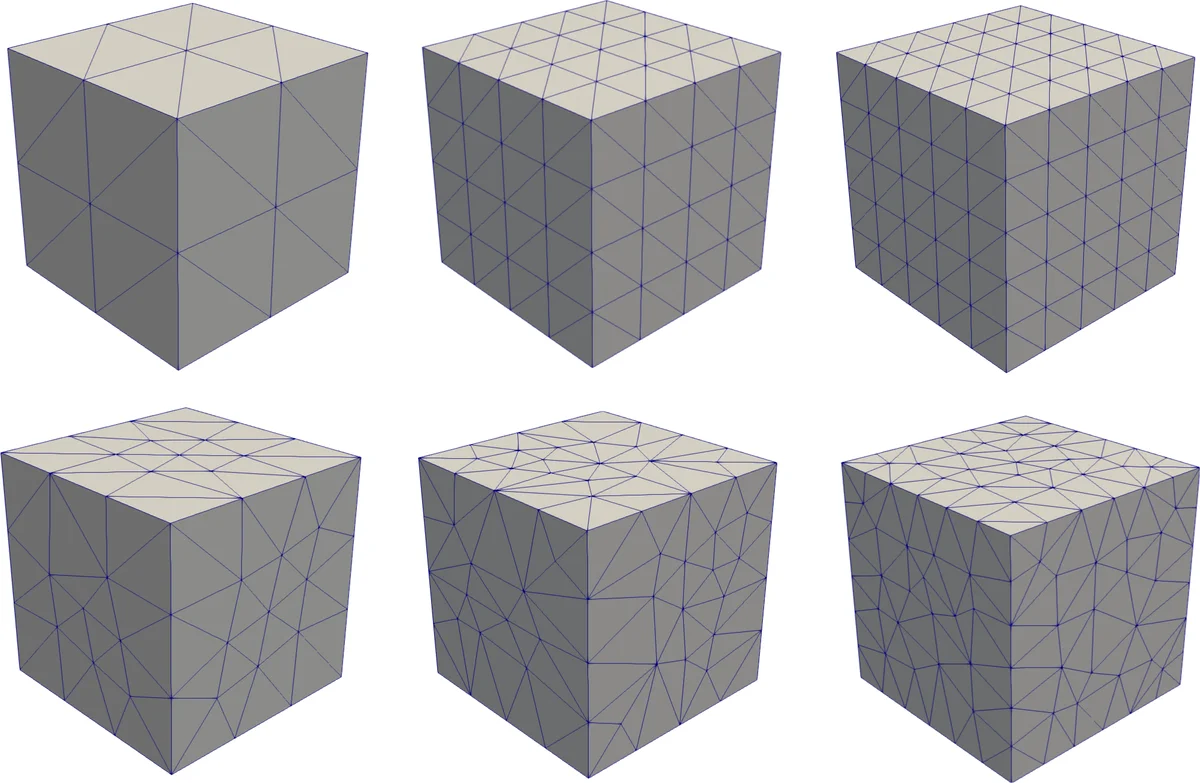
We introduce a new class of mixed finite element methods for 2D and 3D compressible nonlinear elasticity. The independent unknowns of these conformal methods are displacement, displacement gradient, and the first Piola-Kirchhoff stress tensor. The so-called edge finite elements of the curl operator is employed to discretize the trial space of displacement gradients. Motivated by the differential complex of nonlinear elasticity, this choice guarantees that discrete displacement gradients satisfy the Hadamard jump condition for the strain compatibility. We study the stability of the proposed mixed finite element methods by deriving some inf-sup conditions. By considering 32 choices of simplicial conformal finite elements of degrees 1 and 2, we show that 10 choices are not stable as they do not satisfy the inf-sup conditions. We numerically study the stable choices and conclude that they can achieve optimal convergence rates. By solving several 2D and 3D numerical examples, we show that the proposed methods are capable of providing accurate approximations of strain and stress.
💡 Research Summary
This paper introduces a novel class of mixed finite element methods (FEM) for solving two- and three-dimensional problems in compressible nonlinear elasticity. The formulation is distinctive in its use of three independent unknown fields: the displacement vector (U), the displacement gradient tensor (K), and the first Piola-Kirchhoff stress tensor (P).
The methodological foundation is deeply rooted in the differential complex of nonlinear elasticity. This mathematical structure elegantly encodes the kinematics (strain compatibility via curl K = 0) and kinetics (equilibrium via div P = 0) of finite deformation elasticity. The authors leverage the connection between this elasticity complex and the well-known de Rham complex from differential geometry. This connection allows them to systematically discretize the problem using the Finite Element Exterior Calculus (FEEC) framework.
The core innovation lies in the choice of conforming finite element spaces derived from FEEC. The trial space for the displacement gradient K is discretized using H^c-conforming spaces, which are suitable for the curl operator (e.g., Nédélec-type edge elements). This choice guarantees that the discrete displacement gradient inherently satisfies the Hadamard jump condition for strain compatibility across element boundaries. Conversely, the test space for the constitutive relation (linking K and P) uses H^d-conforming spaces, suitable for the divergence operator (e.g., Raviart-Thomas-type face elements). This three-field weak formulation (2.3) differs significantly from prior Hu-Washizu-based approaches, as it does not correspond to a saddle-point problem for hyperelastic materials but rather falls under the broader definition of mixed methods that approximate a field and its derivative simultaneously. A key advantage is that it removes an unphysical constraint present in some previous formulations, where the stress was implicitly required to lie in the intersection of H^c and H^d spaces.
A major contribution of the work is a rigorous stability analysis for the proposed Galerkin approximation. Employing a general framework for nonlinear problems, the authors derive a set of inf-sup conditions—one sufficient and two weaker necessary conditions—that ensure the stability of the discrete method. They then perform a comprehensive theoretical study of 32 possible combinations of simplicial (triangular/tetrahedral) conforming finite elements of polynomial degrees 1 and 2. This analysis theoretically proves that 10 of these combinations are unstable as they violate the established inf-sup conditions, providing clear guidance for practitioners.
The numerical experiments focus on the stable element choices. Results from several 2D and 3D benchmark examples demonstrate that these stable methods achieve optimal convergence rates for all three fields: displacement, displacement gradient, and stress. The methods provide accurate approximations of strain and stress fields, benefiting from the compatible discretization of the displacement gradient. Additional numerical tests are conducted to verify the inf-sup conditions computationally.
In summary, this paper successfully develops a new conformal mixed FEM framework for nonlinear elasticity that is theoretically sound (based on differential complexes), systematically implementable (via FEEC), stable for a wide range of element choices, and capable of delivering accurate results in both 2D and 3D. It provides a significant advance by combining mathematical structure with practical finite element design and analysis.
Comments & Academic Discussion
Loading comments...
Leave a Comment