Model Predictive Tracking Control for Invariant Systems on Matrix Lie Groups via Stable Embedding into Euclidean Spaces
For controller design for systems on manifolds embedded in Euclidean space, it is convenient to utilize a theory that requires a single global coordinate system on the ambient Euclidean space rather than multiple local charts on the manifold or coord…
Authors: Dong Eui Chang, Karmvir Singh Phogat, Jongeun Choi
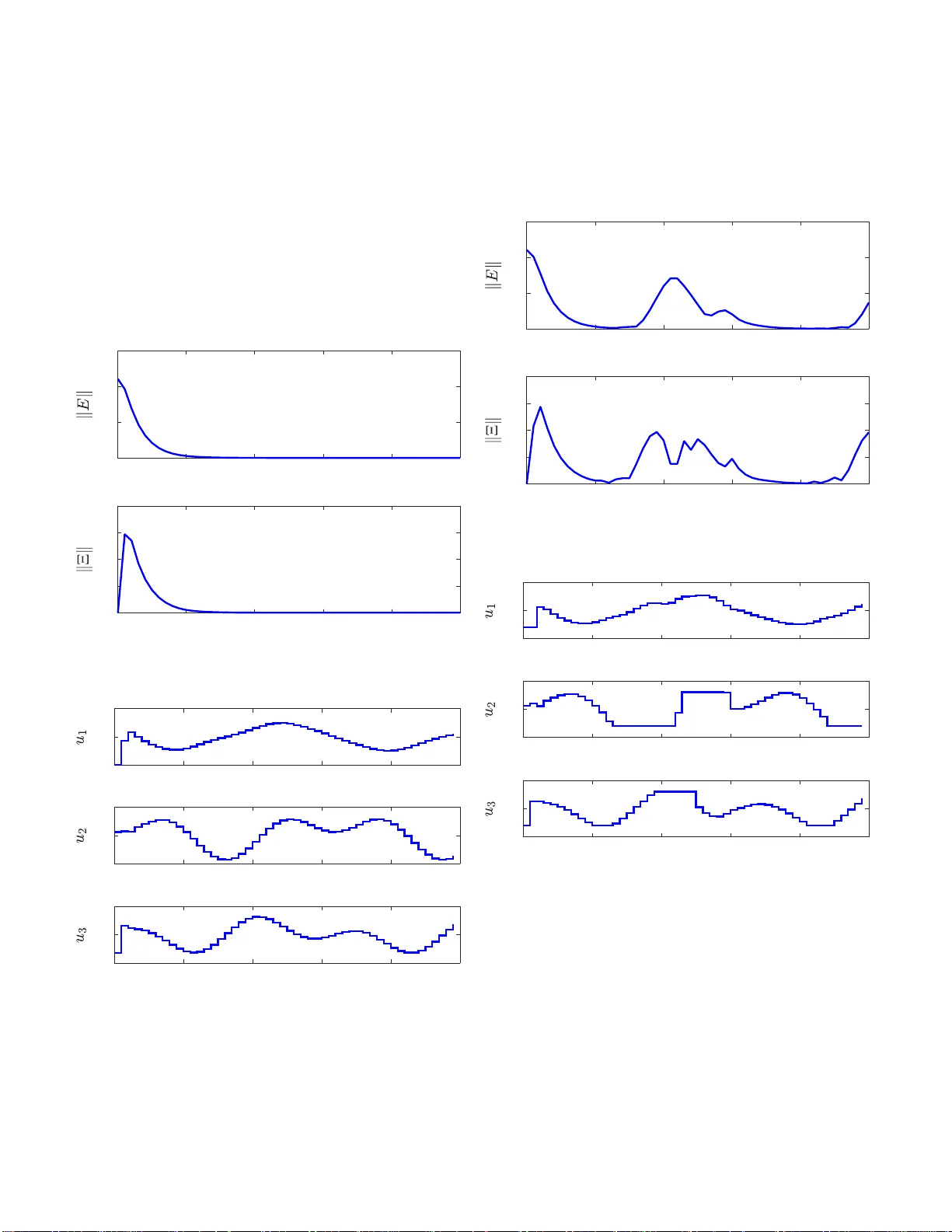
1 Model Predicti v e T racking Control for In v ariant Systems on Matrix Lie Groups via Stable Embedding into Euclidean Spaces Dong Eui Chang, Karmvir Singh Phogat, and Jongeun Choi, Senior Member , I EEE Abstract —Fo r controller design for systems on manifolds embedded in Euclidean space, it is con venient to utilize a theory that requires a si ngle global coordinate system on the ambient Euclidean space rather than multiple local charts on the manif old or coordinate-fr ee tools from differ ential geometry . In this article, we apply such a theory to design model predictiv e tracking controllers f or systems whose dynamics evo lve on manifolds and illustrate its efficacy with th e fully actuated rigid body attitude control system. Index T erms —Model predictiv e control, Matrix Lie gr oups, T racking control, Attit u de c ontrol. I . I N T R O D U C T I O N M ODEL predictive control (MPC), which requires solv- ing a constrained finite time-horiz o n optimal co ntrol problem , has been initially utilized mostly in slow proc e ss industries [1]. In contrast to con ventional co ntrol sche mes, MPC is prevalent in safety critical systems due to its ability to hand le state and con trol constraints fo r large-scale sys- tems [2], [3]. Due to the rise in computatio n al power and sophisticated algorithm s, several successful MPC imp lemen- tations have recently been rep o rted in various applicatio ns with fast dyna m ics, inclu d ing autonom o us vehicles [4], [5] and power electronics [6]. O bvio usly , MPC design ing strate- gies for co ntinuou s-time systems req uire lin earized discrete- time sy stems, accou n ting for the system dynam ics. Beca u se linearization an d discretization o f th e system dynamics ar e relativ ely daun tin g tasks o n m anifolds as compared to Eu- clidean spa ces, designin g MPC on ma n ifolds is a non trivial matter . First, a manifold cannot be entirely covered by o ne local coordin ate chart unless it is d iffeomorphic to a Euclidean space. As a resu lt, one needs to carry out coordinate changes when the system trajector y tr av erses throu gh multiple char ts. Second, linearizatio n and discretization of system d ynamics are both local app roxima tio ns, so th ese pr ocedur es re q uire use of local char ts as well. In gen eral, coordin ate chan g e is an expensiv e o peration in terms of computatio n tim e, and it m ay Dong Eui Chang an d Karmvir Singh Phoga t are with th e School of Electric al Engineeri ng, KAIST , Da ejeon, 34141, Korea . dechang@kaist. ac.kr, karmvir.p@gmail.com Jongeun Choi is with the School of Mechani cal Engineeri ng, Y onsei Uni versi ty , Seoul 03722, Kore a. jo ngeunchoi@yonse i.ac.kr This re search h as been in part supported by KAIST under grant s G04170001 a nd N11180231 and by the Mid-caree r Research Program through the National Researc h Foundation of Korea funded by the Ministry of Science and ICT under grant NRF-2018R1A2B600 8063. (Corresponding Author: K.S. Phogat, Co-correspon ding Author: J. Choi). (T o be) Published in IEEE Tra nsactions on Automatic Control. doi: 10.1109/T AC .2019.2946231 introdu c e fairly large discontin u ities to th e dyn amics du e to switchings of local cost functions for M PC that are defined chartwise on the manifold . As m any m echanical sy stem s such as aerial vehicles and rob otic systems ev olve on manif olds, it is e ssen tial to have a theor y that does not require switching of charts or u nconventional tools from geo metric contr o l theo ry . In this article, we propose a mo del pr edictive con troller design for systems o n m a n ifolds by employin g a stable em- bedding technique , which is summarized as follows: Given a control system on a manifold M , fir st emb e d the manifold into the Euclidean space R n and extend the system dy namics stably to the ambient Euclidean space, i.e., the system dyn amics are extended on R n in such a way tha t the manifo ld M becom es an in v ariant attracto r o f the mod ified dyn amics defined on R n . Since the system dynamics are now de fin ed in R n , we can ca r ry out linearizatio n in one single glo bal Eu clidean coordin ate set for R n and then discretization of th e linear ize d system in R n . Th e stable embedd in g techniqu e in creases th e dimension o f the system, and therefor e MPC for the ex- tended dynamics may be computationally mor e expensive than the dynamics in minimal co ordinates; howe ver , it simplifies linearization and discretization of th e system dynam ics to a large extent. This approach was su ccessfully applied for linear stabilizing /tracking contro ller design [7] an d structur e- preserving nu merical integration [8]. Recent attemp ts on MPC o n manifo lds may be f o und in [9], [10], which req u ire implicit representation of th e system dynamics or explicit constraints in the op timization to preserve the manifold structur e of SO(3) . In additio n , these schemes require switching of charts as the local contr o l law , which is neede d for stability , is defined in ch arts. In co ntrast to these conventional schemes, we take the aforemention ed stable embedd in g approach to design MPC for systems d efined on manifold s. In ou r study , we co nsider a class o f systems defined by fully actu ated left inv ariant vector field s on matr ix L ie group s and stably em bed the system dyn amics in Euclidean spaces. Subsequ ently , to track a refe r ence trajectory , time- varying tr acking er r or dyn amics are d efined in the amb ient Euclidean spa c e; th ose are linearized along the reference and simp lified u sing sym metry inv ariance, b o th in on e sing le global co ordina te system on the a m bient Eu clidean spa c e, and the lo cal stabilizability of the origin a l no nlinear trackin g error dynamics to zero is then readily established. For ap plying MPC, the error dyna mics are line a rized and discretized , and the stabilizability of th e discrete- time linear error d ynamics is also proven, for which a f undam ental sufficient con di- 2 tion is der iv ed in an inequality form that inv olves the two parameters: the d iscretization time step and the transversal stability p arameter that is intr o duced in the proc ess of stable embedd in g. Later, an M PC law is designed for the discrete- time linear error dynamics and is ap p lied to th e original nonlinear system. It is worth mentionin g at this junctu re that, to the b est of the auth ors’ knowledge, the issue of establishin g exponential stability of the time-varying system dynamics under the synthesized MPC control law rem ains o pen. Some results on the stability of the samp led data sy stems may be found in [11], [1 2]. T o demonstrate the efficac y of the propo sed MPC tech nique, we desig n a tr a cking controller for spacecraft attitude contro l dyn amics and c onduc t n umerical studies for various real-time scen arios, suc h as referen ce track- ing un der tig ht con trol con straints and noisy m e asurements, to illustrate the validity of the designed co ntroller . Nu merical simulations show that the MPC tracking contr o ller de signed using the discrete- tim e linear system in the Euclid ean space is robust to un modeled disturbance s and pr ovides good trackin g perfor mance when applied to the actu al non linear system. The stru cture of this article is as follows: W e establish stabilizability of the tracking erro r dyn amics fo r left inv ariant systems on matrix Lie gro ups and discuss the design proced ure for the MPC contro ller in Section II . Section III is dev oted to design of an MPC tracking con tr oller fo r a r igid body attitude control system. Numerical studies of the d esigned track ing controller f or attitud e dyn amics are in Section IV, fo llowed by o u r con clusions in Section V . I I . M P C O N M A T R I X L I E G RO U P S Let G be a m atrix L ie gro up of d imension m with I a s the group identity and g be the Lie alg ebra o f the Lie group G . Suppose that a controlled system dyn amics on th e matrix L ie group is given by a left in variant vector field: Σ : ( ˙ g = g ξ , ˙ ξ = f ( ξ , u ) , (1) where g ∈ G, ξ ∈ g and u ∈ R m . I t is assum ed that ∂ f ∂ u ( ξ , u ) is an in vertible lin ear map from R m to g for each ( ξ , u ) ∈ g × R m . Su ppose that the matrix L ie g roup G is embedded into a E uclidean space R n × n . The vector space R n × n is split into two orthog o nal subspaces g and g ⊥ such that R n × n = g ⊕ g ⊥ , where g ⊥ is the orth ogona l co mplement of g in R n × n under the E uclidean metric defined by h A, B i = trace( A T B ) fo r all A, B ∈ R n × n . In the subsequ ent discussion , we ref er to g as the parallel dir ection an d g ⊥ as the tran sversal direction, an d we defin e orth ogon a l projectio n maps fr om the amb ient space R n × n to g an d g ⊥ as R n × n ∋ v 7→ v k ∈ g , R n × n ∋ v 7→ v ⊥ ∈ g ⊥ . A d etailed discussion on left inv ariant systems and the differ- ential g eometric tools e m ployed in this article may be fou n d in [13]–[ 15]. Let us tur n to stably embed the system dyn a m ics (1) in to R n × n considerin g the following assumptio n : Assumption 1 . There exis ts a C 2 function R n × n ∋ x 7→ V ( x ) ≥ 0 ∈ R with the following pr operties: (A-i) V − 1 (0) = G . (A-ii) V ( xg ) = V ( x ) for all x ∈ R n × n , g ∈ G. (A-iii) ∇ 2 V ( I ) is po sitive definite in the transver sal direction, i.e., ∇ 2 V ( I ) · ( y , y ) > 0 for all y ∈ g ⊥ \{ 0 } . Since V attains its minimum value 0 at each poin t in G , ∇ V vanishes on G . Hen ce, th e system d y namics (1) can be extended to th e ambien t Euclid e an space R n × n × g as ˜ Σ : ( ˙ x = xξ − α ∇ V ( x ) , ˙ ξ = f ( ξ , u ) , (2) where α > 0 , x ∈ R n × n , ξ ∈ g and u ∈ R m . Let R ∋ t 7→ ( g 0 ( t ) , ξ 0 ( t )) ∈ G × g (3) be a re f erence state trajecto ry and R ∋ t 7→ u 0 ( t ) ∈ R m be the correspo nding contr ol trajec to ry of the system dynamics (1). Assumption 2. There exist consta nts β g max ≥ β g min > 0 such that the refer en ce trajectory R ∋ t 7→ g 0 ( t ) ∈ G satisfies β g min I g 0 ( t ) g 0 ( t ) ⊤ β g max I for a ll t. The track ing erro r trajectory , d efined b y R ∋ t 7→ ( E ( t ) , Ξ( t )) : = x ( t ) g − 1 0 ( t ) − I , ξ ( t ) − ξ 0 ( t ) ∈ R n × n × g such that ( E ( t ) , Ξ( t )) = 0 fo r all t ensur es, that the sy stem dynamics (2) is tracking the referen ce trajectory , i.e., x ( t ) = g 0 ( t ) , ξ ( t ) = ξ 0 ( t ) for all t . Theref ore, the refer ence tracking problem is translated to stab ilization of the error dynam ics to zero. The error dyn amics fo r a given ref erence trajecto ry is giv en as δ Σ : ( ˙ E = g 0 + E g 0 Ξ g − 1 0 − α ∇ V ( g 0 + E g 0 ) g − 1 0 , ˙ Ξ = f (Ξ + ξ 0 , u ) − f ( ξ 0 , u 0 ) . (4) T o design a linear MPC c o ntroller, let us linearize the erro r dynamics (4) aroun d zero . The linearized erro r dyna m ics around zero is given by δ Σ ℓ : ( ˙ E = g 0 Ξ g − 1 0 − α ∇ 2 V ( g 0 ) · ( E g 0 ) g − 1 0 , ˙ Ξ = ∂ f ∂ ξ ( ξ 0 , u 0 )Ξ + ∂ f ∂ u ( ξ 0 , u 0 ) δ u, (5) where δ u : = u − u 0 . Befor e simplifyin g the error dynam ic s ˙ E in (5) and splitting it further along the parallel and the transversal direction to gain mo re geometr ic in sight, let u s discuss som e key prop erties associated with the function V : Lemma 1. Under Assump tion 1, the fo llowing h o ld: (a) ∇ 2 V ( I ) · v k = 0 for all v k ∈ g . (b) ∇ 2 V ( I ) · v ⊥ ∈ g ⊥ for a ll v ⊥ ∈ g ⊥ . (c) ∇ 2 V ( g ) · ( v g ) = ∇ 2 V ( I ) · v g − 1 ⊤ for all v ∈ R n × n and g ∈ G . 3 Pr oof. 1) Note that ∇ V ( g ) = 0 for all g ∈ G. Ther efore, ∇ 2 V ( I ) · v k = d ds s =0 ∇ V (exp ( sv k )) = 0 . 2) For any v ⊥ ∈ g ⊥ , ∇ 2 V ( I ) · v ⊥ ∈ g ⊥ if and only if v k , ∇ 2 V ( I ) · v ⊥ = 0 fo r all v k ∈ g . Theref o re, using the fact that ∇ 2 V ( I ) is symmetric and then ap plying Lemma 1(a) leads to the fo llowing: D v k , ∇ 2 V ( I ) · v ⊥ E = D ∇ 2 V ( I ) · v k , v ⊥ E = 0 for all v k ∈ g . 3) For ar b itrary vectors w , v ∈ R n × n , w, ∇ 2 V ( g ) · ( v g ) = d dt d ds t = s =0 V ( g + tv g + sw ) = d dt d ds t = s =0 V ( I + tv + sw g − 1 ) = wg − 1 , ∇ 2 V ( I ) · v = w, ∇ 2 V ( I ) · v ( g − 1 ) ⊤ . Therefo re, we con clude that ∇ 2 V ( g ) · ( v g ) = ∇ 2 V ( I ) · v ( g − 1 ) ⊤ . Employing th e prop erties discussed in Lemm a 1, it is straightfor ward to show that the linearized er ror dyna mics in (5) is transfo rmed to the f ollowing: ˙ E ⊥ = − α ∇ 2 V ( I ) · E ⊥ g 0 g ⊤ 0 − 1 ⊥ , (6a) ˙ E k = g 0 Ξ g − 1 0 − α ∇ 2 V ( I ) · E ⊥ g 0 g ⊤ 0 − 1 k , (6b) ˙ Ξ = ∂ f ∂ ξ ( ξ 0 , u 0 )Ξ + ∂ f ∂ u ( ξ 0 , u 0 ) δ u, (6c) where the linear er ror E in (5) has simplified a nd sp lit into the tr ansversal direction error R ∋ t 7→ E ⊥ ( t ) ∈ g ⊥ and the parallel d ir ection erro r R ∋ t 7→ E k ( t ) ∈ g . Theorem 1 . Und e r Assump tions 1 an d 2, the system dynamics (6a) is exponentially stable to zer o. Pr oof. Let us d efine a cand id ate L yapunov fun ction g ⊥ ∋ η 7→ V ( η ) : = 1 2 ∇ 2 V ( I ) · η , η ∈ R . Then, using th e p roperties of V discussed in Lemma 1, we obtain: d V dt E ⊥ = ∂ V ∂ η ( E ⊥ ) , ˙ E ⊥ = − α ∇ 2 V ( I ) · E ⊥ , ∇ 2 V ( I ) · E ⊥ g 0 g ⊤ 0 − 1 ⊥ = − α D ∇ 2 V ( I ) · E ⊥ , ∇ 2 V ( I ) · E ⊥ g 0 g ⊤ 0 − 1 E ≤ − α β g max ∇ 2 V ( I ) · E ⊥ , ∇ 2 V ( I ) · E ⊥ ≤ − 2 αλ min β g max V E ⊥ , where λ min is the sm allest eigenv alue o f the op e rator ∇ 2 V ( I ) restricted to g ⊥ . T h erefor e, V E ⊥ ( t ) ≤ exp − 2 αλ min β g max t V E ⊥ (0) , and b y the definition of V , we know that λ min k E ⊥ k 2 ≤ 2 V ( E ⊥ ) ≤ λ max k E ⊥ k 2 , where λ max is the largest eig en value of the oper ator ∇ 2 V ( I ) restricted to g ⊥ . So , k E ⊥ ( t ) k ≤ r λ max λ min exp − αλ max β g max t k E ⊥ (0) k . This proves the assertion. Remark 1. The pr oof of Theor em 1 uses the bo unded ness of g 0 ( t ) g 0 ( t ) ⊤ fr om above, see Assump tion 2. The lin e a rized er ror dynamics ( 6) can be exponentially stabilized to zero by feedback. Consequently , the or ig inal non- linear tra c k ing e r ror dy n amics (4) is exponentially stabilizable. Theorem 2. Suppose Assumptions 1 and 2 h o ld. Then, for any two matrices K p , K d ∈ R n × n such that the ma trix 0 I K p K d (7) is Hurwitz, the PD-like co ntr oller δ u = ∂ f ∂ u ( ξ 0 , u 0 ) − 1 n [Ξ , ξ 0 ] + Y − ∂ f ∂ ξ ( ξ 0 , u 0 )Ξ o (8) with Y : = g − 1 0 − ˙ W + K p E k + K d ( g 0 Ξ g − 1 0 + W ) g 0 (9) and W : = − α ∇ 2 V ( I ) · E ⊥ g 0 g ⊤ 0 − 1 k , stabilizes the con tr olled dyn a mics ( 6) exponen tia lly to zer o, wher e ˙ W in (9) can be e xpr essed in terms of state v ariables using (6a) a n d ˙ g 0 = g 0 ξ 0 . F u rthermor e, the contr oller u = u 0 + δ u exponentially stab ilizes (4) to zer o. Pr oof. Since the exp onential stability of the tr a nsversal dy - namics (6a) has been proved in Theorem 1 , the expon ential stability of the su b systems (6 b) and (6c) with the contro l law (8) re m ains to be p roved. Apply ing the contr oller (8) to subsystems (6 c) transf o rms the subsystems (6b) and (6c) to the following system of differential e q uations ˙ E k ˙ ˜ e ! = 0 I K p K d E k ˜ e , (10) where ˜ e : = g 0 Ξ g − 1 0 − α ∇ 2 V ( I ) · E ⊥ g 0 g ⊤ 0 − 1 k . (11) Therefo re, the linear system ( 10) is expon entially stable to zero if the matrix (7) is Hurwitz stable. Since E ⊥ and ˜ e are exponentially stable, it follows fr o m ( 1 1), Theorem 1 and Assumption 2 that Ξ is a lso expon e ntially stable. By the L ya- punov linearization metho d, th is contro l law also exponen tially stabilizes (4) to zero. T his p roves the assertion. 4 T o apply th e MPC, let us discr e tize the linearized error dynamics (6) using Euler’ s method as E ⊥ k +1 = E ⊥ k − hα ∇ 2 V ( I ) · E ⊥ k g 0 ,k g ⊤ 0 ,k − 1 ⊥ , (12a) E k k +1 = E k k + hg 0 ,k Ξ k g − 1 0 ,k − αh ∇ 2 V ( I ) · E ⊥ k g 0 ,k g ⊤ 0 ,k − 1 k , (12b) Ξ k +1 = Ξ k + h ∂ f ∂ ξ ( ξ 0 ,k , u 0 ,k )Ξ k + h ∂ f ∂ u ( ξ 0 ,k , u 0 ,k ) δ u k , (12c) where h is a d iscretization step, and for a fun c tion R ∋ t 7→ Γ( t ) ∈ R n × n , Γ k : = Γ( k h ) . The stability of the MPC for d iscr e te-time systems re quires stabilizability of th ese discrete-time systems [16]. Theref ore, it is crucia l to p rove stabilizability of the discrete-time dynam ic s (12). First, we prove the exponentially stability o f the subsystem (12a) for an ap propr iate ch oice of th e discr e tization step h an d the parameter α . T hen, we pr oceed to the gener al c a se and establish stabilizab ility of the discrete-time dynamics ( 12). In a d dition, T heorem 3 establishes a re la tio n b etween the stabilizing param eter α and the d iscretization step leng th h that is cruc ial in implemen tation o f MPC. Theorem 3. Supp ose that Assumptions 1 and 2 hold . Then, the system dyn a mics ( 12a) is exponentially stable to zer o if the following h olds: 0 < αh < 2 λ min β 2 g min λ 2 max β g max , wher e λ min and λ max ar e the min imum and th e maximum eigen- values of the operator ∇ 2 V ( I ) restri cted to g ⊥ , respectively . Pr oof. Let us d efine a cand id ate L yapunov fun ction g ⊥ ∋ η 7→ V d ( η ) : = ∇ 2 V ( I ) · η , η ∈ R . Then, using the prop erties of V fro m Lemm a 1 g iv es V d E ⊥ k +1 = ∇ 2 V ( I ) · E ⊥ k +1 , E ⊥ k +1 = ∇ 2 V ( I ) · E ⊥ k , E ⊥ k − 2 αh D ∇ 2 V ( I ) · E ⊥ k , ∇ 2 V ( I ) · E ⊥ k g 0 ,k g ⊤ 0 ,k − 1 E + α 2 h 2 ∇ 2 V ( I ) · E ⊥ k g 0 ,k g ⊤ 0 ,k − 1 2 ∇ 2 V ( I ) ≤ 1 − 2 αh λ min β g max + α 2 h 2 λ 2 max β 2 g min V d E ⊥ k ≤ αh λ max β g min − 1 2 + 2 αh λ max β g min − λ min β g max V d E ⊥ k . Therefo re, the system dynam ics (1 2a) is expone ntially stable if 0 ≤ αh λ max β g min − 1 2 + 2 αh λ max β g min − λ min β g max < 1 which lead s to the following condition : 0 < αh < 2 λ min β 2 g min λ 2 max β g max . This p roves the assertion. Theorem 4. Supp ose that Assumptions 1 and 2 hold . Then, for a ny two matrices K p , K d ∈ R n × n such that the ma trix I hI K p K d (13) is Schur stable, the contr oller δ u k = 1 h ∂ f ∂ u ( ξ 0 ,k , u 0 ,k ) − 1 n Y k − I + h ∂ f ∂ ξ ( ξ 0 ,k , u 0 ,k ) Ξ k o (14) wher e Y k : = g − 1 0 ,k +1 K p E k k + K d g 0 ,k Ξ k g − 1 0 ,k + W k − W k +1 g 0 ,k +1 and W k : = − α ∇ 2 V ( I ) · E ⊥ k g 0 ,k g ⊤ 0 ,k − 1 k , stabilizes the contr olled dyn amics (1 2) exponentially to zer o. Pr oof. Since the exp onential stability of the tr a nsversal dy - namics (12a) has b een proved in Th e orem 3, the exponen tial stability of the subsystems (12b) and ( 12c) with the control law (14) re m ains to b e proved. Applying the controller (1 4) to subsystems (12c) tran sforms the subsystems (1 2b) an d (12c) to the following system of d ifference equ ations E k k +1 ˜ e k +1 = I hI K p K d E k k ˜ e k (15) where ˜ e k : = g 0 ,k Ξ k g − 1 0 ,k − α ∇ 2 V ( I ) · E ⊥ k g 0 ,k g ⊤ 0 ,k − 1 k . (16 ) Therefo re, the linear system ( 15) is expon entially stable to zero if the matrix (13) is Schur stable. Since E k k and ˜ e k are exponentially stable, it follows fr o m ( 1 6), Theorem 3 and Assumption 2 that Ξ is also expone ntially stable. This proves the assertion. Equipp e d with Theorem 4, we are in a position to design an MPC con trol law for the system dyn amics (12). MPC computes a static state feedba ck control law at each time instant by solvin g a co n strained finite horizo n discrete-time optimal co ntrol pro blem. A typical optimal co ntrol pro blem for a ho rizon N is to minimize a p e rforma n ce objective J ( E 0: N , Ξ 0: N , δ u 0: N − 1 ) : = N − 1 X k =0 ( k E k k 2 Q E + k Ξ k k 2 Q Ξ ) + N − 1 X k =0 k δ u k k 2 Q δu + k E N k 2 Q f E + k Ξ N k 2 Q f Ξ , (17) where Q E , Q Ξ , Q δu , Q f E , Q f Ξ ∈ R n × n are po siti ve semidefi- nite m atrices, while satisfying th e system dynamics (12) and the state and control constraints E k ∈ X E k for all k = 0 , . . . , N , Ξ k ∈ X Ξ k for all k = 0 , . . . , N , δ u k ∈ U k for all k = 0 , . . . , N − 1 , (18) where X E k , X Ξ k are the admissible state sets and U k is an admissible action set at eac h time instant k . 5 Concisely , an op tim al con trol δ u j | j at th e time in stant j for a fixed given state E j | j , Ξ j | j is ob tained by solving the following c onstrained d iscrete-time optima l contro l p roblem: minimize { δu j + i | j } N − 1 i =0 J E j : j + N | j , Ξ j : j + N | j , δ u j : j + N | j subject to dynamics (12) f or k = j | j, . . . , j + N − 1 | j, constraints ( 18) for k = j | j, . . . , j + N − 1 | j, E j | j , Ξ j | j is fixed . (19) Then, the con trol law u ( t ) = u 0 ( t ) + δ u j | j is app lied to the sy stem (1) fo r t ∈ [ j h, ( j + 1) h [ , where j = 0 , 1 , 2 , · · · . Remark 2 . Note that the system d y namics (1 2) is expo- nentially sta b ilizable. Ther efor e, we design an exponentially stabilizing MPC law for the dyn amics (1 2) in Euclidean spaces that in turn stabilizes Euler’ s appr oximation of the err or dyn amics (4) exponen tially to zer o [17]. However , to the be st of the a uthors’ knowledge, the issue of establishing exponential stability of the time-varying sampled data system (4) under the synthesized MPC contr ol law r emains open. Some r esults on the stability o f the samp le d data systems ma y be fou n d in [11], [12]. I I I . A N I L L U S T R A T I V E E X A M P L E : T H E R I G I D B O DY C O N T RO L S Y S T E M Let us consider an example o f r igid body attitude d ynamics to d iscuss the the o ry d ev eloped in Section II. The rigid body attitude co ntrol system is defined b y ˙ R = R ˆ Ω , (20a) ˙ Ω = I − 1 ( I Ω × Ω) + I − 1 u, (20b) where R ∈ SO(3) (th e set of 3 × 3 real or thogon al matrices with determ inant 1) is a ro tation matrix that determ ines the attitude of the rig id b ody , Ω ∈ R 3 defines the an gular veloc ity of the r igid body ; u ∈ R 3 is the co ntrol torque; I is the momen t of inertial matrix of the rigid b o dy; an d the hat map ∧ maps R 3 vectors to 3 × 3 real ske w symmetr ic ma tr ices such that ˆ x y = x × y for all x, y ∈ R 3 with × as th e vector prod uct on R 3 . Note that the man ifold SO (3) × R 3 ⊂ R 3 × 3 × R 3 is an in variant set of the sy stem dyn amics (20). T o stably embed the system dyn amics ( 2 0) into R 3 × 3 × R 3 , let us consider a function W × R 3 ∋ ( X , Ω) 7→ V ( X , Ω) : = 1 4 k X ⊤ X − I k 2 ∈ R , (21) where W : = { X ∈ R 3 × 3 | det X > 0 } . Then, V − 1 (0) = SO(3) × R 3 and ∇ X V ( X , Ω) = X ( X ⊤ X − I ) , ∇ Ω V ( X , Ω) = 0 . It is easy to sh ow th at V satisfies Assump tion 1, which will actually be proven in th e proo f of The orem 5 . W ith th e help of the func tio n V , th e system dynam ics (20) is exten d ed to the Euclid ean space R 3 × 3 × R 3 as de fin ed in (2) to b e ˙ X = X ˆ Ω − αX ( X T X − I ) , ( 2 2a) ˙ Ω = I − 1 ( I Ω × Ω) + I − 1 u, (22b) where ( X , Ω) ∈ R 3 × 3 × R 3 . T ake a referenc e tr a jectory R ∋ t 7→ ( R 0 ( t ) , Ω 0 ( t )) ∈ SO(3) × R 3 (23) and th e corr espondin g contro l signal R ∈ t 7→ u 0 ( t ) ∈ R 3 such that the trajecto ry obeys th e system dy namics (20). It is trivial to show that R 0 ( t ) satisfies Assumption 2. Define the error trajecto ry as R ∋ t 7→ E ( t ) , Ξ( t ) : = X ( t ) R − 1 0 ( t ) − I , Ω( t ) − Ω 0 ( t ) ∈ R 3 × 3 × R 3 such that E = 0 , Ξ = 0 en sures that the system dynam ics follows the refe r ence trajectory . The linearized erro r dynamics along the reference state-con tr ol trajectory ( R 0 , Ω 0 , u 0 ) ∈ SO(3) × R 3 × R 3 is ther e fore given by ˙ E = R 0 ˆ Ξ R − 1 0 − 2 α Sy m ( E ) , (24a) ˙ Ξ = I − 1 ( I Ξ × Ω 0 + I Ω 0 × Ξ) + I − 1 δ u, (24b) where Sym ( E ) is the symmetric co m ponen t o f the m atrix E and δ u ( t ) : = u ( t ) − u 0 ( t ) . Now we are in the p osition to split the erro r d ynamics (24 a) into the parallel and the transversal direction. Th e para llel dir ection is given by the Lie a lg ebra so (3) ( the set of 3 × 3 ske w sy mmetric matrices) of the L ie group SO(3) and the transversal d irection is given by the perpen d icular space so (3) ⊥ to th e Lie algebr a so (3) in R 3 × 3 under the Euc lid ean norm, i.e., the set of 3 × 3 symme tric matrices. Consequently , the attitud e er ror d ynamics (24a) is split into the para llel and th e transversal direction , simp lifying (24) to ˙ E ⊥ = − 2 αE ⊥ , (25a) ˙ E k = R 0 ˆ Ξ R − 1 0 , (25b) ˙ Ξ = I − 1 ( I Ξ × Ω 0 + I Ω 0 × Ξ) + I − 1 δ u, (25c) where R ∋ t 7→ E ⊥ ( t ) ∈ so (3) ⊥ and R ∋ t 7→ E k ( t ) ∈ so (3) . Remark 3 . I t is worth noting that the parallel err or dynamics (25b) and the transversal err or dynamics (25a) ar e decoup led. Ther efor e, in the ab sence of a drift vector field, i.e., α = 0 , the initial err or in th e transversal dir ection can not be mitigated and that lead s to a steady-state err or in the transversal dir ection. In other wor ds, for α = 0 , the lin earized err or dynamics (25 a) can not be sta b ilized to zer o. The discre tize d dyn amics of (25), by Euler’ s meth od, is giv en by E ⊥ k +1 = E ⊥ k − 2 h αE ⊥ k , (26a) E k k +1 = E k k + hR 0 ,k ˆ Ξ k R − 1 0 ,k , (26b) Ξ k +1 = Ξ k + h I − 1 ( I Ξ k × Ω 0 ,k + I Ω 0 ,k × Ξ k ) + I − 1 δ u k , (26c) 6 where h is the sam pling time. The following th eorem proves exponential stability of (2 6a): Theorem 5. The transversal err or dyna mics (2 6a) is e xpon e n- tially stab le if 0 < αh < 1 . (27) Pr oof. W e e m ploy Theo rem 3 to establish the stability of the dy namics ( 26a). It is easy to p rove tha t the function V in (21) satisfies V ( X R ) = V ( X ) f or all X ∈ R 3 × 3 , R ∈ SO (3 ) and ∇ 2 V ( I )( X ⊥ , X ⊥ ) = 2 X ⊥ , X ⊥ for all X ⊥ ∈ so (3) ⊥ . Therefo r e the min imum eigenv alue λ min and the maximum eigenv alue λ max of the operato r ∇ 2 V ( I ) ar e equal to 2. Furth er , using the fact that R ⊤ 0 ( t ) R 0 ( t ) = I for all t lead s to β g min = β g max = 1 . Applying Th eorem 3 to the dynamics (2 6a), we obtain (27). Remark 4. In an iden tica l manner , one can pr ove e xponentia l stabilizability of the system dyn a mics (26) by app lying Theo- r em 4. A. Mo del predictive contr ol design In this section, we design a mod el pred ictiv e tracking control of the discrete-time a ttitu de con trol dy namics (2 6). Notice that the transversal dy namics (26a) in ( 26) is deco upled from (26b) and (26c) and expon entially stable (see Theorem 5). Th erefor e , it is advantageous to choose Q E , Q f E in ( 17) which d ecouples the c o st ( 17) along the parallel and the transversal directio n, i.e., k E N k 2 Q f E = k E k N k 2 Q f E + k E ⊥ N k 2 Q f E and k E i k 2 Q E = k E ⊥ i k 2 Q E + k E k i k 2 Q E for all k = 0 , . . . , N − 1 , so that we can ignore the transversal dynam ics as it is not influencing th e optim ization prob lem. Consequently , an N h orizon optimal contro l problem (19) at a g iv en time instant k for the system dyn amics (26) with the perfor mance objective (17) and con stra in ts (18) is given by minimize { δu k + i | k } N − 1 i =0 J E k k : k + N | k , Ξ k : k + N | k , δ u k : k + N | k subject to E k k + i +1 | k = E k k + i | k + hR 0 ,k + i | k ˆ Ξ k + i | k R − 1 0 ,k + i | k Ξ k + i +1 | k = Ξ k + i | k + h I − 1 ( I Ξ k + i | k × Ω 0 ,k + i | k ) + h I − 1 ( I Ω 0 ,k + i | k × Ξ k + i | k ) + I − 1 δ u k + i | k δ u k + i | k ∈ U k + i for all i = 0 , . . . , N − 1 , ( E k k + i | k ∈ X E k + i Ξ k + i | k ∈ X Ξ k + i for all i = 1 , . . . , N , E k k | k , Ξ k | k = E k k , Ξ k (28) where E k k , Ξ k is fixed, and X E k + i and X Ξ k + i are admissible sets for E k k + i | k and Ξ k + i | k , respectively . Th e quadra tic pro - gram (28) can be solved in MA TLAB using an optimization modeling too lb ox Y ALMIP [1 8]. A detailed exposition of computatio nal com plexity of real- tim e MPC exists in [1 9]– [21]. T h e op timal co n trol pro blem (28) is so lved at each time instant k and the contro l u : = u 0 + δ u, where δ u : = δ u k | k for [ k h, ( k + 1) h [ , is applied to th e system as shown in Figure 1 . ZOH Attitude dy namics Disturbances Sampler MPC ( E k , Ξ k ) δ u + u ( E , Ξ) ( X 0 , Ω 0 ) − ( X, Ω) u 0 + + δ u k Fig. 1: T he sampled -data closed-loo p system with MPC. I V . S I M U L A T I O N R E S U LT S W e simulate o ur MPC in a sampled- d ata system as shown in Figure 1. T h e finite d imensional quadr atic pro grammin g problem (28) is solved at each time instan t k to calculate a feedback control law . The moment of in ertia matr ix of th e rigid b ody in (28) is I = diag (4 . 250 , 4 . 3 37 , 3 . 66 4) , which was taken fr o m a satellite f r om the Euro p ean Student Earth Orbiter (ESEO) [22]. L et us track a refere n ce tr ajectory R ∋ t 7→ ( R 0 ( t ) , Ω 0 ( t )) ∈ SO(3) × R 3 , where R 0 ( t ) : = exp ( t ˆ e 1 ) exp ( t ˆ e 2 ) exp ( t ˆ e 3 ) with e i as the un it vector along the i th axis, and Ω 0 ( t ) : = 1 + cos t, sin t − sin t cos t, cos t + sin 2 t ⊤ , using the MPC c o ntrol law with the co rrespond ing refer ence control signa l R ∋ t 7→ u 0 ( t ) = I ˙ Ω 0 ( t ) − ( I Ω 0 ( t )) × Ω 0 ( t ) ∈ R 3 . The initial d ata and par ameters considered for the optimiza- tion (2 8) are the f o llowing: • E k 0 = R 0 (0 . 2) − R 0 (0) k , Ξ 0 = (0 , 0 , 0) ⊤ , • Q E = 100 I , Q Ξ = 10 I , Q δu = 0 . 01 I , • Q f E = 100 I , Q f Ξ = 10 I , • sampling time: h = 0 . 2 sec , • MPC time horizon : N = 4 . The MPC controller takes the tr a cking erro r measuremen ts E k , Ξ k for comp uting the fe e d back co ntrol δ u k at the each iteration k . The se track ing error measure m ents are calcu lated as a d ifference o f the re f erence states R 0 ,k , Ω 0 ,k and th e states ob tained fro m the ODE simulation (we have used the MA TLAB integrator, ode45, with the option s, Re l T ol = AbsT ol = 10 − 6 ) of th e rigid body dynam ics (20) . In turn, the ODE simulation is d r iv en by the zer o-ord er ho ld con trol actions gener ated by the MPC contr oller , and that forms the closed-loo p M PC sy stem; see Figu re 1. W e simulate th ree different scenarios as follows: 7 A. Ca se 1: Loose constraint and no n oise In the first case study , we con sid e r the f ollowing state a n d control con straints (18): X E k = so (3) , X Ξ k = R 3 , U k = U − u 0 ,k for ea c h k , where U : = { y ∈ R 3 | − 10 ≤ y i ≤ 10 for i = 1 , 2 , 3 } . The closed-loo p system with the d esigned MPC shows a successful tracking perfo r mance as the erro r trajectory ( E ( t ) , Ξ( t )) tend s to zero quic k ly (see Figure 2 ), an d the optima l co ntrol pr ofile obeys th e con trol constraints as shown in Figure 3. It is worth noting tha t the angular velocity erro r Ξ shown in Figu re 2 increases initially f r om z e r o in or der to m itigate the initial orientation er ror E . 0 2 4 6 8 10 0 0.2 0.4 0.6 0 2 4 6 8 10 0 0.2 0.4 0.6 0.8 P S f r a g r e p l a c e m e n t s T ime [ sec ] T ime [ sec ] Fig. 2: The tracking er rors fo r Case 1. 0 2 4 6 8 10 -10 0 10 0 2 4 6 8 10 -10 0 10 0 2 4 6 8 10 -10 0 10 P S f r a g r e p l a c e m e n t s T ime [ sec ] T ime [ sec ] T ime [ sec ] T i m e [ s e c ] Fig. 3: Zero-o rder hold contro l for the sampled data system with M PC for Case 1 . B. Ca se 2: T i ght contr ol con straint The second case we study is the one with th e following tight con straints: X E k = so (3) , X Ξ k = R 3 , U k = U − u 0 ,k for ea c h k , where U : = { y ∈ R 3 | − 6 ≤ y i ≤ 6 for i = 1 , 2 , 3 } . T he closed-loo p system with th e designed MPC considering a tigh t control bound shows a compro mised tracking performan ce. As the co n trol trajectory h its the c o ntrol bo unds (see Figu re 5), the error trajectory ( E ( t ) , Ξ( t )) deviates fro m zer o , as sh own in Figur e 4. 0 2 4 6 8 10 0 0.2 0.4 0.6 0 2 4 6 8 10 0 0.2 0.4 0.6 0.8 P S f r a g r e p l a c e m e n t s T ime [ sec ] T ime [ sec ] Fig. 4: The tracking er rors fo r Case 2. 0 2 4 6 8 10 -10 0 10 0 2 4 6 8 10 -10 0 10 0 2 4 6 8 10 -10 0 10 P S f r a g r e p l a c e m e n t s T ime [ sec ] T ime [ sec ] T ime [ sec ] Fig. 5: Zero-o rder hold contro l for the sampled data system with MPC for Case 2 . C. Case 3 : Noisy measur ements In this case stud y , the state and control constrain ts are con - sidered as in Case 1 in Section IV -A; howev er , a m e a surement noise in the tracking er r or E k k + i +1 | k , Ξ k + i +1 | k ∈ so (3) × R 3 for i = 1 , . . . , N , is realized by the indepen dent and identically distributed (i.i. d.) random variables, i.e., w ∼ N (0 , σ 2 w ) , wher e σ w = 0 . 03 . Due to the noisy state m e asurements, the erro r trajecto ry ( E ( t ) , Ξ( t )) fluctua te s aro und zero instead of stabilizin g at zero; see Figur e 6. However , th e tr a cking per forman ce of the 8 closed lo op system is similar to Case 1, as shown in Figure 6 and Figu re 7. 0 2 4 6 8 10 0 0.2 0.4 0.6 0 2 4 6 8 10 0 0.2 0.4 0.6 0.8 P S f r a g r e p l a c e m e n t s T ime [ sec ] T ime [ sec ] Fig. 6: The tracking er rors fo r Case 3. 0 2 4 6 8 10 -10 0 10 0 2 4 6 8 10 -10 0 10 0 2 4 6 8 10 -10 0 10 P S f r a g r e p l a c e m e n t s T ime [ sec ] T ime [ sec ] T ime [ sec ] Fig. 7: Zero-o rder hold contro l for the sampled data system with M PC for Case 3 . V . C O N C L U S I O N In this pap er , we hav e presented a tech n ique to design model predictive tra c king co ntrollers for con trol systems ev olving on manifold s in Euclid ean spaces. W e h av e app lied the propo sed technique to the systems on matrix Lie groups and demon- strated its potency by designing a linear MPC law for th e rigid body attitu de d y namics. Our ap proach simplifies MPC design for contr ol systems on man ifolds. This development could be quite useful f o r control enginee r s in dealing with nonlinear mechanical co ntrol system applicatio n s in p ractice. R E F E R E N C E S [1] F . Borrelli, A. Bemporad, and M. Morari, Predict ive contr ol for linear and hybrid systems . Cambridge Univ ersity Press, 2017. [2] ——, Predic tive contr ol for linea r and hybrid systems . Cambridge Uni versi ty Press, 2017. [3] J . B. Rawlings, D. Q. Mayne, and M. Diehl, Model Pre dictiv e Contr ol: Theory , Computation, and Design . Nob Hill Publishing, 2017. [4] S . H. Lee and C. C. Chung, “Multile v el approximate model predicti v e control and its applicati on to autonomous vehic le acti ve steering, ” in IEEE 52nd Annual Confer ence on Decision and Contr ol (CDC) . IE EE, 2013, pp. 5746–5751. [5] H . Li, W . Y an, and Y . Shi, “Continu ous-time model predicti ve control of under-actu ated spacecraft with bounded control torques, ” Automatica , vol. 75, pp. 144–153, 2017. [6] B. Stellato, T . Geyer , and P . J. Goulart , “High-spee d finite control set model predict i ve control for power electroni cs, ” IEEE T r ansactions on P o wer Electr oni cs , vol. 32, no. 5, pp. 4007–4020, May 2017. [7] D . E. Chang, “On contro ller design for systems on manifolds in Euclidea n space, ” International J ournal of Robust and Nonlin ear Contr ol , vol. 28, no. 16, pp. 4981–4998, 2018. [Online]. A v ailabl e: https:/ /doi.org/ 10.1002/rnc.429 4 [8] D . E. Chang, F . Jim ´ enez, and M. Perlmutter , “Feedback integrat ors, ” J . Nonlinear Sci. , vol. 26, no. 6, pp. 1693–1721, 2016. [Online]. A vaila ble: https://do i.org/10 .1007/s00332- 016- 9316- 7 [9] U . V . Kalabi ´ c, R. Gupta, S. Di Cairano, A. M. Bloch, and I. V . Ko lmanovsk y , “MPC on manifol ds with an appl icati on to the cont rol of spacecr aft attitude on SO(3) , ” Automatica , vo l. 76, pp. 293–300, 2017. [Online]. A v ai lable: https:/ /doi.org/ 10.1016/j.automat ica.2016.10.022 [10] A. Kny aze v and A. Malyshev , “Continu ation model predicti v e control on smooth m anifolds, ” IF AC -P ape rsOnLine , vol . 48, no. 25, pp. 126 – 131, 2015, 16th IF A C W orkshop on Control Applica tions of Optimization CA O2015. [Online]. A v ail able: http:/ /www .scie ncedirec t.com/science/article/pii/S2405896315023290 [11] D. Nesic, A. T e el, and P . Kokot ovic, “On the design of a controll er based on the discr ete-time approximation of the nonlinea r plant model, ” in Proce edings of the 1999: American Contr ol Conferen ce , vol. 5. IE EE, 1999, pp. 3474–3478. [12] D. Nesic and A. R. T ee l, “ A framew ork for s tabili zation of nonlinea r sampled-da ta systems based on their approximate discrete -time m odels, ” IEEE T ransact ions on Automat ic Contr ol , vol. 49, no. 7, pp. 1103–1122, 2004. [13] R. Abraham, J. E. Marsden, and T . Ratiu, Manifol ds, tensor analysis, and applicati ons . S pringer Science & Business Media, 2012, vol. 75. [14] S. Sastry , Nonlinear Systems: Analysis, Stabil ity , and Contr ol . Springer Science & Business Media, 2013, vol. 10. [15] A. M. Bloch, Nonholonomi c mechanic s and contr ol , 2nd ed., ser . Interdisc iplinar y Applie d Mathemati cs. Springe r , New Y ork, 2015, vol. 24, with the collaborat ion of J. Bailieul, P . E. Crouch, J. E. Marsden and D. Z enko v , Wi th scientific input from P . S. Krishnaprasad and R. M. Murray . [Online]. A vaila ble: https://doi.or g/10.1007/ 978- 1- 4939- 3017- 3 [16] J. B. Rawli ngs and K. R. Muske, “The stabilit y of constra ined recedi ng horizon control, ” IEEE T ransac tions on Automatic Contr ol , vol. 38, no. 10, pp. 1512–151 6, 1993. [Online]. A vaila ble: https:/ /doi.org/ 10.1109/9.241565 [17] P . Falcone , F . Borrell i, H. E . T seng, J. Asgari, and D. Hrov at, “Linear time-v aryin g model predicti v e control and its app licati on to activ e steering systems: Stability analysis and expe rimental v alidat ion, ” Inter- national Journal of Robust and Nonlinear Contr ol , vol. 18, no. 8, pp. 862–875, 2008. [18] J. L ¨ ofbe rg, “Y ALMIP: A toolbox for m odeling and optimiz ation in MA TLAB, ” in Pr oceedi ngs of the CACSD Confer ence , vol. 3. T aipei, T a iwan, 2004. [19] S. Richte r , C. N. Jones, and M. Morari, “Computati onal complexit y certific ation for real-ti me MPC with input constrai nts based on the fast gradien t m ethod, ” IEEE T ransact ions on Automat ic Contr ol , vol. 57, no. 6, pp. 1391–1403, 2012. [20] M. Rubagot ti, P . Patrinos, and A. Bemporad, “Stabiliz ing embedded MPC with computati onal comple xity guarant ees, ” in 2013 Eur opean Contr ol Confer ence (ECC) . IEEE, 2013, pp. 3065–3070 . [21] V . Nedelcu, I. Necoara , and Q . Tran-Dinh, “Computati onal complexity of ine xact gradie nt augmented Lagrangi an methods: appli cation to constrai ned MPC, ” SIAM Journal on Contr ol and Optimization , vol. 52, no. 5, pp. 3109–3134 , 2014. [Online]. A v ail able: https:/ /doi.org/ 10.1137/12089 7547 [22] Ø. Hegrenæs, J. T . Gravdahl , and P . Tøndel, “Space craft attitude control using expl icit model predic ti ve control, ” Automatic a , vol. 41, no. 12, pp. 2107–211 4, 2005. [Online]. A vaila ble: https:/ /doi.org/ 10.1016/j.aut omatica.2005.06.015
Original Paper
Loading high-quality paper...
Comments & Academic Discussion
Loading comments...
Leave a Comment