Advanced Autonomy on a Low-Cost Educational Drone Platform
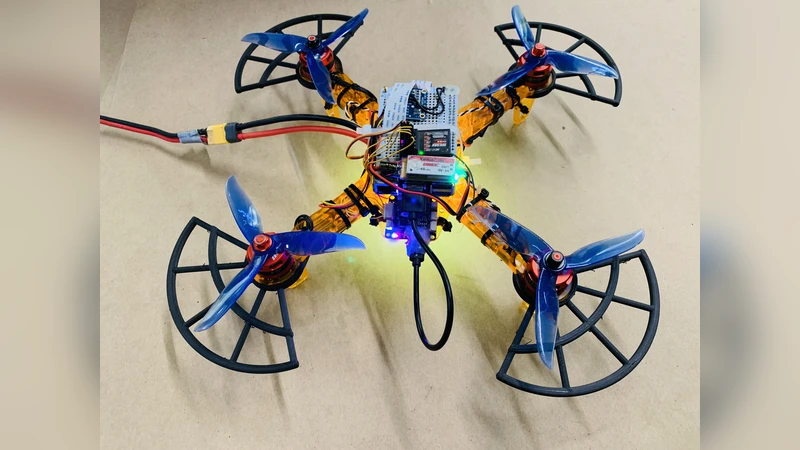
PiDrone is a quadrotor platform created to accompany an introductory robotics course. Students build an autonomous flying robot from scratch and learn to program it through assignments and projects. Existing educational robots do not have significant autonomous capabilities, such as high-level planning and mapping. We present a hardware and software framework for an autonomous aerial robot, in which all software for autonomy can run onboard the drone, implemented in Python. We present an Unscented Kalman Filter (UKF) for accurate state estimation. Next, we present an implementation of Monte Carlo (MC) Localization and FastSLAM for Simultaneous Localization and Mapping (SLAM). The performance of UKF, localization, and SLAM is tested and compared to ground truth, provided by a motion-capture system. Our evaluation demonstrates that our autonomous educational framework runs quickly and accurately on a Raspberry Pi in Python, making it ideal for use in educational settings.
💡 Research Summary
The paper presents a complete hardware‑software framework that equips the low‑cost PiDrone educational quadrotor with advanced autonomous capabilities. Hardware improvements over the original platform include a Raspberry Pi HAT for easier soldering, 3‑D‑printed propeller guards for safety, and a total component cost below $225. The software architecture is modular, allowing plug‑and‑play replacement of core components such as PID controllers, sensor drivers, state estimators, and user scripts, which makes it suitable both for teaching and for rapid research prototyping.
State estimation is performed with an Unscented Kalman Filter (UKF). Two variants are provided: a simple 2‑dimensional UKF that estimates only vertical position and velocity using a downward‑facing infrared range sensor, and a more complex 7‑dimensional UKF that tracks three‑axis position, three‑axis velocity, and yaw. The 7‑D model incorporates IMU accelerations transformed to the global frame via quaternion rotation, and fuses additional measurements from a downward‑facing camera (optical flow for planar velocity and visual features for planar position). The UKF implementation relies on the Python library FilterPy, which removes the need for manual Jacobian computation and keeps the code accessible to undergraduate students.
For localization, the authors implement Monte Carlo Localization (MCL) using a particle filter. The motion model is a simplified odometry model that adds noisy translations (Δx, Δy) and rotation (Δθ) to each particle. The measurement model uses ORB feature detection and matching (via OpenCV) to obtain 2‑D pose estimates from the downward camera. A key‑frame strategy is employed: measurement updates are triggered only after the drone has moved a significant distance or after a fixed number of motion updates, thereby reducing computational load and allowing the algorithm to run in a single thread on the Raspberry Pi. Particle weights are computed as the product of Gaussian probabilities for position and orientation errors. Experimental results show average position error around 0.15 m and orientation error near 5°, demonstrating that accurate localization can be achieved on modest hardware.
Simultaneous Localization and Mapping (SLAM) is realized with FastSLAM. FastSLAM factorizes the joint posterior over robot pose and landmarks by assigning an independent 2‑D EKF to each landmark within each particle. This avoids the O(N²) covariance matrix growth of traditional EKF‑SLAM. New ORB features become landmarks; existing landmarks are updated when re‑observed. Particle weights are derived from the likelihood of observed features given the current map. Because FastSLAM is computationally heavier, the authors run it off‑board on a separate ROS‑enabled workstation while the drone streams sensor data; nevertheless, the system maintains real‑time performance (~30 Hz) and produces coherent 2‑D maps.
The authors validate the entire stack against a motion‑capture system in an indoor lab. The 2‑D UKF provides the most stable flight control, while the 7‑D UKF offers richer state information at the cost of increased computation. MCL and FastSLAM both achieve errors comparable to those reported in the literature for low‑cost platforms. All algorithms run entirely in Python, with the Raspberry Pi 4 achieving update rates above 30 Hz for state estimation and localization.
From an educational perspective, the use of pure Python, open‑source libraries (FilterPy, OpenCV, ROS), and a low‑cost, safe hardware platform enables students with little prior robotics experience to build, program, and experiment with sophisticated perception and estimation algorithms. The modular design encourages students to replace or extend components (e.g., swapping the UKF for an EKF, adding new sensors, or implementing alternative SLAM back‑ends) without destabilizing the overall system. The paper demonstrates that advanced autonomy—state estimation, particle‑filter localization, and FastSLAM—can be taught and executed on an affordable educational drone, thereby lowering the barrier to entry for robotics education and research.
Comments & Academic Discussion
Loading comments...
Leave a Comment