Predictive Control Based on Reduced Order Model for temperature homogeneity in a resin transfer molding tool for thermoset materials
Resin Transfer Molding (RTM), which has attracted much attention in the last years for lightweight manufacturing, represents an important challenge in terms of control technology. During the process, a resin fills the cavity where a reinforcement fab…
Authors: Miguel Escolano, Jose Manuel Rodriguez, Javier Orus
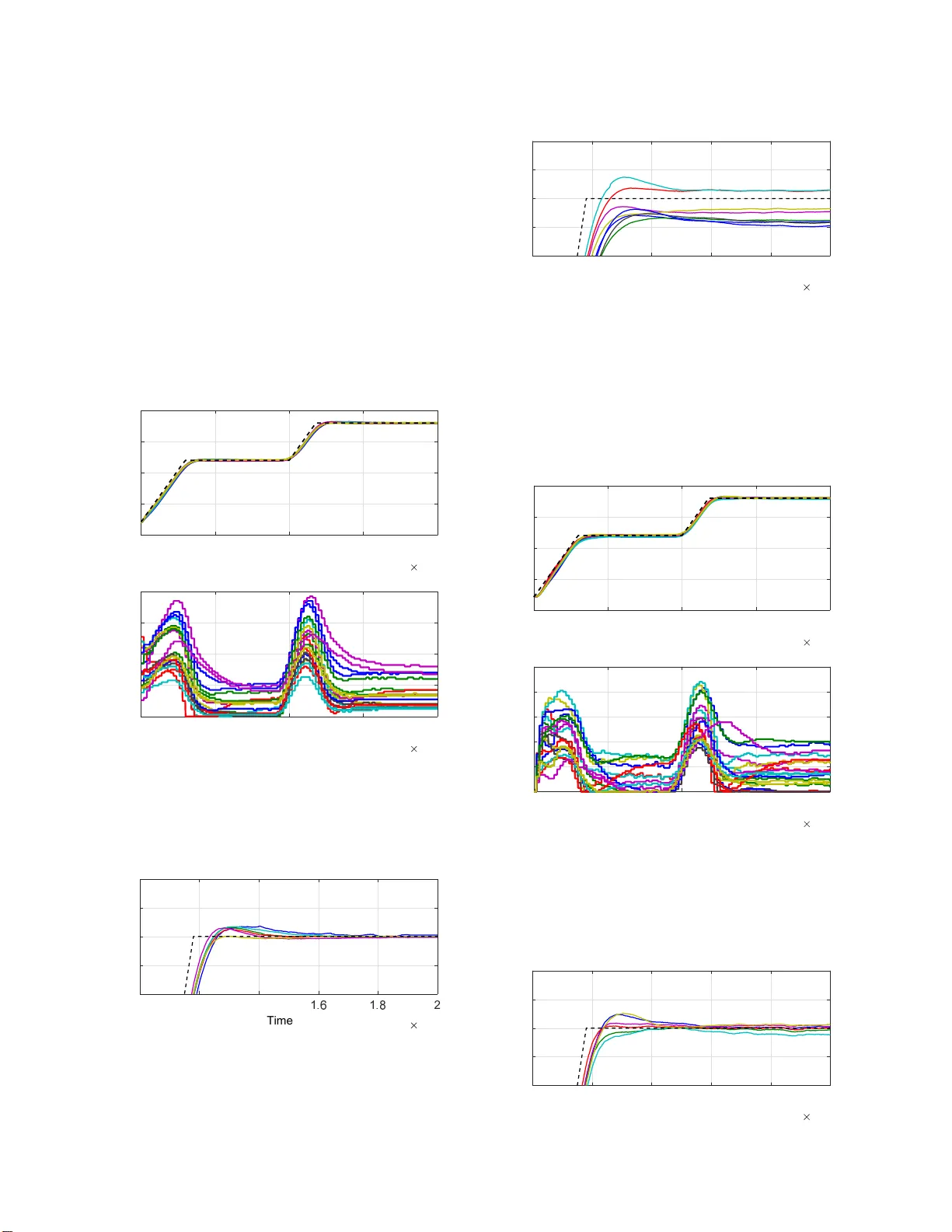
Predictive Contr ol Based on Reduced Or der Model f or temperature homogeneity in a resin transfer molding tool f or thermoset materials Miguel Escolano Jos ´ e Manuel Rodr´ ıguez Javier Or ´ us Manuel Laspalas Agust´ ın Chiminelli IT AINNO V A Zaragoza, 50018 Spain mescolano@itainn ova.es Resin T r an sfer Molding (RTM), wh ich has a ttracted much attention in the last years for lightweight manufactur- ing, r epr esents an important challenge in terms of c ontr ol technology . During the pr ocess, a r esin fills the cavity wher e a reinfor cement fabric has pr eviously been layer ed. This r esin under goes a chemical r eaction which is thermically ac- tivated. Therefor e, assuring a pr oper r eaction requir es a pr e- cise co ntr ol of temperatur e in th e entir e mo ld cavity . Thr ee factors make th is contr ol pr oblem esp e cially ha r d: the cou- pling among the lar ge number of actuators and senso rs, the variability of the test condition s and the power li mitation s of the electric actuators which do not o ffer cooling capabil- ity . The p r esent work describes an optimized Model Pr edic- tive Contr ol (MPC) ar chitectur e capable o f han dling these difficulties and also achie ving the tight contr ol r equir ements needed in the applica tion. The thermal distribution in side the mold cavity is included into th e c ontr oller by a simpli- fied Red uced Or der Model (R OM). This r epr esentatio n is ob - tained b y data fr om an experimentally valida ted F inite El- ement Model (FEM), u sing AutoRe gr essive model with eX- ogenous terms (ARX) identification . In or der to ma intain the simplicity of th is linear repr esentation, the time-varying model p a rameters a r e estimate d by using a perturba tio n ob- server . Addition ally , the performance o f the b asic algorithm is impr oved: firstly , an a ugmented ob server to estimate the temperatur e distrib ution of an e xtende d spatial r esolutio n; and seco ndly , a symmetry con dition in the ca lculation of the contr ol commands. The developed arc hitectu res have suc- cessfully been implemen ted in a RTM too l with the fulfillmen t of the contr ol r equir ements. 1 Introduction The p roductio n of lightweight pa rts for the au tomotive industry has continuously been gaining im portance in recent years for fu lfilling the mo re and m ore restricti ve r equire- ments of low fu el c o nsumptio n an d improved rang e in ICE and electr ic vehicle s. In this con n ection, techno logies like injection a n d compression moldin g, whic h allo w a h igh v ol- ume p roduc tio n of p arts, are extensively used in th e in dus- try . Specifically , Resin T ransfe r Mo ld ing (R TM) offers better structural capab ilities compared to the former ones by virtue of the better co ntrol of the fiber align ment and the use of long fibers [1]. One importan t factor in the R TM p rocess is the temperatur e con trol d u ring the proce ss as it directly affects the resin viscosity and highly influen ces the impregnation and the pressure injection. A poor control causes defects like fiber wash-ou t, p reform misalignm e nt and race-tra cking [2]. The present paper describ es th e development of a tem- perature co ntroller for a R TM tool heated by distributed ca r- tridge resistances. In this case, the mo ld will b e used for research activities on the filling an d curing processes. In co n- sequence, the norm ally strict tem p erature contro l req uired in R TM too ls is e ven more important in the case u nder analy sis. Specifically , two cond itio ns have to be fu lfilled: firstly , the spatial h omoge n eity of the temp erature inside the mold cav- ity all along the pr ocess; an d secon d ly , th e ac c urate tracking of the tempera tu re levels dur ing the rise-up and maintenan ce phases of the tests. T o do that, the contro ller has to ha n dle in an efficient mann e r the d ifficulties deriv ed fr om the ther- mal distribution in the cavity , the pr esence o f time-varying variables and intern al per turbation s (temperatur e depend ent conv ection cooling, the exothermic nature of the curing heat) and the limited capabilities of the heaters. Different typ es of molds are alre a d y widesprea d in the industry and it is th erefore possible to find co mmercial so- lutions for therm al control like [3]. T h ese alternatives are general de velopm e nts and norm ally rely o n standard PID compen sato rs [ 4]. Given its technical imp o rtance, more a d- vanced solutions can also b e fou nd in the scientific bibliog - raphy . These app roaches add the knowledge of the system in the contro ller itself fo r imp roving its per forman ce. T h is is the case of [5] and [6], which use fuz z y con trols in p las- tic in jection mold s, and [ 7], which ap plies neural ne twork s (NN). In [8], a dece n tralized PI-controller is combined with a feedf orward ter m calculated with a linearized model in a vulcanizatio n test bench . In the p r esent work, MPC is used. This type of contro ller in cludes a v alidated rep resentation of the system for optimizing the control co mmand s also tak - ing into acco u nt the characteristics of the actuators. The use of MPC f or controlling the temperature o f dif feren t typ es o f molds has already bee n reported in the litera tu re. [ 9] and [10] used this techno logy in plastic injection application s. I n the first case, MPC a n d IMC are comp ared for controllin g the barrel of a plastic injectio n machine. T o d o that, a simplified mold representation based on different tr a n sfer functio ns d e- pending o n the o peration point are used. In the secon d case, three simple linear mo dels describe the system dyn amics u s- ing d ata direc tly extracted from a ru nning mach in e. The controller pro posed in the pr esent paper u ses a d ifferent ap- proach pa rtly du e to the different p rocess techn ology (R TM). As it has to assur e the tempe r ature hom ogeneity inside the cavity , a discretized mode l in different geo m etrical region s is used. T his model also co n siders the cou p lings between the sensors an d th e a ctuators. Apart from that, the mo del faces th e nonlinear ities in the system by u sing a per turbation observer therefor e simplifying the ref erence model, which remains linear and indepen dent f r om the operation point. The present pap er extends the re su lts from [1 1] where the basic MPC controller was described and includes the improvements obtaine d by add ing an observer for increas- ing the reso lution of the temperature estimation in the ca vity and includ ing the symmetry effects in the optimiz a tio n pro- cess. I n overall, the pr o posed con troller is capab le of dealing with c o mplex and realistic indu strial geom etries by combin- ing ARX models with validated FE simulations. The con - trollers descr ib ed in the present p aper have been successfu lly implemented on a real m old. This pap er is structur ed as follows: system de scription (section 2), thermal mod e l of the mold an d its redu ced or- der represen tation (sectio n 3), d esign of the co ntrol architec- tures (section 4), experimenta l analysis (section 5) and con- clusions (sectio n 6 ). 2 System description In this section, the main f eatures o f the R TM too l an d its control har dware ar e briefly described (Fig. 1). The R T M tool co n sists on two steel blocks separated by a spacer which defines the height of the cavity wher e the reinfor c e ment fabrics ar e placed and the resin is injected. The cavity is design ed to produce composite mater ial panels of 4 0 0x30 0mm with a thickness that can b e ad justed u sing spacers of dif fere n t h eight (comm only 2, 3 or 5 mm ). Fig. 1. R TM tool and control hardware and softw are For heating the tool, th e system h as 16 intern al car tridge resistances (8 in the upper and 8 in th e lo wer part) an d 4 lateral h eating b elts (o ne per lateral face) as it a ppears in Fig. 2. The m aximum power that the actuator s can supply is 5 00 W for the cartrid ge resistances (from U 1 to U 1 6), 750 W for the 2 large heater belts ( U 17 − U 18 ) and 550 W f or the 2 short he a ter belts ( U 19 − U 2 0). Th e power o f the 20 heaters can be independen tly command ed by PWM signals. Fig. 2. RTM tool sketch. P osition and numeration of the heaters. 6 p ermanen t therm o couples (also called contro l sensors in this paper) are embe d ded in the m old cavity ( 4 in th e upp er and 2 in the lower cavity) in o rder to measure the tempera- ture, which is afterwards used by the controller for calculat- ing the requ ired a c tuation in the heaters. T h e ho mogene ity of the temperature distribution in the ca vity , and ther e f ore the control perf ormance , is ev aluated with 8 additional (also called auxiliary) th ermoco uples. Figure 3 shows the position of the perman e nt a n d auxiliar y thermo c ouples on the cavity surfaces. In addition , the he a t losses are reduced by insulation panels. They have a th ickness of 6 mm in the u pper and lower faces and 7 mm in the lateral ones. The MPC co ntroller is implemente d in L abVIEW using control algorithms pre viously de veloped in MA T - LAB/Simulink. The configur a tion of resistances, sensors and insulatio n has been selected based on p rior thermal analysis comb ining simulation and experimental validations. Fig. 3 . Sketch for the position of the per manent (black dots) and auxiliar y (red dots) ther mocouples on the surf aces of the upper cavity (left) and lower cavity (right). Dashed line represents the composite material panel. 3 System modeling The detailed FE model of th e thermal system is de- scribed in section 3.1 and its reduc e d order repr esentation appears in sectio n 3.2. 3.1 Continuous model The math ematical descriptio n o f the mold is formulated by app lying the pr in ciple of energy con servation. The resu lt- ing model has the f orm of a PDE mode l an d its numerical solution is addr essed by a d opting a Finite Element Mod el (FEM) discretization m ethod. The thermal m odel is discretized in 76952 nod es a nd the considered heat tran sfer mechanisms are conduction and conv ection . The later is repre sen ted by effecti ve con vection coefficients in the extern a l sur faces of the mo ld. Figure 4 shows the FE discretization o f the g eometry in a quar ter of the mold . Fig. 4. FEM discretization of the geometr y in a quar ter of the mold. The material of the steel mold is assumed to be h omo- geneou s an d isotro pic. Its th ermal p roperties are co ntained in table 1. T able 1. Thermal proper ties of steel Property V alue Density , ρ ( kg / m 3 ) 7850 Specific heat, c ( J / k gK ) 520 Thermal con ductivity , ( W / mK ) 33-35 .5 In o rder to ob tain th e real values of the convection and the in sulation co nductio n coefficients, an extensiv e set of ex- perimental tests an d simulations ha s been carr ied out. This identification and validation process considers the thermal behavior of th e emp ty mo ld in station ary state at different temperatur e levels. The fitted ther mal condu ctivity coefficients f or the in su - lation p anel 1 and 2 are, r espectively , 0.53 W / mK and 0.26 W / mK . The evolution o f the co n vection coefficients of the uppe r and lower faces has been fitted with Eq.( 1). The coefficient of the later al faces has be e n adjusted with Eq.(2). The iden- tified v alues of the co efficients (a, b and c) ar e shown in the table 2. Accordin g to th em, the r ange of values o f the convec- tion coefficients fo r the dif fere n t sur faces are: 6-18 W / m 2 K on the upp er face, 1-8 W / m 2 K on the lower face and 2-1 2 W / m 2 K on the later al faces. Out of th e a n alyzed tempera- ture range ( b elow 25 ◦ C and a b ove 180 ◦ C), the c o efficients are assumed to be con stant. h = a ( ∆ T − b ) c (1) h = a ( b − e − c ∆ T ) (2) T able 2. V al u e s of the convect ion coefficients in the mold surf aces ( h i n W / m 2 K and ∆ T in K ). a b c Upper 4.120 23.56 7 0.317 Lower 0.942 22.93 7 0.533 Lateral 2 0.160 0.395 0.041 Additionally , the therma l mo del takes in to a ccount the heat released by th e exother mic curing pro cess o f the co m- posite material pan el. The curin g kin etic of th e resin h a s been mod eled by m eans of the Kamal-Sour o ur eq uation. The whole FEM model h as b een impleme n ted in the software Abaqus/Standar d. 3.2 Reduced Order Model (ROM) The previous FE represen tation is complex an d compu- tationally expensiv e to be run in real time as it is required by the Model Predictive Controller . Therefore , a Redu c e d Ord er Model based on ARX is built using the d a ta obtain ed fr om FE transient simulations. For the se virtual te sts, the tempera- ture of the m old ca vity me asured b y the 6 permanent sensors ( y , o u tputs) is registered when hea ting power is supplied b y the 20 a ctuators ( u , inputs). Eq uation ( 3) shows th e definition of the ARX model. y t + 1 = ∑ r − 1 i = 0 a i y t − i + ∑ s i = 0 b i u t − i (3) Where a and b are th e para m eters of th e m odel, and r and s are the regression o rder for the outpu ts and inputs, re- spectiv ely . A limitation of the ARX de scr iption is its linear n ature, which cann ot handle the time-varying nature of the conv ec- tion par ameters. In consequen ce, an initial R OM is obtained using FE resu lts with constant convection coefficient: 1 5 W / m 2 K is selected as a m e an referen ce value for natural conv ection . Significan t tempera ture differences are obtained when th is initial ROM is com p ared with the validated FE model, which inclu des variable co n vection coefficients ac- cording to Eq.(1) and Eq.(2). Th e id entification error s may reach up to 13% (Fig . 5). In order to predict and compensate these d eviations, a perturbation ob ser ver based on a Kalman filter is im plemented . The ARX model in Eq.(3) can be written as the state space rep r esentation in Eq. ( 4): X t + 1 = AX t + B U t Y t = C X t (4) Where, X t = [ Y t ; Y t − 1 ; Y t − 2 ; ... ; U t − 1 ; U t − 2 ; U t − 3 ; ... ] This mod el assumes constant convection coefficient (15 W / m 2 K ). If convection co efficients are not constant, the ef- fect can be described as perturbation s in the Eq.(5). X t + 1 = AX t + B U t + B p P t Y t = C X t (5) Where P t represents the con vection he a t differences be- tween 1 5 W / m 2 K constant coefficient and variable coeffi- cients according to E q.(1) and Eq . (2). Th e state-space repre- sentation is then u pdated by introdu cing the p erturb a tions P t as add itional state variables: X m , t = [ Y t ; Y t − 1 ; Y t − 2 ; ... ; U t − 1 ; U t − 2 ; U t − 3 ; ... ; P t ] The final state-space representatio n is: X m , t + 1 = A m X m , t + B m U t Y m , t = C m X m , t (6) Where, A m = A B p 0 1 B m = B 0 C m = C 0 The Kalman filter a lg orithm is applied to the Eq .(6) state-space, described in Eq.(7-11). 1. Prediction: ˜ X m , t = A m ˆ X m , t − 1 + B m U t (7) ˜ P k , t = A m P k , t − 1 A t m + C q (8) 2. Update: K t = ˜ P k , t C t m ( C m ˜ P k , t C t m + C s ) − 1 (9) ˆ X m , t = ˜ X m , t + K t ( z t − C m ˜ X m , t ) (10) P k , t = ( I − K t C m ) ˜ P k , t (11) Where C q y C s are the uncertain ties of the estimation model and the sensor s respectively; P is the covariance o f the esti- mated state; K is the g ain of the Kalman filter; and z is the temperatur e m easurement of th e sensors. After compensating the pertu r bations, temp erature er- rors lo wer than 6% are achieved in the R OM validation. Fig- ure 5 sh ows the improvement in the R OM validation on ce perturb ations are compensated . 0 2 4 6 8 10 12 Time (s) 10 4 100 150 200 250 300 Temperature (ºC) Temperature 1 0 2 4 6 8 10 12 Time (s) 10 4 100 150 200 250 300 Temperature (ºC) Temperature 2 0 2 4 6 8 10 12 Time (s) 10 4 100 150 200 250 300 Temperature (ºC) Temperature 3 0 2 4 6 8 10 12 Time (s) 10 4 100 150 200 250 300 Temperature (ºC) Temperature 4 0 2 4 6 8 10 12 Time (s) 10 4 100 150 200 250 300 Temperature (ºC) Temperature 5 0 2 4 6 8 10 12 Time (s) 10 4 100 150 200 250 300 Temperature (ºC) Temperature 6 FEM ROM validation (perturbation estimator) ROM validation (without perturbation estimator) Fig. 5. ROM validation with respect to Finite Element Model, before and after the implementation of Kalman filter per turbation estimator 4 Control architectures In th is section, three different architectur es are described for the tem perature co ntrol of the R TM tool: 1. Standard MPC controller in section 4.1. 2. Extended domain MPC controller: an aug m ented ob- server has been implem e nted for estimating the temper- ature o f ad ditional po ints of the mold cavity , in section 4.2. 3. Symmetric actuation MPC contro ller: in addition to the previous app r oaches, symmetry c ondition in the power command s is included, in sectio n 4.3. 4.1 Standard MPC controller A M PC contro ller is designed for comman ding the op- timal power to th e heater s in ord er to minimize the temper- ature differences into the mo ld cavity . T o do that, the R OM and the per turbation observer are used. The inp ut signal of the MPC contr oller is the state estimation o f the system af- ter compen sating the p erturba tions P t by the Kalman filter estimator d escribed in th e p revious section. The contro l ar- chitecture is sho wn in Fig. 6. Fig. 6. Control architecture: MPC controller and per turbation esti- mator . The MPC co ntroller includ es two algorithms: firstly , th e estimation of th e system evolution p redicted by th e R OM up to a time horizon defined by N p ; and second ly , the calculatio n of th e heatin g powers by the Hild reth op tim ization algo r ithm. The state-space r e p resentation shown in E q .(5) has been adapted for its impleme ntation: the inputs ar e power inc re- ments ( ∆ U t = U t − U t − 1 ) and the outpu ts ar e integrated inside the state vector itself, according to the Eq.(12). X e , t = [ ∆ X m , t ; Y m , t ] (12) Where ∆ X m , t = X m , t − X m , t − 1 Then an exten d ed state-space re presentation is obtained: X e , t + 1 = A e X e , t + B e ∆ U t Y e , t = C e X e , t (13) Where, A e = A m 0 C m A m 1 B e = B m C m B m C e = 0 1 For the construction of the MPC state-space, the ev olu- tion o f the following states until th e tempo ral horizo n N p is considered accor ding to the Eq.(14). Y = F X + G ∆ U (14) Where, X = X e , t Y = [ Y e , t + 1 ; Y e , t + 2 ; Y e , t + 3 ; ... ; Y e , t + N p ] ∆ U = [ ∆ U t ; ∆ U t + 1 ; ∆ U t + 2 ; ... ; ∆ U t + N p − 1 ] F = C e A e C e A 2 e C e A 3 e . . . C e A N p e G = C e B e 0 0 · · · 0 C e A e B e C e B e 0 · · · 0 C e A 2 e B e C e A e B e C e B e · · · 0 . . . . . . . . . · · · . . . C e A N p − 1 e B e C e A N p − 2 e B e C e A N p − 3 e B e · · · C e B e The optimizatio n functio n J depends o n two terms ac- cording to Eq.(1 5): quadratic err or between the ref erence and th e measured tempera tu re at the co ntrol sen sors, and quadra tic term for the p ower c o nsumptio n, weighted by Q and R matrices respectively . J = ( Re f − Y ) T Q ( Re f − Y ) + ∆ U T R ∆ U (15) Where Re f is the vector of reference temp eratures un til temporal ho rizon N p . The Hildreth metho d is an analy tical ap proach f or solv- ing th e constrained q uadratic o ptimization p roblem , based o n the resolu tion of E q .(16): ∂ J ∂∆ U = 0 (16) T aking Eq. ( 16), and adapting Eq. ( 14) and Eq.(1 5 ), the value o f the optimal power incremen ts can be obtaine d by means of E q .(17). ∆ U = ( G T G + R ) − 1 G T ( Re f − F X ) (17) During the o ptimization, th e con trol co mmand s canno t exceed the maximum values admitted by th e resistances a nd must be h ig her than zer o. In case that the optimization vari- ables do no t fulfill the constra in ts, the algor ithm recalculates the com m ands by the iterati ve proce dure d escribed in [12]. 4.2 Extended domain MPC controller The MPC contro ller described in the previous section only considers the temper ature o f the control sensors. How- ev er, no infor mation is kn own from the rest of the mold cavity . In or d er to im prove the temperature homo geneity in the whole d o main, an augmente d Kalman filter estima- tor is added to the algorithm for estimating the tempe rature of some ca vity poin ts. It includ es 8 more points, which will be called virtu al nodes hereinaf ter . The loc ations of these points co rrespon d with the on es measure d by the aux iliary thermoco uples (Fig. 3). In this way , the MPC controller calculates th e optimal heating powers ba sed, not o nly on the temper ature o f the 6 control sensors, but also on th e tempe r ature estimation o f these 8 virtual nodes ( ˆ T nod es ). The op timization fun ction J is aug mented accordin g to Eq.(1 8). J = ( Re f − Y ) T Q ( Re f − Y ) + ... +( Re f − ˆ T nod es ) T Q ( Re f − ˆ T nod es ) + ∆ U T R ∆ U (18) 4.3 Symmetric actuation MPC controller Despite the extend ed temperature domain app roach de- scribed in th e previous sectio n, the tem perature d ifferences of some ca vity areas could b e still minimized. In the presen t section, the symmetry of th e mold is used for ob taining a higher ho mogen eity in areas wh ere the co ntrol sen sors a r e not present. T o do that, the comman ded heating power of the resistances at sym metrical p ositions with respect to the central line of the mold are forced to be the same. The con- ditions are applied to the power deman ds a s co nstraints in the optimizatio n meth od. According to the nu meration fol- lowed in Fig. 2, the exp r essions described in Eq.(19) are implemented . U 1 = U 8 U 2 = U 7 U 3 = U 6 U 4 = U 5 U 9 = U 1 6 U 1 0 = U 15 U 1 1 = U 14 U 1 2 = U 13 U 17 = U 18 U 19 = U 20 (19) 5 Experimental analysis The p revious MPC contro llers have been implem ented on a real mo ld and the obtain ed results are described in this section. I n order to compa r e the perform ance, two different condition s are used: 1. T emp e r ature control of an empty mo ld ( section 5. 1). 2. T emp e r ature contro l in mold in g cond itions (section 5.2). For this analysis, the c o ntroller updates the power com- mands each 2 00s and N p is fixed to 6. This means that the estimation h o rizon fo r the MPC is 1200s. Regarding th e o p- timization fun ction, th e weigh t of matrix R is two orders of m a g nitude lower than the weight of matrix Q ( Q = 1, R = 0 . 01) as temperatur e h omoge n eity is the critical indi- cator for this application . The obtained results fr om the e xpe r imental an alysis are compare d in section 5.3. 5.1 Experimental analysis in empty mold The thre e developed MPC controller s ar e co m pared when controlling the temp erature o f th e mo ld cavity in empty condition s. The test sequen c e is the f ollowing o ne: firsty , th e mold is he a ted from r o om tempe r ature (23 ◦ C) u p to 12 0 ◦ C at 2 ◦ C/min rate; at 120 ◦ , the temp erature remains c o nstant until t=10 000s; then the mold is heated again u p to 180 ◦ C at 2 ◦ C/min rate; at 180 ◦ C, temperatur e remains constant until t=20000 s. 5.1.1 Standard MPC controller Figure 7 shows th e tem peratur e ev olutio n mea su red b y the 6 co n trol senso r s whe n th e heating powers calculated b y the standard MPC contr o ller are comman ded. In Fig . 8 an d Fig. 9, the temperature s measured by the control sensors and by the au xiliary therm ocoup les at 180 ◦ C reference are displayed respe ctiv ely . 0 0.5 1 1.5 2 Time (s) 10 4 0 50 100 150 200 Temperature (ºC) 0 0.5 1 1.5 2 Time (s) 10 4 0 100 200 300 400 Power (W) Fig. 7. T emperature tracking by the control sensors (upper) and power commands (below) f or standard MPC controller. 1 1.2 1.4 1 2 Time (s) 10 4 170 175 180 185 190 Temperature (ºC) Fig. 8. T emperatures measured by the control sensors at 180 ◦ C ref erence (standard MPC controller). 5.1.2 Extended Domain MPC controller Figure 10 shows the temperature ev olution measure d b y the 6 co n trol senso r s whe n th e heating powers calculated b y the extended doma in MPC contr oller are com manded . In 1 1.2 1.4 1.6 1.8 2 Time (s) 10 4 170 175 180 185 190 Temperature (ºC) Fig. 9. T emperatures measured by the auxiliar y ther mocouples at 180 ◦ C ref erence (standard MPC controller). the Fig. 11 an d Fig. 12, the temperatur es measur ed by the control sensors an d by th e auxiliary ther mocoup les at 18 0 ◦ C referenc e are d isplayed respectively . 0 0.5 1 1.5 2 Time (s) 10 4 0 50 100 150 200 Temperature (ºC) 0 0.5 1 1.5 2 Time (s) 10 4 0 100 200 300 400 500 Power (W) Fig. 10. T emperature tracking by the control sensors (upp e r) and power commands (below) f or extended domain MPC controller. 1 1.2 1.4 1.6 1.8 2 Time (s) 10 4 170 175 180 185 190 Temperature (ºC) Fig. 11. T emperatures measured by the control sensors at 180 ◦ C ref erence (Extended domain MPC controller). 1 1.2 1.4 1.6 1.8 2 Time (s) 10 4 170 175 180 185 190 Temperature (ºC) Fig. 12. T emperat ures measured by the auxiliar y thermocouples at 180 ◦ C ref erence (Extended domain MPC controller). 5.1.3 Symmetric actuatio n MPC Co ntroller Figure 13 shows the temperature ev olution measure d b y the 6 co n trol senso r s whe n th e heating powers calculated b y the symm e tric actuation MPC controller are commanded . In Fig. 14 and Fig. 15, th e temperatures measured by the con- trol sensors and by the auxiliary th ermocou ples at 180 ◦ C ref- erence are displayed respectively . 0 0.5 1 1.5 2 Time (s) 10 4 0 50 100 150 200 Temperature (ºC) 0 0.5 1 1.5 2 Time (s) 10 4 0 100 200 300 400 500 Power (W) Fig. 13. T emperature tracking by the control sensors (upp e r) and power commands (below) f or symmetric actuation MPC controller 1 1.2 1.4 1.6 1.8 2 Time (s) 10 4 170 175 180 185 190 Temperature (ºC) Fig. 14. T emperatures measured by the control sensors at 180 ◦ C ref erence (Symmetric actuation MPC controller). 1 1.2 1.4 1.6 1.8 2 Time (s) 10 4 170 175 180 185 190 Temperature (ºC) Fig. 15. T emperat ures measured by the auxiliar y thermocouples at 180 ◦ C ref erence (Symmetric actuation MPC controller). 5.2 Experimental analysis in molding conditions The m olding o f a co mposite material panel has be e n carried ou t by applyin g the symmetr ic actuation MPC co n- troller, which is the b est appr o ach for m inimizing tem pera- ture differences in the entire m o ld cavity . Du e to the cu ring process, an internal heat source from the chemical reactions affects to the temp erature contro ller a s a pertur b ation. The ev olution of the referenc e temperatur e fo r this test is the following on e: firstly , the mo ld is heated fro m ro om temperatur e (23 ◦ C) u p to the injection temp erature ( 1 20 ◦ C) at 2 ◦ C/min rate; once the tec hnician detects a stable station - ary level, the resin is inje c te d ; the m old is he a ted up to curing temperatur e (185 ◦ C) a t 2 ◦ C/min rate; finally the curin g o f the resin is ensured maintaining at 185 ◦ C during two hours. Figure 16 shows the temperature ev olution measure d b y the 6 co n trol sen so rs. Figu re 17 sh ows th e temp eratures a t 185 ◦ C ref erence. In this case, it is n ot po ssible to measure the temp erature o f other cavity points by the auxiliary ther- mocoup les becau se of the re sin in jection. Figu re 18 shows the fo rmed com posite material panel, wh ere no defects or visible variations in super ficial appea r ance are detected . 5.3 Comparative of r esults and discussion The ob jectiv e of the co ntroller is the track in g of a refer- ence temper a ture hom o geneou sly in the entire mold cavity . In or d er to analyze and co mpare the experimental results, the temperatur e d omain homo geneity and the tracking erro r are treated as ind e p enden t indicato r s. Additionally , these indi- cators ar e obta in ed for the transient state ( d uring the cur ing process) and for the stationary state ( 2 hours afte r the cur ing temperatur e is demanded , t f ). 1. Stationary indicator of temperature homogeneity ( RM S E avg , s t at ): Root mean squared error o f tempe rature by perman ent and auxiliar y thermoco uples ( T i ) with respect to th eir average value ( T avg ) at t f , obtained b y Eq.(20). RM S E avg , s t at = q 1 n ∑ n i = 1 ( T i , t f − T avg , t f ) 2 (20) 2. Stationary in d icator of th e ref e rence temp e rature track- ing ( RM S E re f , st at ): Root mean squared error of tempera- 0 5000 10000 15000 Time (s) 0 50 100 150 200 Temperature (ºC) 0 5000 10000 15000 Time (s) 0 100 200 300 400 500 Power (W) Fig. 16. T emperature tracking by the control sensors (upp e r) and power commands (below) f or composite material pane l forming. 0.7 0.8 0.9 1 1.1 1.2 1.3 1.4 1.5 Time (s) 10 4 175 180 185 190 195 Temperature (ºC) Fig. 17. T emperatures measured by the control sensors at 185 ◦ C ref erence (composite material panel forming). Fig. 1 8. Composite material panel formed by applyin g MPC con- troller . ture by p ermanen t and auxiliary thermoco uples ( T i ) with respect to reference tem p erature value ( T re f ) a t t f , ob - tained by Eq.(21). RM S E re f , st at = q 1 n ∑ n i = 1 ( T i , t f − T re f , t f ) 2 (21) 3. Global indicator o f temperatur e hom ogeneity ( RM S E avg , gl obal ): Root mean squa red erro r of tem- perature by perm anent and aux iliary ther mocou ples ( T i ) with respect to their mean value ( T avg ) from the beginning of the heating pro cess up to the curing temperatur e ( t i =1000 0 s) to t f , obtain ed by E q .(22). RM S E avg , gl obal = q 1 n ( t f − t i ) ∑ t f t = t i ∑ n i = 1 ( T i , t − T avg , t ) 2 (22) 4. Global indicator of the reference temperatur e tr a cking ( RM S E re f , gl obal ): Root mean squared error of tempera - ture by permanent an d auxiliary therm ocoup le s with re- spect to reference temperature value ( T re f ) from the be- ginning of the heatin g p rocess up to cu ring temperature ( t i =1000 0 s) to t f , o btained by E q .(23). RM S E re f , gl obal = q 1 n ( t f − t i ) ∑ t f t = t i ∑ n i = 1 ( T i , t − T re f , t ) 2 (23) The values of the in dicators f or the ap plied c ontrol al- gorithms are summarized in the table 3 and some p oints are highligh ted. T able 3. Indicators f or the analyzed control algorithms RMS E avg , stat RMS E re f , st at RMS E avg , global RMS E re f , g lobal Empty mold Standard MPC Controller 2.09 2.44 2.27 4.73 Extended domain MPC contro ller 2.00 2.43 2.08 3.81 Symmetric actuation MPC Controller 0.69 0.76 1.48 2.95 Molding of a compo site material panel Symmetric actuation MPC Controller 0.27 0.35 1.17 3.34 From th e c omparison of the three MPC co ntrollers for the empty mold cavity , it is concluded that successi ve im- provements in the standard alg o rithm make that th e track- ing of the refer ence temperatur e is more accura te. Using the R OM f or estimatin g th e tempe r ature of virtu al nod es has the effect of redu cing the RMSE fro m 4.7 3 ◦ C to 3.81 ◦ C during the cur ing pro cess, and fr om 2.4 4 ◦ C to 2.43 ◦ C fo r the stationary state. Ad d itionally , if symm etry is app lied in the power com mands of the h eaters, the RMSE is red uced to 2.95 ◦ C durin g the cu ring pr ocess and to 0.76 ◦ C for the stationary state. The improved algorithms also minimize temp erature differences in th e en tire c avity: th e RMSE durin g the curing process is red u ced fr om 2.27 ◦ C to 2. 08 ◦ C for the extended domain app roach and to 1.4 8 ◦ C when symmetry is also con- sidered. Th is redu ction is found in the stationary state too : the RMSE decreases from 2. 09 ◦ C to 2.00 ◦ C and to 0 .69 ◦ C respectively . For this mold geometry , applyin g symme tric p ower commman ds achie ves high er temperatu re homogene ity in the mold cavity than extending the domain by estimatin g th e temperatur e o f virtu al nodes. For the molding of a comp osite materia l p anel, the last MPC contro ller app roach is analyzed only con sidering the RMSE in the control sensors as au xiliary therm ocoup les can not be disposed. The tracking erro r is 3.34 ◦ C dur ing the cur- ing p rocess and 0.35 ◦ C for the stationary state; and d eviation in temperatur e homo g eneity is 1.17 ◦ C during the curin g pro- cess and 0 .27 ◦ C for the stationary state. These resu lts fulfill the maximum allowed d eviations for R TM processses, which normally rang e between 2 and 3C. 6 Conclusions The present paper describes three p ossible approach es for contr o lling the temperature in a R TM tool by using MPC controller s. The results sh ow how th e u se o f R OM with a perturb ation o bserver permits reducing th e co mplexity o f the model. I n co m bination with that, the inclu sion of state o b - servers and symmetr ical condition s co n tributes to improve the ho mogen eous temperatur e distribution in side the mold cavity . All the d ev elop e d algorith m s h av e been experimen- tally analy z ed. As a summary of the obtain ed re su lts in empty cond i- tions, the stan dard MPC c o ntroller shows a max imum error between the r eference an d the measured temperatur e o f 2.2 7 ◦ C. Improving th is algo rithm b y means of th e tem perature estimation of 8 virtual n odes and applying symmetry co ndi- tions to the power demand s red uces the d eviations to 1.48 ◦ C. F or this improved approach , 0.69 ◦ C RMSE value is o b- tained once the stationary state is reached. This controller h as also been an alyzed du r ing m olding condition s. T ight tracking and tempe r ature ho mogen e ity into the mold have been achieved, resulting in the fo rming o f a panel withou t visible discontinuities or defects. In order to improve these results, the redefin ition of the number and op timal distribution of sensors a n d actuators could be ad dressed in futu re de velopmen ts. Ada ptiv e m odel parameters and failure diagn osis b a sed on detailed models could also b e explored as mo re complex contr ol ap proach es. In addition , th e describ ed method ology in this paper co uld be applied to other proce sses, for instance, flu id hea ting o r hybrid systems. Acknowledgements This work was supported by the Span ish Ministry of Econom y , Indu stry a n d Comp etitiv eness in the framework of the ”National Progr am fo r Research Aimed at the Challenges of Society , 2014 ” and th e ”I NNP ACT O Nation a l pu blic- priv ate coope r ation p rogram , 2 012”. References [1] M azumdar, S., 2001 . Comp osites manufacturing : ma- terials, p r od u ct, and pr ocess engineering . CrC press. [2] Bro cks, T ., Sh iino, M. Y ., Cioffi, M . O . H., V oorwald, H. J. C., and Capor alli Filho, A., 2013. “Experim en- tal rtm man ufacturing an alysis of carbo n/epoxy com - posites f or aerospace application”. Materials Researc h, 16 (5) , pp. 1175 –118 2. [3] W atlow , accessed February 6 , 2 019. Cat ´ alogo de sistemas t ´ ermicos y t ´ ecnicas de medici ´ on y control. http://www .watlo w .es/common/catalog s/files/esplc0604.pdf. [4] A k ashi, T ., 1 986. “T emp erature con tr ol of heating cylinder of injection mou lding machine by deco upling method”. T ransaction s of the So ciety of Instrument a nd Contr ol En gineers, 22 (2), pp. 230–237 . [5] W ang , Y .-T ., an d W u, S.-L., 20 06. “Mod eling and con- trol fo r a the rmal barre l in plastic molding pr ocesses”. Ł, 9 (2), pp. 1 29–14 0. [6] M u ˜ noz-Barro n, B., Mo rales-V elazq uez, L . , Romer o- T ronc o so, R. J., Rod riguez-Do nate, C., T rejo- Hernand e z, M., Benitez-Rangel, J. P ., and Osornio- Rios, R. A., 2012. “Fpga-based m u ltiprocessor sys- tem fo r injection mo lding contro l”. Sensors, 12 (10 ) , pp. 1 4068– 1408 3. [7] D e n g, J., Y ang, Z. , Li, K., Menary , G . , and Harkin - Jones, E., 2 012. “Heuristically o ptimized rbf n eural model for the co ntrol o f sectio n weights in stretch b low mouldin g”. In Control (CONTR OL), 20 12 UKA CC I n- ternational Con f erence on , I EEE, p p . 24–2 9 . [8] Bo sselman n, S., Frank, T ., W ielitzka, M., Dagen, M., and Ortmaier, T ., 2017. “Ther m al m odeling an d decen - tralized co n trol of mold temperature for a v ulcanization test ben ch”. In Contr ol T echn ology an d Application s (CCT A) , 2017 IE EE Conf erence on , IEEE, pp . 377– 382. [9] K a n agalakshm i, S., Mana m alli, D., and Rafiq, M. M., 2014. “ Design of multim odel b a sed m pc and imc con- trol schemes ap plied to injectio n mold ing machine”. In- ternational Journal of En gineering & T echnology , 3 (2), p. 82 . [10] Gustaf son, D. E., and Lebow , W . M., 198 7. “Model predictive contro l (mpc ) o f in jection moldin g ma- chines”. I n Decision and Control, 198 7. 26th IEEE Conferenc e on, V ol. 2 6 , IEEE, pp. 2017–2 026. [11] Esco la n o, M., Cond e, I., Laspalas, M., Lizaran zu, M., Rodr´ ıguez, J., Alfonso , J., Or ´ us, J., Chimin e lli, A., de Aja, J. S., an d de la Escalera, F . M., 2018. “Mod e- lado y control pr edictiv o de u n mold e de rtm”. Materi- ales Comp uestos, 2 (3) , pp. 5 6 –62. [12] W ang, L., 2009. Mod el pr edictive con tr ol system de- sign an d implemen tation using MAT LAB R . Springer Science & Business Media.
Original Paper
Loading high-quality paper...
Comments & Academic Discussion
Loading comments...
Leave a Comment