A Reactive-Darwinian Model for the Ultimatum Game: On the Dominance of Moderation in High Diffusion
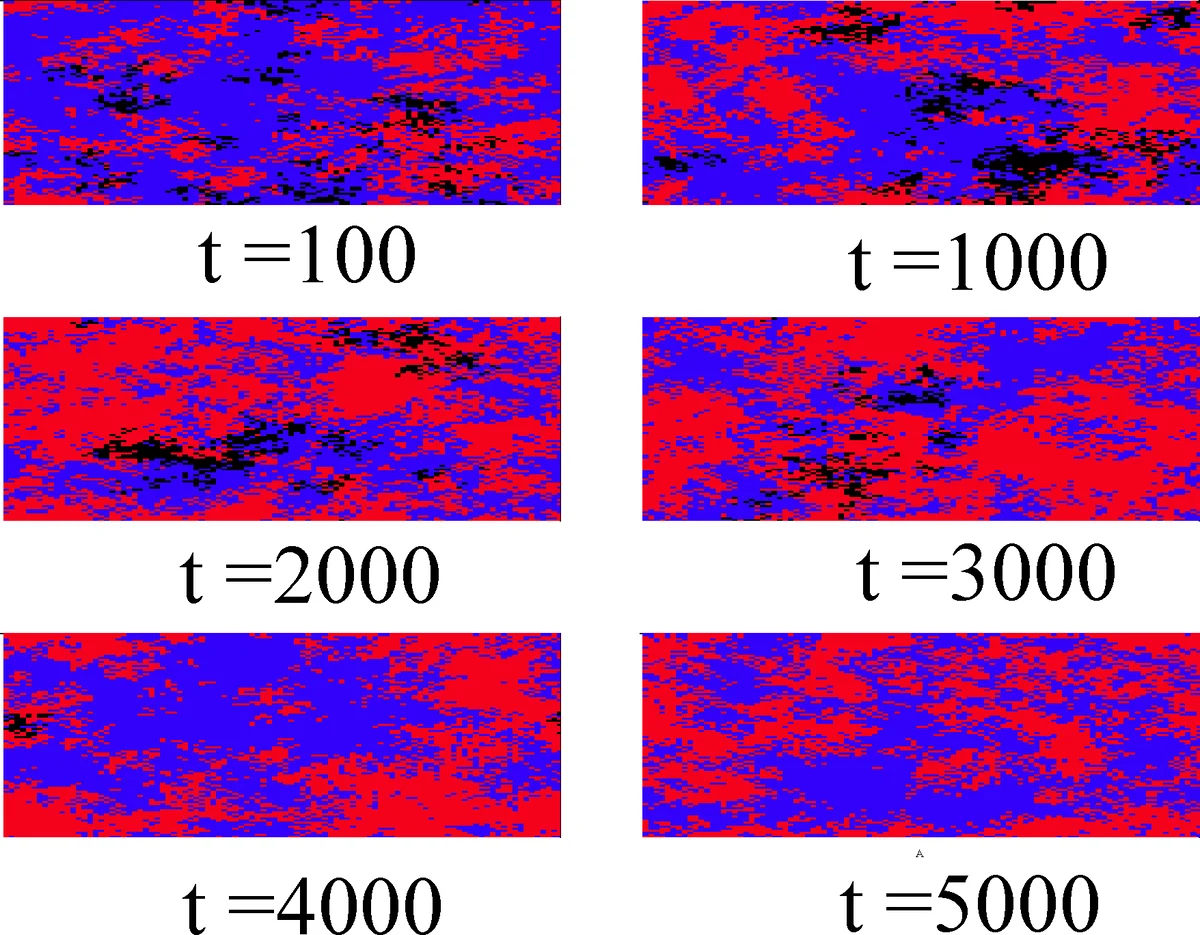
We consider a version of the ultimatum game which simultaneously combines reactive and Darwinian aspects with offers in [0,1]. By reactive aspects, we consider the effects that lead the player to change their offer given the previous result. On the other hand, Darwinian aspects correspond to copying a better strategy according to best game payoff when the current player compares with one of their neighbours. Therefore, we consider three different strategies, which govern how the players change their offers: greedy, moderate, and conservative. First, we provide an analytic study of a static version of game, where Darwinian aspects are not considered. Then, by using numerical simulations of a detailed and complete multi-agent system on a two dimensional lattice, we add an extra feature, in which players probabilistically scape from extreme offers (those close to 0 or 1) for obvious reasons. The players are also endowed reciprocity on their gains as proposers, which is reflected on their gains as responders. We also analyse the influence of the player’s mobility effects. An analysis of the emergence of coexistence of strategies and changes on the dominant strategies are observed, which in turn depends on the player’s mobility rate.
💡 Research Summary
This paper introduces a novel “reactive‑Darwinian” version of the Ultimatum Game in which offers are continuous values in the interval
Comments & Academic Discussion
Loading comments...
Leave a Comment