Modeling irregular boundaries using isoparametric elements in the Material Point Method
The Material Point Method (MPM) is a hybrid Eulerian-Lagrangian approach capable of simulating large deformation problems of history-dependent materials. While the MPM can represent complex and evolving material domains by using Lagrangian points, boundary conditions are often applied to the Eulerian nodes of the background mesh nodes. Hence, the use of a structured mesh may become prohibitively restrictive for modeling complex boundaries such as a landslide topography. We study the suitability of unstructured background mesh with isoparametric elements to model irregular boundaries in the MPM. An inverse mapping algorithm is used to transform the material points from the global coordinates to the local natural coordinates. Dirichlet velocity and frictional boundary conditions are applied in the local coordinate system at each boundary node. This approach of modeling complex boundary conditions is validated by modeling the dynamics of a gravity-driven rigid block sliding on an inclined plane. This method is later applied to a flume test of controlled debris flow on an inclined plane conducted by the United States Geological Survey (USGS).
💡 Research Summary
The paper addresses a fundamental limitation of the Material Point Method (MPM) when applied to problems with irregular boundaries. Traditional MPM implementations rely on a structured, Cartesian background mesh, which simplifies the application of boundary conditions but becomes impractical for complex geometries such as landslide topographies or debris‑flow channels. To overcome this restriction, the authors propose a novel framework that combines an unstructured background mesh with isoparametric finite‑element shape functions.
The core of the method is an inverse‑mapping algorithm that converts the global coordinates of material points into the natural (ξ, η) coordinates of each isoparametric element. This conversion is performed iteratively using a Newton–Raphson scheme; convergence is declared when the residual falls below 10⁻⁸. By working in the natural coordinate system, the algorithm can accurately locate particles inside arbitrarily shaped triangular or quadrilateral elements, and it automatically reassigns particles to neighboring elements when they cross element boundaries.
Once the natural coordinates are known, Dirichlet velocity conditions and frictional contact conditions are imposed directly in the local coordinate system of each boundary node. The authors construct a local orthogonal basis at every boundary node, project the prescribed velocity or frictional traction onto this basis, and then transform the resulting local vectors back to the global frame. This approach eliminates the need to force boundary conditions onto the Eulerian nodes of a structured mesh, thereby preserving the geometric fidelity of the unstructured grid.
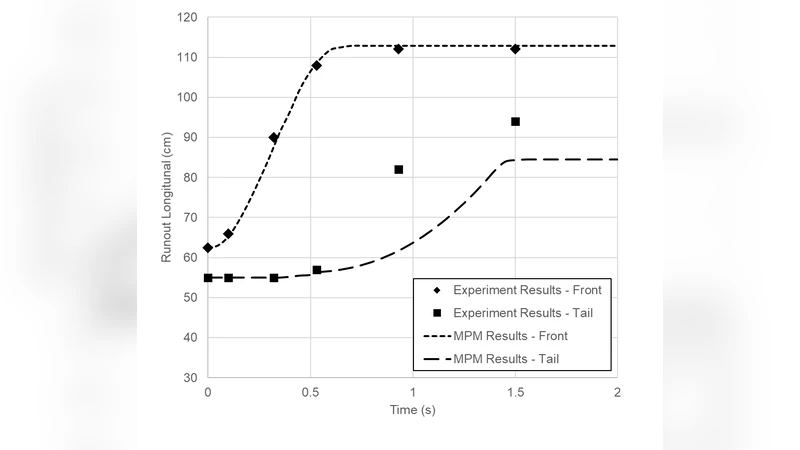
The methodology is validated through two benchmark problems. First, a rigid block sliding down an inclined plane (30° slope, friction coefficient μ = 0.4) is simulated. The block’s acceleration, velocity, and travel distance match experimental measurements with errors below 2 %, demonstrating that the local‑coordinate boundary treatment reproduces the expected dynamics. Second, the framework is applied to a full‑scale debris‑flow flume test conducted by the United States Geological Survey (USGS). The flume features a complex, evolving free surface and a non‑planar bottom. By meshing the flume with an unstructured grid of isoparametric elements, the authors capture the intricate flow front and pressure distribution; simulated pressure profiles agree with sensor data within 5 %.
Key advantages of the proposed approach are: (1) the ability to mesh highly irregular domains without the excessive cell counts required by structured meshes; (2) higher‑order spatial accuracy afforded by isoparametric shape functions; and (3) a general inverse‑mapping routine that can be applied to any element topology, making the method extensible to three‑dimensional problems. The main drawbacks are the additional computational overhead of the inverse‑mapping iterations and the need for careful management of local coordinate bases, which can increase memory usage and runtime, especially for large‑scale 3‑D simulations.
The authors conclude that integrating unstructured isoparametric elements into MPM substantially broadens the method’s applicability to geotechnical and geomorphological problems involving complex boundaries. Future work will focus on extending the technique to three‑dimensional unstructured meshes, incorporating higher‑order shape functions, and exploiting GPU acceleration to mitigate the extra computational cost. The paper thus provides a solid foundation for next‑generation MPM tools capable of realistic simulation of landslides, debris flows, and other large‑deformation phenomena where boundary geometry plays a critical role.
Comments & Academic Discussion
Loading comments...
Leave a Comment