The Hamming and Golay Number-Theoretic Transforms
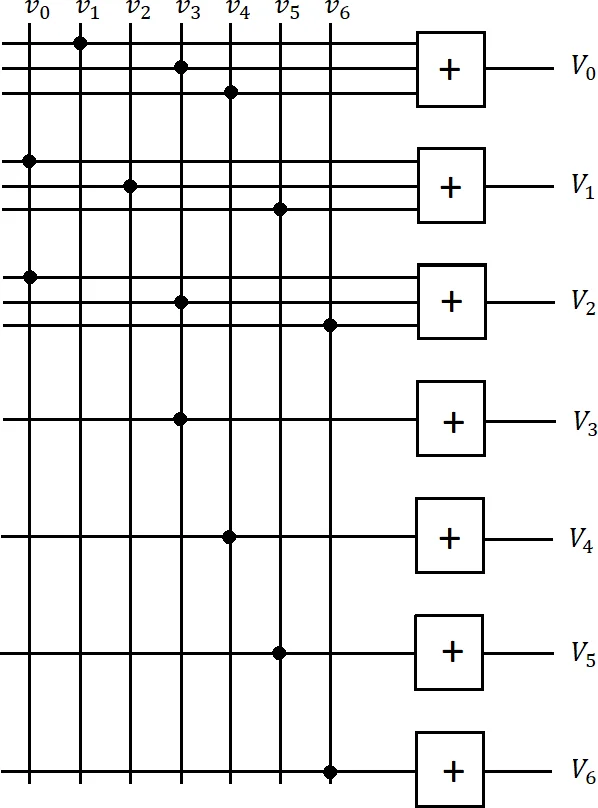
New number-theoretic transforms are derived from known linear block codes over finite fields. In particular, two new such transforms are built from perfect codes, namely the \textit {Hamming number-theoretic transform} and the \textit {Golay number-theoretic transform}. A few properties of these new transforms are presented.
💡 Research Summary
The paper introduces a novel class of number‑theoretic transforms (NTTs) that are directly derived from perfect linear block codes, specifically the Hamming and Golay codes. The authors start by observing that for any linear transformation T over a finite field GF(p), eigenvectors v satisfy (T − λI)v = 0. By reversing this relationship, they construct a transformation matrix T from a given code’s parity‑check matrix H. The construction proceeds by extending H to a square matrix Hₑ (by adding k rows, either zero rows or linear combinations of existing rows) and then adding λI, where λ is chosen (typically λ = 1) to ensure T is nonsingular. A transform defined in this way is called a “perfect transform” if the dimension k of its eigenvector subspace meets the sphere‑packing bound, i.e., k = N − logₚ(∑_{i=0}^{t}(p − 1)^{i}C(N,i)). This condition guarantees a one‑to‑one correspondence between the eigenvectors of T and the codewords of a perfect block code.
Two construction pathways are explored for the Hamming code. The first adds null rows to the parity‑check matrix of the binary (7, 4, 3) Hamming code, yielding a 7 × 7 matrix T(1)ₕₐₘₙₜ. Its eigenvector matrix coincides with the generator matrix of the Hamming code, confirming that all Hamming codewords are invariant under the transform. The second pathway uses the parity polynomial h(x) = x⁴ + x² + x + 1 to generate a circulant matrix by cyclically shifting h(x). Adding λI preserves the circulant structure, leading to the cyclic Hamming NTT (CHamNT). The authors formalize CHamNT as V = ˜T(λ)ₕₐₘ·v, where ˜T(λ)ₕₐₘ is built from the polynomial
Comments & Academic Discussion
Loading comments...
Leave a Comment