Close spatial arrangement of mutants favors and disfavors fixation
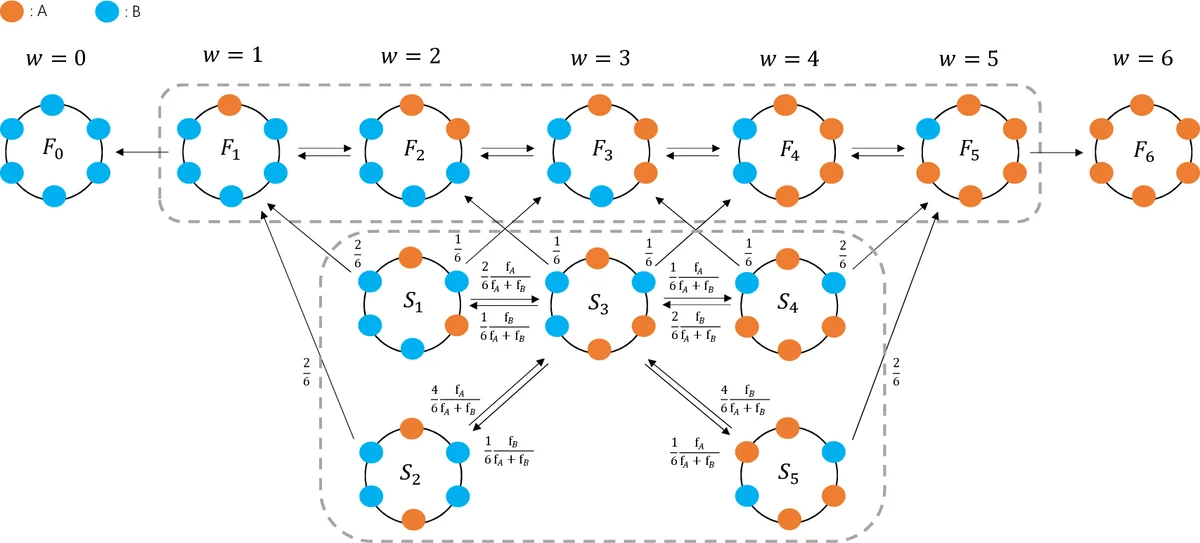
Cooperation is ubiquitous across all levels of biological systems ranging from microbial communities to human societies. It, however, seemingly contradicts the evolutionary theory, since cooperators are exploited by free-riders and thus are disfavored by natural selection. Many studies based on evolutionary game theory have tried to solve the puzzle and figure out the reason why cooperation exists and how it emerges. Network reciprocity is one of the mechanisms to promote cooperation, where nodes refer to individuals and links refer to social relationships. The spatial arrangement of mutant individuals, which refers to the clustering of mutants, plays a key role in network reciprocity. Besides, many other mechanisms supporting cooperation suggest that the clustering of mutants plays an important role in the expansion of mutants. However, the clustering of mutants and the game dynamics are typically coupled. It is still unclear how the clustering of mutants alone alters the evolutionary dynamics. To this end, we employ a minimal model with frequency independent fitness on a circle. It disentangles the clustering of mutants from game dynamics. The distance between two mutants on the circle is adopted as a natural indicator for the clustering of mutants or assortment. We find that the assortment is an amplifier of the selection for the connected mutants compared with the separated ones. Nevertheless, as mutants are separated, the more dispersed mutants are, the greater the chance of invasion is. It gives rise to the non-monotonic effect of clustering, which is counterintuitive. On the other hand, we find that less assortative mutants speed up fixation. Our model shows that the clustering of mutants plays a non-trivial role in fixation, which has emerged even if the game interaction is absent.
💡 Research Summary
The paper investigates how the spatial arrangement of mutant individuals influences their evolutionary fate when the only selective pressure is a frequency‑independent fitness difference, i.e., without any game‑theoretic interaction. The authors use a minimal model on a one‑dimensional ring (circle) where each node has exactly two neighbors. Two strategies exist: A (wild‑type) with fitness f_A and B (mutant) with fitness f_B; the fitness ratio is r = f_A / f_B. Evolution proceeds via a death‑birth (DB) process: in each step a random individual dies, and one of its two neighbors reproduces proportionally to its fitness, placing an offspring on the vacant site.
First, the authors analyze the simplest non‑trivial case with population size N = 6 and exactly two mutants. When the mutants are adjacent (distance d = 0), the state space collapses to a one‑dimensional Markov chain indexed by the number w of mutants. Transition probabilities P_{w,w±1} are derived analytically, leading to a closed‑form expression for the fixation probability π_w. For w = 2 the result is
π_2 = r³(1+3r) / (3 + 2r + 2r² + 2r³ + 3r⁴).
When r > 1 (mutants are advantageous) this probability is markedly larger than for a single mutant, showing that clustering (maximum assortment) amplifies selection. The conditional fixation time τ_A2 is also obtained analytically; it decreases as selection strengthens, confirming that clustered mutants not only fix more often but also faster.
Next, the authors consider separated mutants, i.e., initial distance d = 1 or d = 2 (one or two wild‑type individuals between the two mutants). In this situation the state space no longer forms a simple line. Instead it splits into a “middle” set S (two distinct mutant clusters) and a “final” set F (a single contiguous mutant cluster). The transition matrix can be written in block form
P = \
Comments & Academic Discussion
Loading comments...
Leave a Comment