The apparent roughness of a sand surface blown by wind from an analytical model of saltation
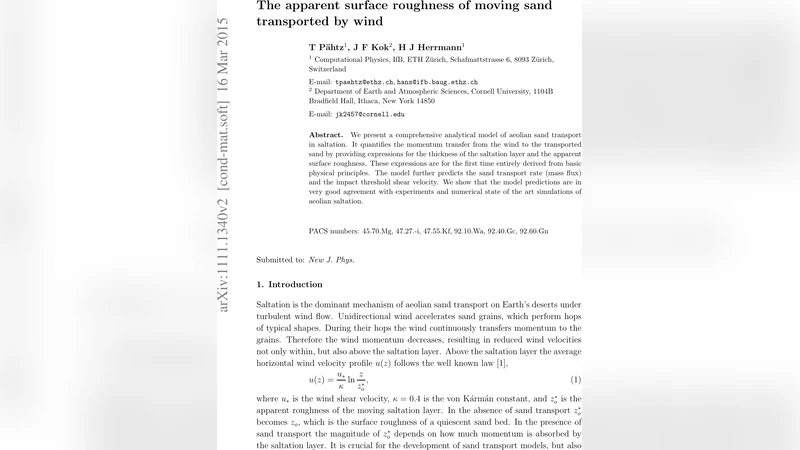
We present an analytical model of aeolian sand transport. The model quantifies the momentum transfer from the wind to the transported sand by providing expressions for the thickness of the saltation layer and the apparent surface roughness. These expressions are derived from basic physical principles and a small number of assumptions. The model further predicts the sand transport rate (mass flux) and the impact threshold (the smallest value of the wind shear velocity at which saltation can be sustained). We show that, in contrast to previous studies, the present model’s predictions are in very good agreement with a range of experiments, as well as with numerical simulations of aeolian saltation. Because of its physical basis, we anticipate that our model will find application in studies of aeolian sand transport on both Earth and Mars.
💡 Research Summary
This paper presents a fully analytical model for aeolian sand transport that predicts the apparent surface roughness (z*) and the thickness of the saltation layer (zₛ) from first‑principles. The authors start by reviewing earlier empirical relations—such as the Charney law (z* ∝ u²/g) and its modified version (z − z₀ ∝ (u* − uₜ)²/g)—and point out their shortcomings when compared with laboratory and field data, especially near the impact threshold uₜ.
The core of the new model is a force‑and‑work balance applied to the average motion of saltating grains. The grain‑shear‑stress profile τ_g(z) is assumed to decay exponentially with height, τ_g(z)=τ_g0 exp(−z/zₛ), an assumption that is supported by wind‑tunnel measurements of particle density and by recent numerical simulations (Kok & Renno). By separating each grain trajectory into an upward and a downward leg, the authors define average horizontal and vertical velocity differences Δv_x(z) and Δv_z(z), the vertical mass flux φ(z), and the corresponding horizontal (τ_g) and vertical (p_g) stress components.
Four dimensionless parameters are introduced:
- α – the ratio of average vertical to horizontal force per unit area,
- β – the ratio of average vertical to horizontal work rate per unit area,
- γ – the ratio between the decay height zₛ and an effective mean motion height z_m,
- η – the ratio linking the mean particle velocity (reduced by slip) to the mean wind velocity.
Through analytical integration of the force and work balances, the authors show that α, β, γ, and η are essentially independent of the shear velocity u* and of atmospheric conditions (air density, kinematic viscosity). They depend only weakly on the effective gravity ˜g and the grain diameter d.
The resulting expressions are:
Apparent roughness
z* = z₀ + (zₛ/α) ln
Comments & Academic Discussion
Loading comments...
Leave a Comment