First Steps Towards Full Model Based Motion Planning and Control of Quadrupeds: A Hybrid Zero Dynamics Approach
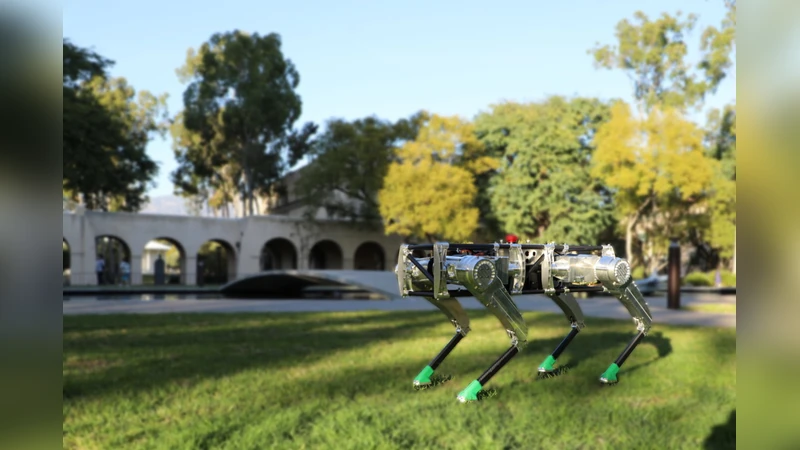
The hybrid zero dynamics (HZD) approach has become a powerful tool for the gait planning and control of bipedal robots. This paper aims to extend the HZD methods to address walking, ambling and trotting behaviors on a quadrupedal robot. We present a framework that systematically generates a wide range of optimal trajectories and then provably stabilizes them for the full-order, nonlinear and hybrid dynamical models of quadrupedal locomotion. The gait planning is addressed through a scalable nonlinear programming using direct collocation and HZD. The controller synthesis for the exponential stability is then achieved through the Poincar'e sections analysis. In particular, we employ an iterative optimization algorithm involving linear and bilinear matrix inequalities (LMIs and BMIs) to design HZD-based controllers that guarantee the exponential stability of the fixed points for the Poincar'e return map. The power of the framework is demonstrated through gait generation and HZD-based controller synthesis for an advanced quadruped robot, —Vision 60, with 36 state variables and 12 control inputs. The numerical simulations as well as real world experiments confirm the validity of the proposed framework.
💡 Research Summary
This paper extends the Hybrid Zero Dynamics (HZD) methodology—originally successful for bipedal locomotion—to the more complex domain of quadrupedal robots. The authors develop a comprehensive framework that simultaneously handles gait generation, trajectory optimization, and exponential stability verification for a full‑order, nonlinear, hybrid model of a quadruped.
The robot under study is the Vision 60 (36 state variables, 12 actuated joints). Its dynamics are modeled as a hybrid automaton with multiple continuous domains corresponding to different foot‑contact configurations (single, double, triple, and quadruple support). In each domain the Euler‑Lagrange equations are augmented with holonomic contact constraints, yielding constrained dynamics that are rewritten in control‑affine form ˙x = fᵥ(x) + gᵥ(x)u. A time‑based output y(q,t) = yₐ(q) – Bᵥ(t) is defined, and an input‑output feedback‑linearizing controller u_io = A⁻¹(L – 2εy – ε²ẏ) forces the output to follow the desired trajectory exponentially.
Discrete events are modeled as either lift‑off (contact force drops to zero) or impact (swing foot strikes the ground). Lift‑off is treated as an identity map, while impact uses a plastic‑collision model that introduces a velocity jump while satisfying the post‑impact holonomic constraints.
Gait generation is performed with the FR‑OST toolbox, which translates the hybrid control problem into a direct‑collocation nonlinear program (NLP). The cost function minimizes the squared joint torques, and constraints enforce closed‑loop dynamics, hybrid continuity/periodicity, and physical feasibility (joint limits, friction cones, foot clearance). By varying foot‑clearance constraints, the same optimization pipeline produces walking, ambling, and trotting gaits. Computation times on a standard laptop are 262 s (walk), 43 s (amble), and 116 s (trot).
Because the NLP does not guarantee stability, the authors apply a Poincaré‑section analysis to the resulting periodic orbit. They parameterize the output functions with a set of controller parameters ξ and express the discrete‑time return map Pₐ(xₐ, ξ). Exponential stability requires the eigenvalues of the Jacobian A(ξ) = ∂Pₐ/∂xₐ to lie inside the unit circle. To achieve this, a three‑step iterative algorithm is used: (1) first‑order sensitivity analysis to obtain a linear approximation of the return map, (2) formulation of a Bilinear Matrix Inequality (BMI) optimization problem that incorporates Linear Matrix Inequality (LMI) constraints for stability, and (3) iterative update of ξ until convergence. This BMI‑based controller synthesis yields a set of parameters that provably stabilize the gait.
Experimental validation is carried out on the Vision 60 platform. The authors implement the HZD‑based ambling controller and demonstrate stable, repeatable locomotion over several meters of real terrain. Measured joint trajectories, torques, and ground reaction forces match the simulated predictions, confirming the practical applicability of the full‑order HZD framework.
In summary, the paper delivers a self‑contained, model‑based pipeline that can generate, optimize, and stabilize a wide variety of quadrupedal gaits without resorting to model reduction. It showcases the feasibility of applying HZD to high‑dimensional hybrid systems, opens the door to more dynamic behaviors (e.g., galloping, jumping), and highlights future challenges such as reducing computational load, incorporating more realistic contact models, and extending the approach to even higher‑speed locomotion.
Comments & Academic Discussion
Loading comments...
Leave a Comment