Low-temperature marginal ferromagnetism explains anomalous scale-free correlations in natural flocks
We introduce a new ferromagnetic model capable of reproducing one of the most intriguing properties of collective behaviour in starling flocks, namely the fact that strong collective order of the system coexists with scale-free correlations of the modulus of the microscopic degrees of freedom, that is the birds’ speeds. The key idea of the new theory is that the single-particle potential needed to bound the modulus of the microscopic degrees of freedom around a finite value, is marginal, that is has zero curvature. We study the model by using mean-field approximation and Monte Carlo simulations in three dimensions, complemented by finite-size scaling analysis. While at the standard critical temperature, $T_c$, the properties of the marginal model are exactly the same as a normal ferromagnet with continuous symmetry-breaking, our results show that a novel zero-temperature critical point emerges, so that in its deeply ordered phase the marginal model develops divergent susceptibility and correlation length of the modulus of the microscopic degrees of freedom, in complete analogy with experimental data on natural flocks of starlings.
💡 Research Summary
The authors address a striking paradox observed in natural starling flocks: despite a very high degree of alignment (polarization close to unity), the fluctuations of the birds’ speeds (the modulus of the velocity vectors) exhibit scale‑free correlations, i.e. the correlation length grows with the size of the flock. In conventional O(n) ferromagnets, Goldstone modes guarantee scale‑free correlations for the direction of the order parameter, but the modulus remains massive because the single‑particle potential (the “Mexican‑hat”) has a non‑zero curvature in the radial direction. Consequently, standard flocking models based on a quadratic confinement of speeds cannot reproduce the observed speed‑scale‑free behavior.
To resolve this, the paper introduces a “marginal” ferromagnetic model in which the confining potential is quartic:
V(σ·σ)=λ(σ·σ−1)^4.
At the minimum σ·σ=1 this potential has zero second derivative not only transversely (as required by O(n) symmetry) but also longitudinally, making the radial mode marginal. The Hamiltonian also contains a standard ferromagnetic nearest‑neighbour coupling J and an optional external field h.
The authors first treat the model in mean‑field (fully connected) approximation. By introducing the magnetization m and performing a saddle‑point integration, they obtain the free‑energy density g(m). At T=0 the free‑energy minimum is flat (zero curvature), which leads to a divergent modulus susceptibility χ_mod∝1/(λ T). Raising the temperature adds an entropic contribution that generates a finite curvature (an effective mass) and suppresses χ_mod. At the usual critical temperature T_c the whole O(n) symmetry is restored and the model behaves like a standard ferromagnet, with a single diverging susceptibility.
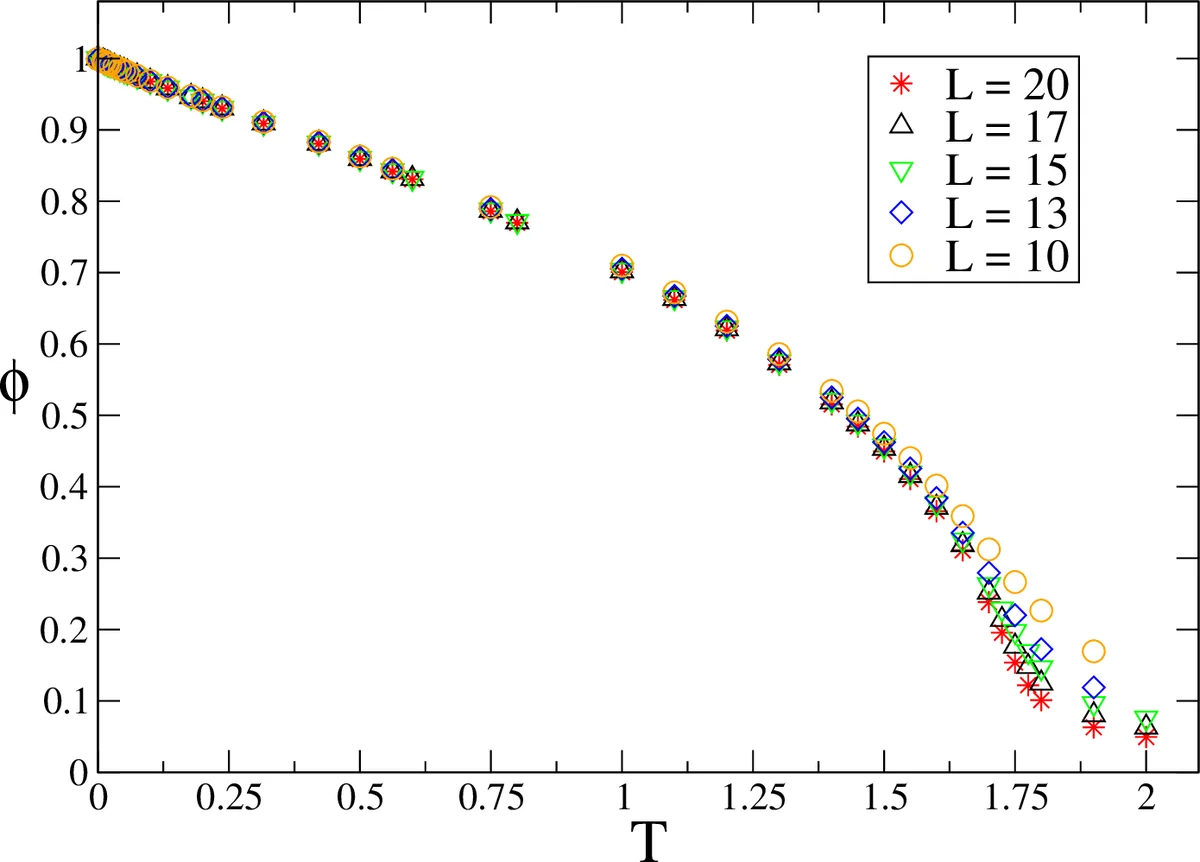
Monte‑Carlo simulations on a three‑dimensional cubic lattice (L^3, n=3) with nearest‑neighbour interactions confirm the mean‑field picture. Finite‑size scaling shows that at low temperature the correlation length of the speed fluctuations ξ_σ scales linearly with the system size L, and the modulus susceptibility grows as a power of L (≈L^2). In contrast, the standard quadratic potential yields a finite ξ_σ and no scale‑free speed correlations in the ordered phase.
These theoretical results match quantitative measurements on starling flocks, where the speed correlation length is comparable to the flock size while the polarization remains high. The marginal potential can be interpreted as a phenomenological description of the birds’ internal regulation of speed (balancing metabolic costs and aerodynamic constraints). Although the model assumes a static interaction network (equilibrium), the authors argue that the timescale for network rearrangement in real flocks is much longer than the relaxation time of velocities, justifying a quasi‑equilibrium treatment.
In summary, the paper demonstrates that a ferromagnetic model with a marginal (zero‑curvature) radial potential possesses a zero‑temperature critical point. This point produces divergent speed‑modulus susceptibility and scale‑free speed correlations even deep in the ordered phase, providing a natural explanation for the anomalous observations in natural starling flocks. The work extends the theoretical toolkit for collective behavior, suggesting that marginal modes beyond Goldstone’s theorem can play a crucial role in active, possibly non‑equilibrium, systems.
Comments & Academic Discussion
Loading comments...
Leave a Comment