What the F-measure doesnt measure: Features, Flaws, Fallacies and Fixes
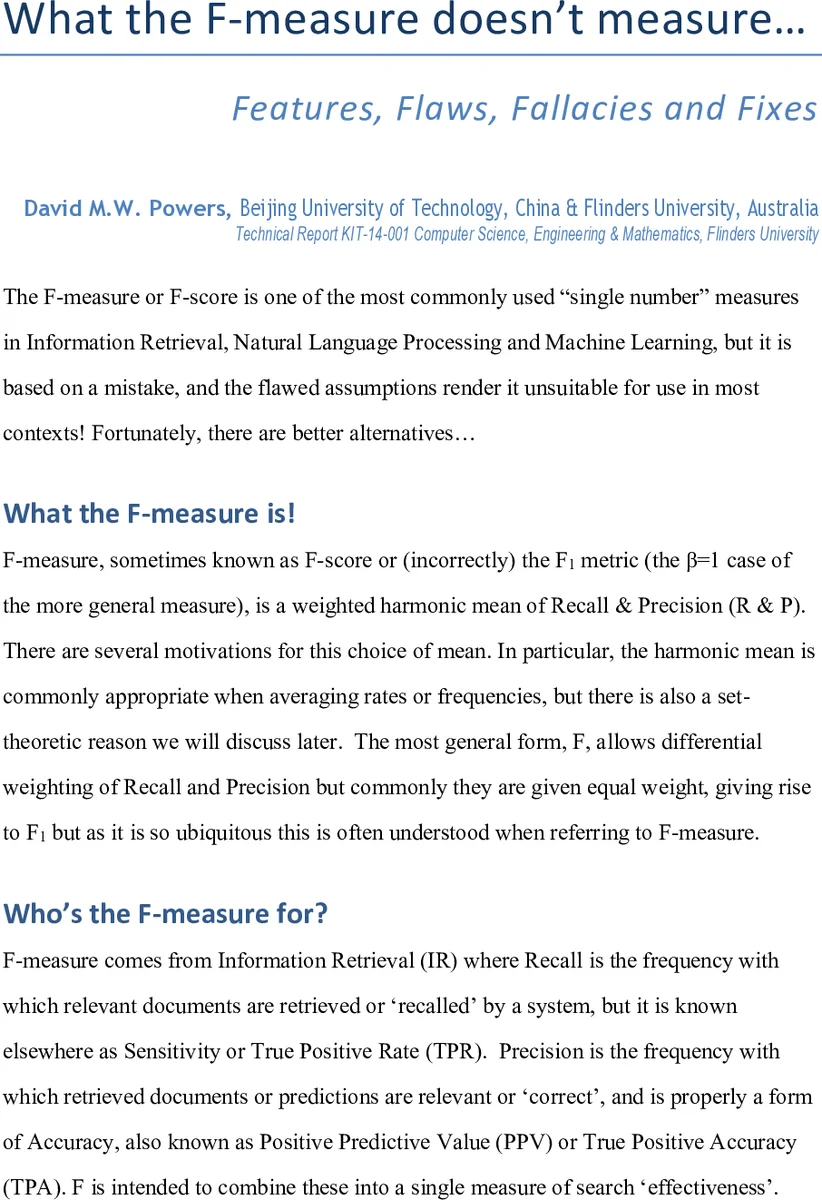
The F-measure or F-score is one of the most commonly used single number measures in Information Retrieval, Natural Language Processing and Machine Learning, but it is based on a mistake, and the flawed assumptions render it unsuitable for use in most contexts! Fortunately, there are better alternatives.
💡 Research Summary
The paper provides a thorough critique of the widely used F‑measure (or F‑score) in information retrieval, natural language processing, and machine learning. It begins by recalling that the F‑measure is the harmonic mean of Recall (True Positive Rate) and Precision (Positive Predictive Value) and notes that the β‑parameter allows weighting between the two, though the default β = 1 (F₁) dominates practice. The authors then systematically expose seven fundamental flaws. First, the metric is inherently single‑class: it ignores true negatives, so adding a large number of correctly classified negatives does not affect the score. Second, it is highly sensitive to the bias (the proportion of predicted positives) versus the prevalence (the true proportion of positives); when these differ, the F‑measure can be dramatically misleading. Third, the underlying assumption that the system’s predictions and the gold‑standard labels are drawn from the same distribution is false in most evaluation scenarios, making the F‑measure a measure of a fictitious “intermediate” distribution rather than actual performance. Fourth, the complementary error measure E = 1 − F fails to satisfy the triangle inequality, so it is not a true metric and leads to pathological behavior in clustering or visualization. Fifth, averaging across classes, queries, or runs is ambiguous; macro‑averaging with arbitrary weights yields values that do not correspond to any meaningful probability. Sixth, the metric does not incorporate true negatives, allowing a system to become arbitrarily worse (by misclassifying many negatives) without any penalty. Seventh, the optimal operating point for F‑measure often diverges from that of other loss functions, encouraging degenerate strategies such as always predicting the majority class.
To illustrate the bias problem, the authors discuss a tagging example where always labeling “water” as a noun yields 100 % Recall and 90 % Precision, achieving a high F‑score, while a more sophisticated model that correctly identifies occasional verb uses obtains a lower score. They argue that no choice of β can eliminate this bias because the harmonic mean always lies between the two extremes.
The paper then surveys alternatives that address these shortcomings. Mean Average Precision (MAP) and R‑Precision integrate performance over the entire Recall‑Precision curve, naturally handling varying bias points. ROC‑based measures such as Informedness or Youden’s J combine True Positive Rate and False Positive Rate, correcting for prevalence and bias. The G‑measure (geometric mean of Recall and Precision) offers a middle ground between arithmetic and harmonic means. Set‑theoretic distances like the Jaccard index satisfy metric properties and correctly weight the union of predicted and true sets.
In conclusion, while the F‑measure may still be useful in niche cases where only a single positive class matters, the authors argue that for most realistic evaluation tasks—especially those involving class imbalance, multiple classes, or the need for metric properties—researchers should adopt more robust alternatives such as MAP, R‑Precision, ROC‑Informedness, or Jaccard‑based distances. The paper calls for a shift away from the entrenched but flawed reliance on F‑measure toward metrics that faithfully reflect both positive and negative evidence and that support sound statistical interpretation.
Comments & Academic Discussion
Loading comments...
Leave a Comment