Robust random search with scale-free stochastic resetting
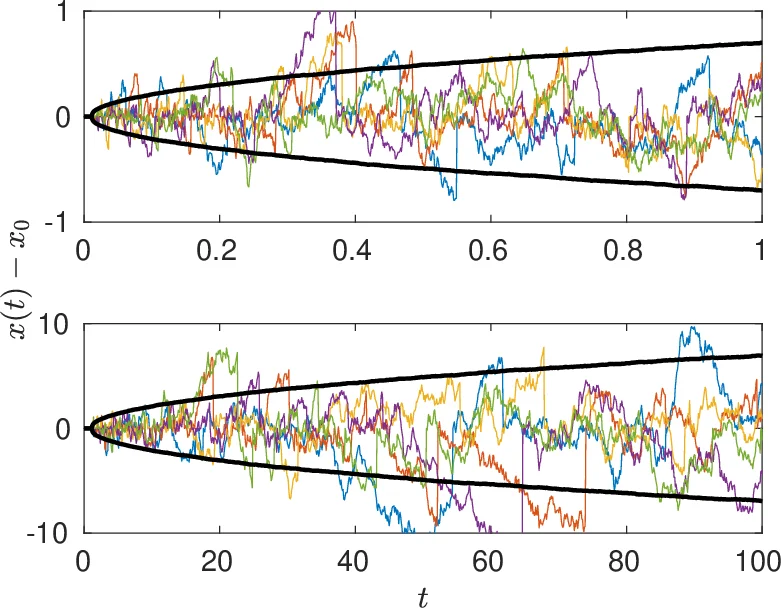
A new model of search based on stochastic resetting is introduced, wherein rate of resets depends explicitly on time elapsed since the beginning of the process. It is shown that rate inversely proportional to time leads to paradoxical diffusion which mixes self-similarity and linear growth of the mean square displacement with non-locality and non-Gaussian propagator. It is argued that such resetting protocol offers a general and efficient search-boosting method that does not need to be optimized with respect to the scale of the underlying search problem (e.g., distance to the goal) and is not very sensitive to other search parameters. Both subdiffusive and superdiffusive regimes of the mean squared displacement scaling are demonstrated with more general rate functions.
💡 Research Summary
This paper introduces a novel model of stochastic resetting for random search problems, where the resetting rate explicitly depends on the absolute time elapsed since the beginning of the process, rather than the time since the last reset. The authors term this “scale-free stochastic resetting,” with the primary focus on a rate function inversely proportional to time: r(t) = α/t, where α is a dimensionless parameter.
The core finding is that this specific form of time-dependent resetting leads to a “paradoxical diffusion” which blends properties of normal and anomalous transport. The process retains the self-similarity of free Brownian motion, resulting in a mean squared displacement (MSD) that grows linearly in time: ⟨(x(t)-x0)²⟩ = 2Dt/(1+α). However, the spatial propagator is non-Gaussian and exhibits a cusp at the resetting position x0, reflecting a mixture of local diffusion and non-local resetting jumps. The authors generalize the rate to r(t) = α/t^μ, showing that it can model subdiffusive (μ<1) or superdiffusive (μ>1) scaling of the MSD at appropriate time scales, offering a versatile tool for modeling anomalous transport phenomena.
A major application and strength of this protocol is in boosting search efficiency. The paper provides a general theoretical framework to analyze the completion time statistics (e.g., first passage times) of an arbitrary underlying search process when subjected to scale-free resetting. Using renewal theory and Laplace transforms, they derive a general expression for the mean completion time (MCT) with resetting, given the Laplace transform of the reset-free completion time density.
Applying this framework to one-dimensional diffusion toward a single target, they demonstrate that while diffusion alone has an infinite mean first passage time (MFPT), scale-free resetting with α > 1/2 renders it finite. Crucially, the MCT can be optimized by tuning α, and the optimal value α* ≈ 3.5 is independent of the intrinsic time scale of the problem (τ_diff = x0²/D). This stands in stark contrast to standard constant-rate resetting, where the optimal rate r* is highly sensitive to the distance to the target (r* ∝ 1/x0²). Therefore, the scale-free protocol is “robust”: it does not require prior knowledge of the problem’s scale (like the target distance) for effective optimization. The search agent can use a near-universal α setting (around 3.5) for efficient performance across different problem scales.
The paper also briefly explores other scenarios, like search processes with a possibility of failure, to illustrate the protocol’s behavior under different conditions. In summary, scale-free stochastic resetting presents a powerful, robust method for enhancing random search efficiency and a rich, analytically tractable model system exhibiting a unique blend of normal scaling and non-Gaussian, non-local dynamics.
Comments & Academic Discussion
Loading comments...
Leave a Comment