Symplectic Reduction and the Lie--Poisson Shape Dynamics of $N$ Point Vortices on the Plane
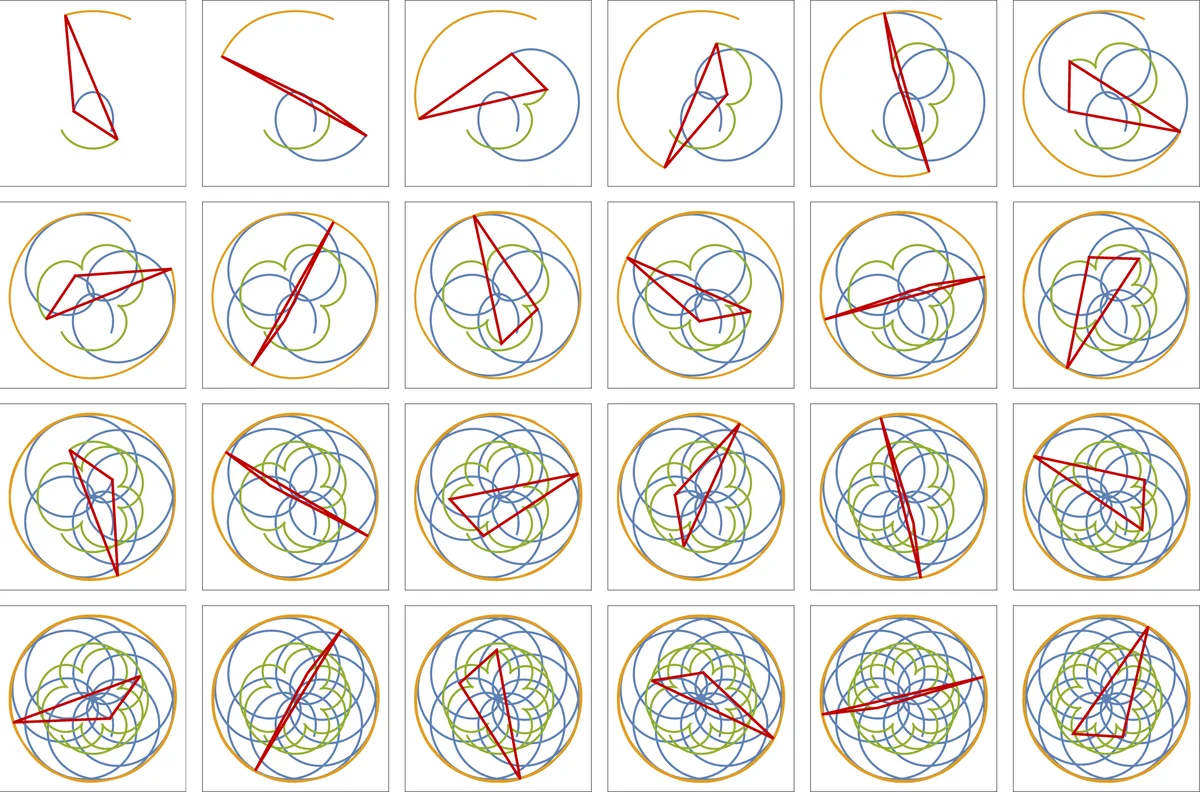
We show that the symplectic reduction of the dynamics of $N$ point vortices on the plane by the special Euclidean group $\mathsf{SE}(2)$ yields a Lie–Poisson equation for relative configurations of the vortices. Specifically, we combine symplectic reduction by stages with a dual pair associated with the reduction by rotations to show that the $\mathsf{SE}(2)$-reduced space with non-zero angular impulse is a coadjoint orbit. This result complements some existing works by establishing a relationship between the symplectic/Hamiltonian structures of the original and reduced dynamics. We also find a family of Casimirs associated with the Lie–Poisson structure including some apparently new ones. We demonstrate through examples that one may exploit these Casimirs to show that some shape dynamics are periodic.
💡 Research Summary
The paper investigates the Hamiltonian dynamics of N point vortices on the plane and shows how the symmetry under the special Euclidean group SE(2) = SO(2)⋉ℝ² can be exploited to obtain a reduced description that is naturally a Lie–Poisson system on a coadjoint orbit. The authors adopt a reduction‑by‑stages approach: first they reduce by the translational subgroup ℝ², then by the rotational subgroup SO(2).
For the translational reduction they introduce the linear impulse momentum map I(q)=−i∑{j=1}^N Γ_j q_j. When the total circulation Γ=∑Γ_j is non‑zero, I is non‑equivariant, so a non‑equivariant Marsden–Weinstein reduction is performed. The level set I^{-1}(−ic) is an affine subspace that is itself symplectic; after shifting the origin it can be identified with the subspace {∑Γ_j q_j =0}. Using relative coordinates z_j = q_j−q_N (j=1,…,N−1) they obtain an explicit symplectic form Ω_Z = –dΘ_Z with Θ_Z = ½ Im(z* K dz), where K is an (N−1)×(N−1) matrix built from the circulations. If Γ=0, I is equivariant and the ℝ²‑action is coisotropic; the reduced space becomes a complex vector space of dimension N‑2 with a similar symplectic form Ω{Z0}.
Next they reduce by rotations. The angular impulse J(q)=½∑Γ_j|q_j|² serves as the momentum map for the SO(2)‑action. For non‑zero angular impulse μ, the level set J^{-1}(μ) is a coadjoint orbit of the Lie algebra u(p,q), where p (resp. q) counts the number of positive (resp. negative) circulations. The authors exhibit a dual pair (I,J) that links the translational and rotational reductions, allowing them to identify the final reduced phase space with the dual of u(p,q) equipped with its canonical Lie–Poisson bracket. Consequently the reduced dynamics satisfy the Lie–Poisson equation
\dot ξ = ad*{∂H_red/∂ξ} ξ,
where ξ encodes the relative distances l{ij}=|q_i−q_j| and the signed area A of the vortex configuration.
The Lie–Poisson structure automatically yields Casimir invariants. Besides the well‑known invariants (total circulation, linear impulse, angular impulse), the authors derive a new family of Casimirs, notably the quantity C₂ given in equation (7). C₂ is a homogeneous quartic expression in the inter‑vortex distances together with a term proportional to A², and it depends on the circulations through the matrix K. These Casimirs define invariant leaves on which the reduced flow lives.
The paper illustrates the theory with two concrete examples. For three vortices with Γ₁+Γ₂+Γ₃=0, the Casimirs (including C₂) restrict the motion to a two‑dimensional torus, implying that the shape dynamics (evolution of the triangle formed by the vortices) is periodic even though the individual vortex trajectories are not exactly periodic. Numerical simulations (Figures 1–2) confirm that the triangle repeatedly returns to a congruent shape. A second example with four vortices and total circulation zero shows a similar phenomenon: the quadrilateral formed by the vortices evolves periodically in shape while the whole configuration drifts in the plane.
The main contributions are: (i) a rigorous derivation of the Lie–Poisson structure on the SE(2)‑reduced space via reduction‑by‑stages, clarifying how the original symplectic form descends to the coadjoint orbit; (ii) a unified treatment of the cases Γ≠0 and Γ=0, including the handling of non‑equivariant momentum maps; (iii) the identification of new Casimir invariants and their use in proving periodicity of shape dynamics; (iv) a geometric reinterpretation of earlier algebraic results on the “vortex algebra” as a manifestation of the underlying symplectic reduction and dual pair.
Overall, the work bridges the gap between the classical point‑vortex literature and modern geometric mechanics, providing a clean, conceptually transparent framework for analyzing relative motions of vortices and opening avenues for further study of integrability, stability, and numerical schemes based on the Lie–Poisson structure.
Comments & Academic Discussion
Loading comments...
Leave a Comment