Nonsymmetric Reduction-based Algebraic Multigrid
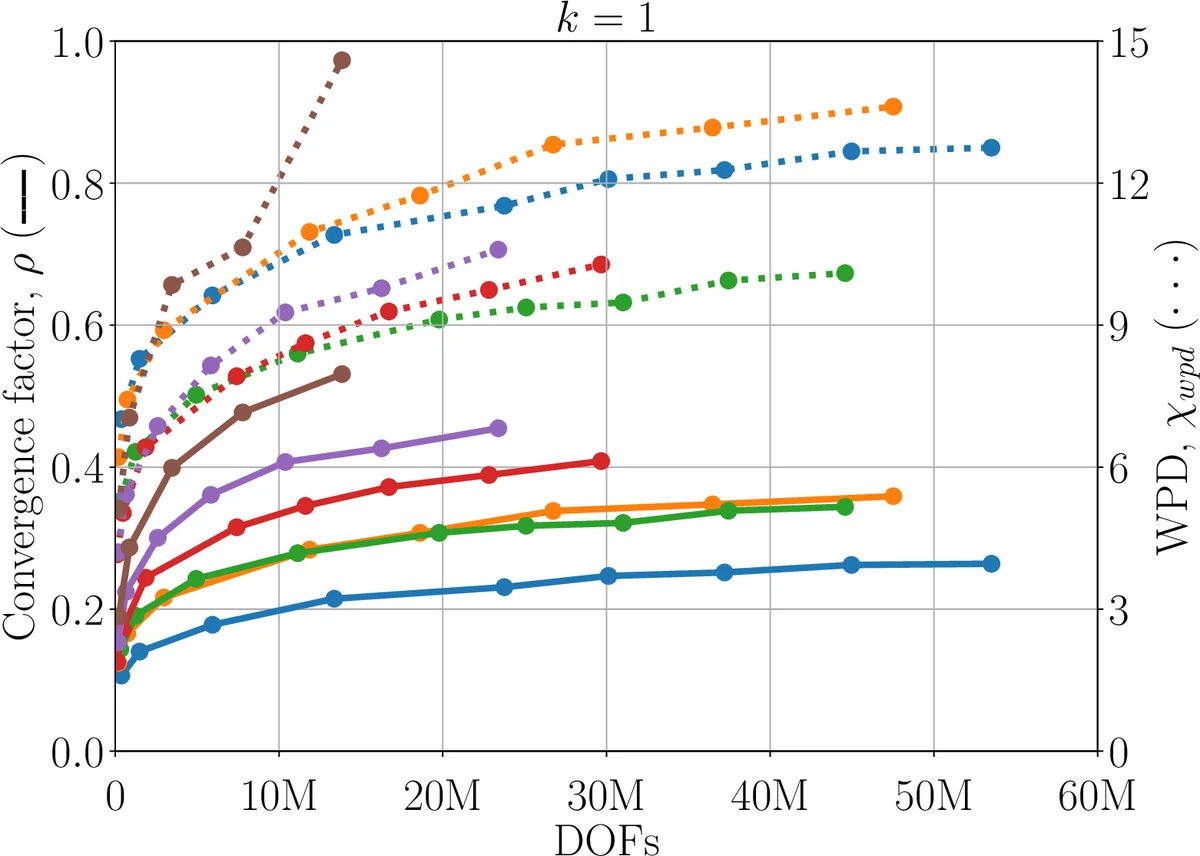
Algebraic multigrid (AMG) is often an effective solver for symmetric positive definite (SPD) linear systems resulting from the discretization of general elliptic PDEs, or the spatial discretization of parabolic PDEs. However, convergence theory and most variations of AMG rely on $A$ being SPD. Hyperbolic PDEs, which arise often in large-scale scientific simulations, remain a challenge for AMG, as well as other fast linear solvers, in part because the resulting linear systems are often highly nonsymmetric. Here, a novel convergence framework is developed for nonsymmetric, reduction-based AMG, and sufficient conditions derived for $\ell^2$-convergence of error and residual. In particular, classical multigrid approximation properties are connected with reduction-based measures to develop a robust framework for nonsymmetric, reduction-based AMG. Matrices with block-triangular structure are then recognized as being amenable to reduction-type algorithms, and a reduction-based AMG method is developed for upwind discretizations of hyperbolic PDEs, based on the concept of a Neumann approximation to ideal restriction ($n$AIR). $n$AIR can be seen as a variation of local AIR ($\ell$AIR) introduced in previous work, specifically targeting matrices with triangular structure. Although less versatile than $\ell$AIR, setup times for $n$AIR can be substantially faster for problems with high connectivity. $n$AIR is shown to be an effective and scalable solver of steady state transport for discontinuous, upwind discretizations, with unstructured meshes, and up to 6th-order finite elements, offering a significant improvement over existing AMG methods. $n$AIR is also shown to be effective on several classes of `nearly triangular’ matrices, resulting from curvilinear finite elements and artificial diffusion.
💡 Research Summary
The paper addresses a long‑standing gap in algebraic multigrid (AMG) theory: the lack of robust, scalable solvers for highly nonsymmetric linear systems, especially those arising from upwind discretizations of hyperbolic partial differential equations (PDEs). Classical AMG is built on the assumption that the matrix is symmetric positive definite (SPD); its convergence proofs and most practical implementations rely on this property. When the matrix is nonsymmetric, coarse‑grid correction may no longer be a contraction, leading to divergence or extremely slow convergence.
To overcome this, the authors develop a reduction‑based AMG framework. They start by partitioning the unknowns into coarse (C) and fine (F) sets and write the system matrix in block form. Using a block LDU factorization, they define the ideal restriction operator (R_{\text{ideal}} =
Comments & Academic Discussion
Loading comments...
Leave a Comment