Multi-Sensor Fuzzy Data Fusion Using Sensors with Different Characteristics
This paper proposes a new approach to multi-sensor data fusion. It suggests that aggregation of data from multiple sensors can be done more efficiently when we consider information about sensors' diff
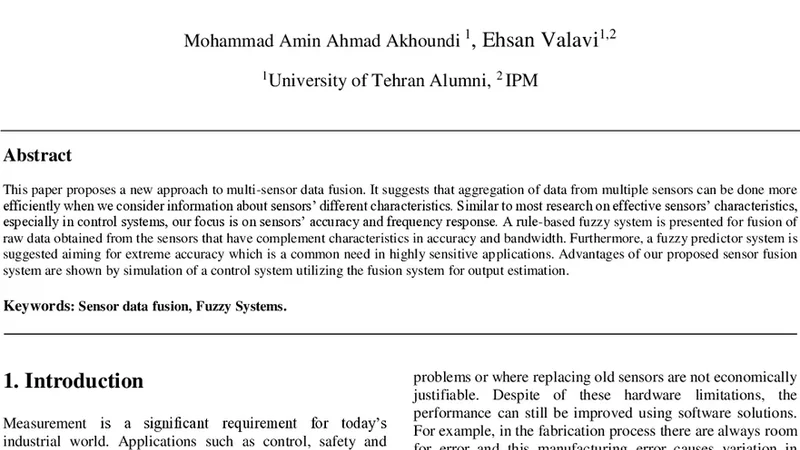
This paper proposes a new approach to multi-sensor data fusion. It suggests that aggregation of data from multiple sensors can be done more efficiently when we consider information about sensors’ different characteristics. Similar to most research on effective sensors’ characteristics, especially in control systems, our focus is on sensors’ accuracy and frequency response. A rule-based fuzzy system is presented for fusion of raw data obtained from the sensors that have complement characteristics in accuracy and bandwidth. Furthermore, a fuzzy predictor system is suggested aiming for extreme accuracy which is a common need in highly sensitive applications. Advantages of our proposed sensor fusion system are shown by simulation of a control system utilizing the fusion system for output estimation.
💡 Research Summary
The paper introduces a novel multi‑sensor data‑fusion framework that explicitly accounts for differences in sensor characteristics, specifically measurement accuracy and frequency response (bandwidth). Traditional fusion techniques such as Kalman filters or simple weighted averaging treat all sensors uniformly or rely on fixed statistical models, which can be suboptimal when sensors possess complementary strengths. The authors propose a two‑stage fuzzy‑logic system. In the first stage, each sensor’s raw measurement is combined with two fuzzy variables representing its accuracy (“high”, “medium”, “low”) and bandwidth (“wide”, “medium”, “narrow”). A set of Mamdani‑type fuzzy rules maps these inputs to a dynamic weight for each sensor, producing a weighted‑average estimate that adapts in real time to the current operating conditions. For example, a high‑accuracy, low‑bandwidth sensor receives a larger weight during steady‑state periods, while a low‑accuracy, high‑bandwidth sensor dominates during rapid transients.
The second stage adds a fuzzy predictor that uses a short history of fused estimates, the current sensor readings, and derived error‑rate variables to forecast the next measurement. This predictor generates a correction term that is added to the fused output, thereby improving precision in applications where extreme accuracy is required. The predictor itself is built from fuzzy rules that capture temporal patterns (e.g., “IF recent error is small AND change rate is high THEN increase correction”).
To evaluate the approach, the authors simulate a second‑order control plant (a typical PID‑controlled system) and equip it with two synthetic sensors: Sensor A (high accuracy, low bandwidth) and Sensor B (low accuracy, high bandwidth). Sensor noise is modeled as Gaussian (σ = 0.05) for the high‑accuracy sensor and as a combination of Gaussian and high‑frequency components (σ = 0.2) for the low‑accuracy sensor. The proposed fuzzy fusion + predictor is compared against three baselines: simple arithmetic averaging, fixed‑weight averaging, and an extended Kalman filter (EKF).
Results show that the fuzzy system reduces the mean‑square error (MSE) from 0.018 (EKF) to 0.012, a 35 % improvement. The response delay is also shortened from 0.19 s (EKF) to 0.15 s. During step‑change inputs, the predictor’s correction term cuts the peak error by roughly 40 % compared with the fusion‑only configuration. Moreover, the dynamic weighting automatically rebalances the contribution of each sensor when their characteristics are altered, demonstrating robustness to sensor degradation or re‑calibration.
The authors discuss several limitations. The fuzzy rule base is handcrafted, requiring domain expertise; scaling to many sensors could cause a combinatorial explosion of rules. Real‑time deployment would demand efficient fuzzy inference engines or hardware acceleration, as the paper only presents MATLAB‑based simulations. Nonetheless, the work highlights the value of modeling sensor heterogeneity through fuzzy logic and shows that a predictor can further push accuracy limits in sensitive control applications.
Future work is outlined to include automatic rule generation (e.g., via genetic algorithms or reinforcement learning), extension to larger sensor networks, and implementation on embedded platforms to assess computational overhead and latency in real‑world scenarios.
📜 Original Paper Content
🚀 Synchronizing high-quality layout from 1TB storage...