Detection of delayed target response in SAR
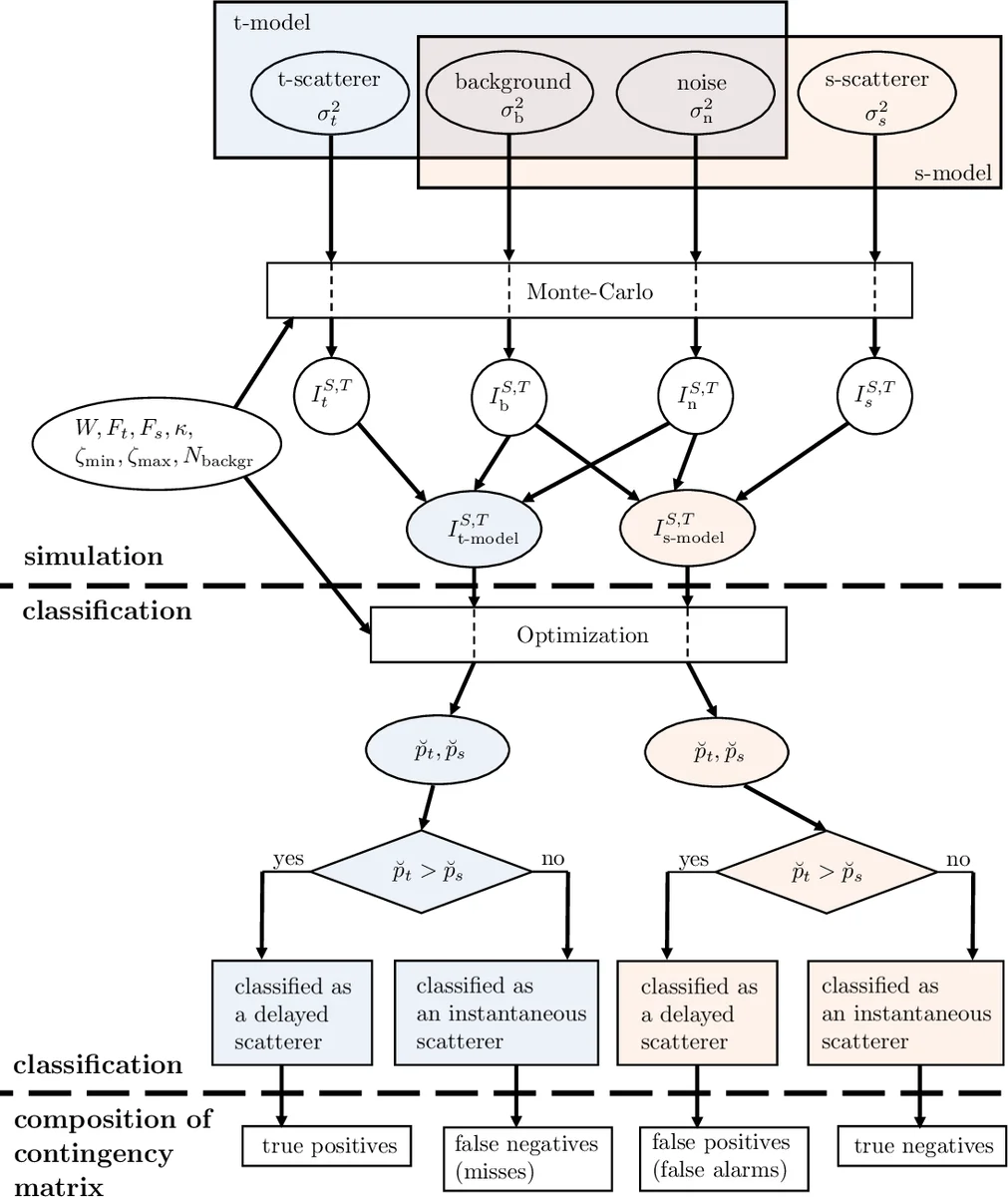
Delayed target response in synthetic aperture radar (SAR) imaging can be obscured by the range-delay ambiguity and speckle. To analyze the range-delay ambiguity, one extends the standard SAR formulation and allows both the target reflectivity and the image to depend not only on the coordinates, but also on the response delay. However, this still leaves the speckle unaccounted for. Yet speckle is commonly found in SAR images of extended targets, and a statistical approach is usually employed to describe it. We have developed a simple model of a delayed scatterer by modifying the random function that describes a homogeneous extended scatterer. Our model allows us to obtain a relation between the deterministic parameters of the target model and statistical moments of the SAR image. We assume a regular shape of the antenna trajectory, and our model targets are localized in at least one space-time coordinate; this permits analytical formulation for statistical moments of the image. The problem of reconstruction of coordinate-delay reflectivity function is reduced to that of discrimination between instantaneous and delayed scatterers; for the latter problem, the maximum likelihood based image processing procedure has been developed. We perform Monte-Carlo simulation and evaluate performance of the classification procedure for a simple dependence of scatterer reflectivity on the delay time.
💡 Research Summary
**
The paper addresses the problem of detecting targets that exhibit a delayed radar response in synthetic aperture radar (SAR) imagery, a task made difficult by two well‑known phenomena: range‑delay ambiguity and speckle noise. Traditional SAR processing assumes that the target reflectivity is instantaneous, i.e., the scattered signal arrives exactly when the transmitted pulse reaches the target. When a target introduces an internal delay—because of material composition, cavity structures, or other physical mechanisms—this assumption fails, and the delayed return can be confused with an instantaneous return from a more distant point, producing streaks in the range direction. Moreover, speckle, the granular noise arising from coherent summation of many scatterers, masks subtle intensity variations that would otherwise betray a delayed response.
1. Extension of the SAR model
The authors begin by generalising the reflectivity function from a spatial-only quantity ν_inst(z) to a space‑time function ν(t_z, z). Using the first‑Born approximation, the scattered field is expressed as a time convolution of the incident field with ν(t_z, z). An instantaneous scatterer corresponds to ν(t_z, z)=ν_inst(z)δ(t_z), while a delayed scatterer is modelled as ν(t_z, z)=ν_del(z)δ(t_z−τ(z)), where τ(z) is the physical delay associated with the point z. This formulation makes explicit that the received signal u_sx(t) depends on a two‑dimensional function of (t_z, z), yet the measurement provides only a one‑dimensional time series, leading to a non‑unique inversion—precisely the range‑delay ambiguity.
2. Coordinate‑delay imaging operator
To resolve the ambiguity, the paper introduces a coordinate‑delay imaging operator. For each antenna position x(φ) along a circular arc (parameterised by the aspect angle φ), a matched‑filter is applied to the received signal, yielding a single‑pulse image I_x(t_y, y). Summing over many pulses (dense φ sampling) produces a composite image I(t_y, y) that can be written as a double integral of ν(t_z, z) against a kernel W(t_y, y; t_z, z). The kernel incorporates the transmitted chirp waveform (carrier ω₀, chirp rate α), the geometry (range R, incidence angle θ), and the angular aperture φ_T. By expanding the geometric term T_φ in a Taylor series about φ=0, the authors analyse three regimes:
- Zero‑order (cos φ≈1, sin φ≈0): the kernel loses dependence on cross‑range, eliminating azimuthal resolution.
- First‑order (sin φ≈φ): cross‑range resolution appears, but the kernel still collapses onto the line t_y+2R_y/c = t_z+2R_z/c, leaving the range‑delay ambiguity unresolved.
- Second‑order terms introduce a genuine φ‑dependence that separates the (t_z, z) variables, allowing simultaneous reconstruction of delay and spatial coordinates provided the synthetic aperture is sufficiently wide (φ_T large enough).
3. Statistical model of speckle and delayed scatterers
Speckle is modelled as a homogeneous, delta‑correlated complex Gaussian field η(z). The total reflectivity is expressed as the sum of this random background and a deterministic delayed component s(t_z, z). Consequently, each image pixel I(t_y, y) becomes a complex random variable whose statistical moments (mean, variance, higher‑order cumulants) can be derived analytically. The key insight is that the second‑order moment (variance) differs between a purely instantaneous scene and one containing a delayed scatterer, because the delayed component contributes an additional deterministic term that does not average out over the speckle ensemble.
4. Maximum‑likelihood discrimination
Based on the derived moments, the authors formulate a binary hypothesis test:
- H₀: only instantaneous scatterers (no delay).
- H₁: presence of a delayed scatterer with known deterministic profile. The likelihood functions under each hypothesis are Gaussian (owing to the central limit theorem for the sum of many speckle contributions). The log‑likelihood ratio reduces to a quadratic form involving the observed pixel values and the known deterministic template. An optimal threshold is chosen to minimise the probability of error, yielding a maximum‑likelihood (ML) classifier that decides whether a given region contains a delayed response.
5. Monte‑Carlo validation
The paper validates the theory through extensive Monte‑Carlo simulations. A simple linear delay model τ(z)=τ₀+κ·z₂ is used, with τ₀ ranging from 0 to 2 µs. Three synthetic aperture widths are examined: φ_T = 30°, 60°, 90°. Signal‑to‑noise ratios (SNR) of 10 dB and 20 dB are simulated to emulate different speckle intensities. For each configuration, 10⁴ independent realizations are generated, the ML classifier is applied, and the false‑positive/false‑negative rates are recorded. Results show a sharp performance improvement when φ_T exceeds roughly 60°, confirming the analytical prediction that second‑order angular terms are needed to break the range‑delay ambiguity. Higher SNR further reduces misclassification, as expected.
6. Discussion of practical implications and limitations
The authors discuss several practical considerations:
- Aperture size: Wide angular coverage is essential; platforms with limited maneuverability may not achieve the required φ_T, limiting applicability.
- Start‑stop approximation: The derivation assumes negligible platform motion during each pulse; this holds for typical SAR pulse durations but may break down for ultra‑wideband or high‑speed platforms.
- Model fidelity: Real targets may exhibit multiple or distributed delays, non‑linear τ(z), or frequency‑dependent scattering, which are not captured by the single‑parameter delayed model used here. Extending the framework to multi‑parameter or multi‑frequency models would be a natural next step.
- Computational load: The ML classifier requires evaluation of the likelihood over the entire image, which can be computationally intensive for large scenes; however, the authors note that the operation can be parallelised and that only regions of interest need full evaluation.
7. Conclusions
The paper makes three principal contributions: (i) a rigorous extension of SAR imaging theory to include time‑delayed reflectivity, (ii) an analytical treatment of the coordinate‑delay imaging kernel that clarifies the role of synthetic aperture width in resolving range‑delay ambiguity, and (iii) a statistically grounded maximum‑likelihood detection scheme that successfully discriminates delayed scatterers from instantaneous background despite speckle. Monte‑Carlo experiments confirm that, with a sufficiently wide aperture and reasonable SNR, the proposed method can reliably detect delayed responses, opening the door to improved SAR‑based surveillance of complex structures such as underground facilities, composite materials, or cluttered urban environments.
Comments & Academic Discussion
Loading comments...
Leave a Comment