A Computational Complexity-Theoretic Elaboration of Weak Truth-Table Reducibility
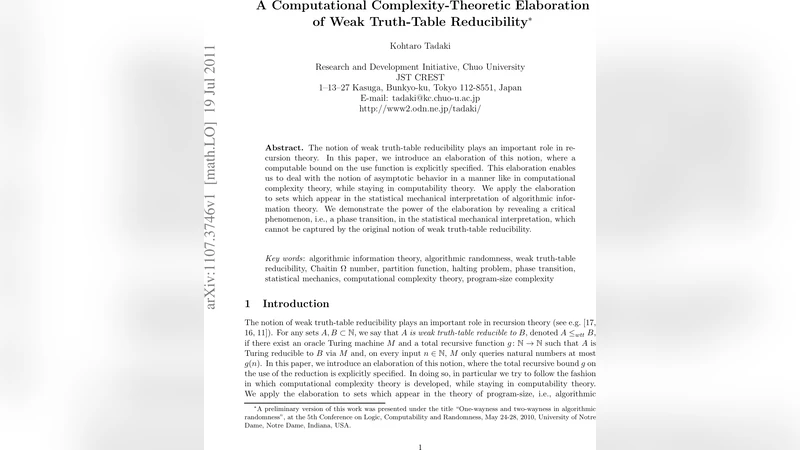
The notion of weak truth-table reducibility plays an important role in recursion theory. In this paper, we introduce an elaboration of this notion, where a computable bound on the use function is explicitly specified. This elaboration enables us to deal with the notion of asymptotic behavior in a manner like in computational complexity theory, while staying in computability theory. We apply the elaboration to sets which appear in the statistical mechanical interpretation of algorithmic information theory. We demonstrate the power of the elaboration by revealing a critical phenomenon, i.e., a phase transition, in the statistical mechanical interpretation, which cannot be captured by the original notion of weak truth-table reducibility.
💡 Research Summary
**
The paper introduces a refined notion of weak truth‑table reducibility by explicitly bounding the use function of a reduction. In the classical setting, a set A is weak truth‑table reducible to a set B (A ≤_wtt B) if there exists a Turing machine M and a total recursive function g such that, on any input n, M queries the oracle B only on numbers ≤ g(n). The function g is unrestricted beyond being total recursive, so the definition does not capture any asymptotic resource constraints.
To bridge this gap, the authors define reducibility in query size f: for a computable function f : ℕ→ℕ, A is reducible to B in query size f if there is a deterministic oracle Turing machine M that (i) computes A from B, and (ii) for every binary input x, all oracle queries made by M have length at most f(|x|). The bound depends solely on the input length, mirroring the way time‑ or space‑complexity bounds are expressed in computational complexity theory.
With this definition the paper distinguishes two new relational properties:
- Unidirectionality – A → B is possible for some computable f, but B → A is impossible for any computable f.
- Bidirectionality – Both directions are possible, each with some computable bound f.
The authors then apply this framework to central objects of algorithmic information theory (AIT): Chaitin’s halting probability Ω, its generalised partition‑function‑like analogue Z(T), and the halting set dom U of an optimal prefix‑free machine U.
Ω versus dom U
Earlier work (Chaitin; Calude‑Nies) showed that Ω and dom U are weak‑truth‑table equivalent. The new analysis reveals a finer structure:
- Theorem 4.1 proves that any reduction Ω → dom U must satisfy f(n) ≥ n + O(1). In other words, to decide the n‑th bit of Ω one needs to ask queries of length at least n.
- Theorem 4.2 gives the symmetric lower bound for dom U → Ω.
- Theorem 4.3 combines these to show that the reductions are unidirectional in both directions: each direction is possible, but neither can be performed with a sub‑linear query bound. Consequently, Ω ↔ dom U is not bidirectional under the query‑size restriction, a nuance invisible to the plain weak‑truth‑table equivalence.
Generalised Ω: Z(T)
For a computable real T with 0 < T ≤ 1, define
Z(T) = ∑_{p∈dom U} 2^{-|p|/T}.
When T = 1, Z(1) = Ω. In previous work the authors showed that Z(T) behaves like a statistical‑mechanical partition function: its value is computable exactly when the “partial randomness” of Z(T) equals T, and the associated thermodynamic quantities (free energy, entropy, etc.) inherit this randomness level.
The new theorems explore reductions involving Z(T):
- Theorem 6.1 states that Z(T) → dom U is possible iff there exists a computable f with f(n) ≥ ⌈T·n⌉ + O(1).
- Theorem 6.2 gives the converse direction with the same bound.
- Theorem 6.3 concludes that for any computable T < 1, the reductions are bidirectional: both Z(T) and dom U can be computed from each other using a linear query bound whose slope is T (strictly less than 1).
Thus, as T drops below 1, the required query size shrinks proportionally, whereas at T = 1 the bound reverts to the full linear size needed for Ω. This sharp change constitutes a phase transition in the computational sense: the “resource‑complexity landscape” of the reduction flips from unidirectional (at the critical temperature T = 1) to bidirectional (for any lower temperature).
Statistical‑mechanical interpretation
The paper revisits the statistical‑mechanical analogy introduced in earlier works. By replacing the set of physical microstates with dom U, the energy of a state with the program length |p|, and the Boltzmann constant with 1/ln 2, the classical partition function Z_sm(T) becomes exactly Z(T). For T > 1 the series diverges, mirroring a physical system’s transition to a high‑energy phase. The present analysis shows that this divergence also corresponds to a breakdown of bidirectional reducibility: once T exceeds the critical value, the query‑size bound required for a reduction becomes super‑linear, making the reduction infeasible under any computable f.
Conversely, for T < 1 the system is in a “low‑temperature” phase where information is highly compressible; the reduction can be performed with a modest linear bound, reflecting the higher degree of algorithmic regularity (partial randomness equals T). The authors argue that this computational phase transition is a precise analogue of thermodynamic phase changes, but now expressed in terms of asymptotic query‑size constraints.
Structure of the paper
- Section 2 supplies the necessary preliminaries on AIT, Kolmogorov complexity, and partial randomness.
- Section 3 formalises reducibility in query size f, proves basic closure properties, and introduces the notions of unidirectionality and bidirectionality.
- Section 4 applies the framework to Ω and dom U, establishing the unidirectional nature of their relationship.
- Section 5 develops auxiliary lemmas (e.g., coding theorems for prefix‑free machines) that are later used to prove bidirectional results.
- Section 6 treats the generalised Ω, Z(T), proving Theorems 6.1–6.3 and highlighting the temperature‑dependent phase transition.
- Section 7 concludes with a discussion of the implications for the statistical‑mechanical interpretation of AIT, and suggests future directions such as exploring other thermodynamic quantities (free energy, specific heat) under the query‑size lens.
Significance
The main contribution is a complexity‑theoretic refinement of weak truth‑table reducibility that makes explicit the asymptotic cost of oracle queries. This refinement uncovers a previously hidden dichotomy between Ω (the “critical” case T = 1) and its low‑temperature generalisations Z(T) (T < 1). By linking the growth rate of the query‑size bound to the temperature parameter, the authors provide a rigorous mathematical analogue of a physical phase transition within the realm of algorithmic information theory.
The work demonstrates that computational reducibility can exhibit phase‑like behaviour, a perspective that may inspire further cross‑fertilisation between recursion theory, computational complexity, and statistical mechanics. It also suggests that other notions of reducibility (e.g., truth‑table, many‑one) could be similarly refined to capture quantitative resource constraints, opening a new line of inquiry into the fine‑grained structure of algorithmic randomness and its thermodynamic analogues.
Comments & Academic Discussion
Loading comments...
Leave a Comment