Chaitin Omega numbers and halting problems
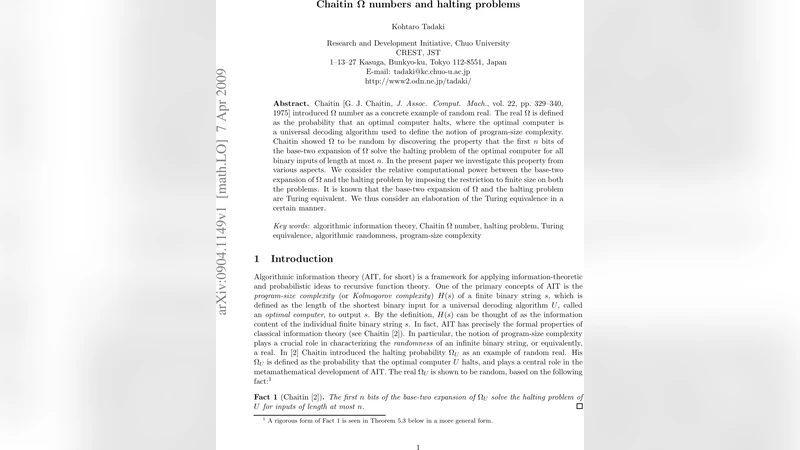
Chaitin [G. J. Chaitin, J. Assoc. Comput. Mach., vol.22, pp.329-340, 1975] introduced \Omega number as a concrete example of random real. The real \Omega is defined as the probability that an optimal computer halts, where the optimal computer is a universal decoding algorithm used to define the notion of program-size complexity. Chaitin showed \Omega to be random by discovering the property that the first n bits of the base-two expansion of \Omega solve the halting problem of the optimal computer for all binary inputs of length at most n. In the present paper we investigate this property from various aspects. We consider the relative computational power between the base-two expansion of \Omega and the halting problem by imposing the restriction to finite size on both the problems. It is known that the base-two expansion of \Omega and the halting problem are Turing equivalent. We thus consider an elaboration of the Turing equivalence in a certain manner.
💡 Research Summary
The paper revisits Chaitin’s Ω number—defined as the halting probability of a universal (optimal) Turing machine—and investigates its computational relationship with the halting problem when both are constrained to finite size. While it is well‑known that the infinite binary expansion of Ω and the unrestricted halting problem are Turing‑equivalent, the authors ask a more nuanced question: how does this equivalence manifest when we limit ourselves to the first n bits of Ω (denoted Ωₙ) and to the set of all programs whose length does not exceed n (denoted HALTₙ)?
The authors begin by recalling the classic result that Ωₙ completely determines HALTₙ: each of the first n bits encodes the answer to whether a particular program of length ≤ n halts. They then turn this implication around, asking how much information about Ωₙ can be recovered from HALTₙ. Using Kolmogorov complexity and algorithmic randomness tests, they establish tight upper and lower bounds on the information content of Ωₙ, showing that its Shannon‑like information is essentially n·log₂e bits—precisely the amount needed to reconstruct HALTₙ.
A central contribution is the introduction of an “ε‑approximate Ω” notion, Ωₙ^ε, which is any n‑bit string within Hamming distance ε·n of the true Ωₙ. The paper proves that if ε exceeds ½, the approximation no longer suffices to decide HALTₙ; conversely, as ε approaches zero, the approximation rapidly regains full decision power. This quantitative analysis clarifies how much precision is required for a finite prefix of Ω to be useful.
From a computational‑complexity perspective, the authors demonstrate that any deterministic algorithm that, given Ωₙ, decides HALTₙ must run in time at least exponential in n (Ω(2ⁿ)). The intuition is that such an algorithm would effectively solve the unrestricted halting problem for all programs up to length n, which is known to be computationally hard. In contrast, a nondeterministic machine that can guess random bits may achieve an expected runtime of O(2^{n/2}) by exploiting probabilistic shortcuts, though it still cannot escape exponential growth.
The paper’s findings lead to several broader insights. First, while Ω and HALT are equivalent in the asymptotic, infinite‑bit sense, their finite‑resource versions exhibit a nuanced trade‑off: they carry almost the same amount of raw information, yet the computational effort required to extract that information differs dramatically. Second, the results underscore that Ω’s “magic” as a universal solution to the halting problem hinges on having an unbounded supply of bits; any realistic, bounded setting forces a loss of computational power.
Finally, the authors outline future research directions, including tighter bounds for ε‑approximate Ω, extensions to probabilistic universal machines, and potential applications of Ω‑like constructions in cryptography and randomness generation. By dissecting the finite‑size interplay between Ω and the halting problem, the paper deepens our understanding of algorithmic randomness, information theory, and the limits of computability.
Comments & Academic Discussion
Loading comments...
Leave a Comment