Fixed point theorems on partial randomness
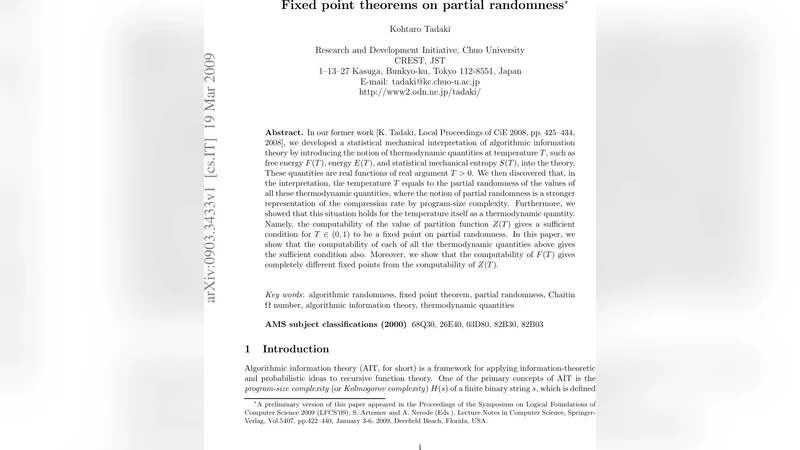
In our former work [K. Tadaki, Local Proceedings of CiE 2008, pp.425-434, 2008], we developed a statistical mechanical interpretation of algorithmic information theory by introducing the notion of thermodynamic quantities at temperature T, such as free energy F(T), energy E(T), and statistical mechanical entropy S(T), into the theory. These quantities are real functions of real argument T>0. We then discovered that, in the interpretation, the temperature T equals to the partial randomness of the values of all these thermodynamic quantities, where the notion of partial randomness is a stronger representation of the compression rate by program-size complexity. Furthermore, we showed that this situation holds for the temperature itself as a thermodynamic quantity. Namely, the computability of the value of partition function Z(T) gives a sufficient condition for T in (0,1) to be a fixed point on partial randomness. In this paper, we show that the computability of each of all the thermodynamic quantities above gives the sufficient condition also. Moreover, we show that the computability of F(T) gives completely different fixed points from the computability of Z(T).
💡 Research Summary
The paper develops a statistical‑mechanical framework for algorithmic information theory (AIT) by treating programs as microscopic states and program length as energy. For a temperature parameter T > 0 the authors define a Boltzmann weight w_T(p)=2^{-|p|/T} for each program p, and from these weights construct the partition function
Z(T)=∑{p∈dom U} 2^{-|p|/T}.
Using Z(T) they introduce the usual thermodynamic quantities: free energy F(T)=−T·log₂ Z(T), mean energy E(T)=Z(T)^{-1}∑{p}|p|·2^{-|p|/T}, and entropy S(T)=(E(T)−F(T))/T. All of these are real‑valued functions of the real argument T.
The central concept is “partial randomness”, a refinement of the classical compression rate. For an infinite binary sequence α, the partial randomness r(α) is defined as the limit of K(α↾n)/n, where K denotes prefix‑free Kolmogorov complexity. A real number T∈(0,1) is said to be a fixed point of partial randomness if r(T)=T; in other words, the optimal description length of the binary expansion of T grows exactly at rate T.
In earlier work the author showed that if the partition function Z(T) is computable then T is such a fixed point. The present paper extends this result in two major directions. First, it proves that the computability of each of the other thermodynamic quantities—free energy F(T), mean energy E(T), and entropy S(T)—also suffices to guarantee that T is a partial‑randomness fixed point. The proofs rely on the monotonicity and continuity of these functions: if, say, F(T) is computable, then the inverse map T↦F(T) can be approximated effectively, which yields an effective procedure to approximate T’s binary expansion to any desired precision. Consequently one can show that K(T↾n)≈n·T, establishing r(T)=T.
Second, the paper demonstrates that the fixed points obtained from F(T) differ fundamentally from those obtained from Z(T). Because F(T)=−T·log₂ Z(T) is a nonlinear transformation, the set of temperatures for which F(T) is computable does not coincide with the set for which Z(T) is computable. In fact, the two sets can be disjoint, showing that partial‑randomness fixed points form a rich hierarchy depending on which thermodynamic quantity is considered.
The authors discuss the meta‑theoretical significance of these results. A temperature that equals its own compression rate is a self‑referential object: the shortest program that outputs the first n bits of T has length essentially T·n. This notion sits between ordinary randomness (Martin‑Löf randomness) and trivial compressibility, providing a nuanced scale of algorithmic randomness parameterised by T.
Finally, the paper outlines future research directions: (i) measure‑theoretic analysis of the fixed‑point sets (e.g., Lebesgue measure, Baire category), (ii) investigation of higher‑order thermodynamic quantities such as heat capacity or susceptibility and their impact on partial randomness, and (iii) concrete connections to physical models (e.g., spin systems) where the program‑energy correspondence could be instantiated. These avenues suggest that AIT, enriched by statistical‑mechanical ideas, may offer new insights into both theoretical computer science and the foundations of statistical physics.
Comments & Academic Discussion
Loading comments...
Leave a Comment