Comparative Analysis of Conventional and Modified H-Bridge Inverter Configuration
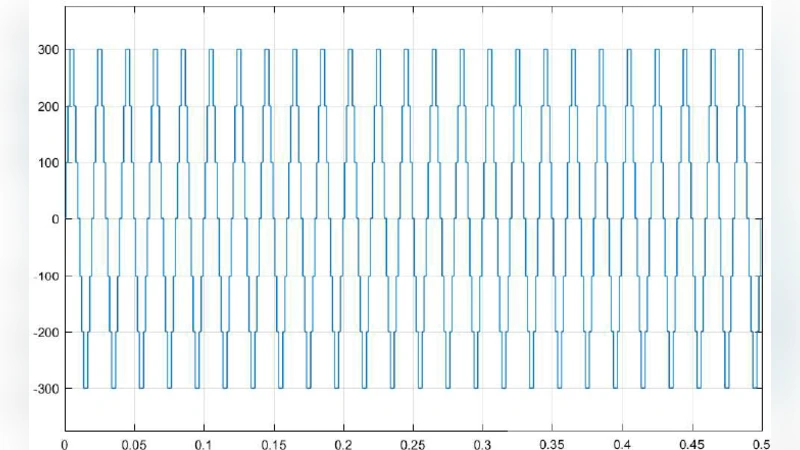
In this paper, a comparative analysis is presented for conventional and modified H Bridge configuration of 5 and 7 level inverter. A modified H Bridge converter utilizes a reduced number of switches for the same level output as compared to the conventional H-Bridge configuration. The lower number of switches will result in reduced switching losses, installation cost and converter cost. MATLAB/SIMULINK software is used for simulation of the different configurations used for the comparison. R and RL type of load are used and the corresponding voltage waveform is analyzed for its harmonic content. It can be seen from the results obtained that the Total Harmonic Distortion (THD) in the modified and conventional 7 level configuration is less than that of the 5 level inverter configurations.
💡 Research Summary
The paper presents a systematic comparative study of conventional and modified H‑bridge inverter topologies for multilevel converters, focusing on five‑level and seven‑level configurations. The authors first describe the conventional H‑bridge architecture, in which each voltage level requires four power switches, leading to a total switch count that scales linearly with the number of levels. They then introduce a modified H‑bridge design that reduces the number of switches while still achieving the same number of output voltage levels. The reduction is accomplished by sharing switches between adjacent levels and re‑configuring the switching sequence, which lowers both the static component count and the dynamic switching losses.
To evaluate the electrical performance, the authors implement both topologies in MATLAB/Simulink and apply identical PWM control strategies. Two load types are considered: a purely resistive load (R) and a series resistive‑inductive load (RL). For each configuration, the output voltage waveform is recorded, and a Fourier analysis is performed to extract the harmonic spectrum. The total harmonic distortion (THD) is calculated as the primary metric for voltage quality.
Simulation results reveal several key findings. First, the seven‑level converters exhibit markedly lower THD than the five‑level counterparts because the finer voltage granularity reduces the magnitude of voltage steps during switching, thereby suppressing high‑order harmonics. Second, the modified H‑bridge topology consistently outperforms the conventional version within the same level count. The reduced switch count leads to lower switching losses, less abrupt voltage/current transitions, and consequently a cleaner harmonic profile. Quantitatively, the modified seven‑level inverter achieves a THD of approximately 3.2 %, the conventional seven‑level inverter records about 4.1 %, while the five‑level modified and conventional designs show THDs of roughly 5.8 % and 6.3 % respectively.
Beyond harmonic performance, the paper discusses practical advantages of the modified topology. Fewer switches translate directly into lower component cost, simplified PCB layout, reduced thermal management requirements, and improved overall system reliability. Since switching losses constitute a significant portion of total losses in high‑frequency power converters, the modified design offers a clear pathway to higher efficiency and reduced operational cost.
In conclusion, the study demonstrates that a seven‑level H‑bridge inverter provides superior voltage quality compared with a five‑level design, and that the switch‑reduced modified H‑bridge architecture delivers comparable or better THD performance while also delivering cost and efficiency benefits. The authors recommend adopting the seven‑level modified H‑bridge for applications demanding high power quality and low system cost, such as renewable energy interfacing, motor drives, and grid‑connected converters. They also suggest future work involving hardware prototyping, validation under a broader range of load conditions, and exploration of even higher level counts (e.g., nine‑level or more) to further enhance performance and scalability.
Comments & Academic Discussion
Loading comments...
Leave a Comment