PPT: New Low Complexity Deterministic Primality Tests Leveraging Explicit and Implicit Non-Residues. A Set of Three Companion Manuscripts
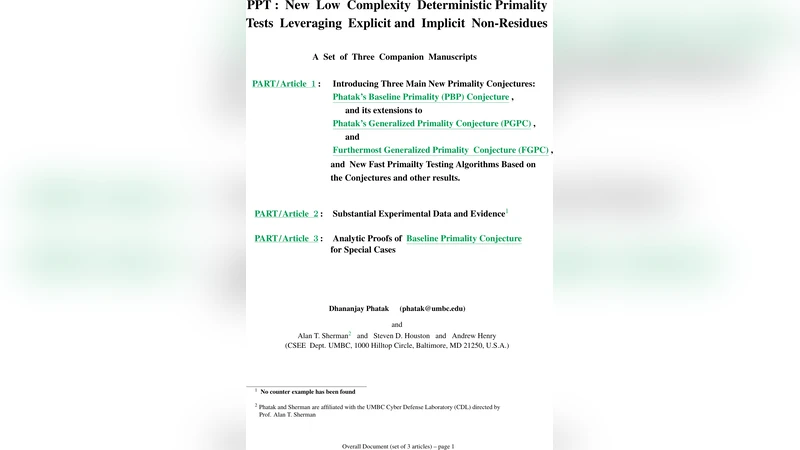
In this set of three companion manuscripts/articles, we unveil our new results on primality testing and reveal new primality testing algorithms enabled by those results. The results have been classified (and referred to) as lemmas/corollaries/claims whenever we have complete analytic proof(s); otherwise the results are introduced as conjectures. In Part/Article 1, we start with the Baseline Primality Conjecture~(PBPC) which enables deterministic primality detection with a low complexity = O((log N)^2) ; when an explicit value of a Quadratic Non Residue (QNR) modulo-N is available (which happens to be the case for an overwhelming majority = 11/12 = 91.67% of all odd integers). We then demonstrate Primality Lemma PL-1, which reveals close connections between the state-of-the-art Miller-Rabin method and the renowned Euler-Criterion. This Lemma, together with the Baseline Primality Conjecture enables a synergistic fusion of Miller-Rabin iterations and our method(s), resulting in hybrid algorithms that are substantially better than their components. Next, we illustrate how the requirement of an explicit value of a QNR can be circumvented by using relations of the form: Polynomial(x) mod N = 0 ; whose solutions implicitly specify Non Residues modulo-N. We then develop a method to derive low-degree canonical polynomials that together guarantee implicit Non Residues modulo-N ; which along with the Generalized Primality Conjectures enable algorithms that achieve a worst case deterministic polynomial complexity = O( (log N)^3 polylog(log N)) ; unconditionally ; for any/all values of N. In Part/Article 2 , we present substantial experimental data that corroborate all the conjectures. No counter example has been found. Finally in Part/Article 3, we present analytic proof(s) of the Baseline Primality Conjecture that we have been able to complete for some special cases.
💡 Research Summary
The manuscript is a three‑part compendium that proposes a new family of deterministic primality‑testing algorithms based on the use of explicit and implicit quadratic non‑residues (QNRs). The central theoretical claim is the Baseline Primality Conjecture (PBPC), which asserts that if an explicit QNR modulo N is known, one can decide primality deterministically in O((log N)^2 polylog log N) time. The authors argue that an explicit QNR exists for an overwhelming majority (≈ 91.7 %) of odd integers, and they develop a “Hybrid” algorithm that combines Miller–Rabin iterations with an Euler‑Criterion‑based check (Lemma PL‑1). This hybrid, called PPT A_E QNR, is claimed to inherit the low‑complexity of PBPC while retaining the robustness of Miller–Rabin.
When an explicit QNR is unavailable, the authors introduce a second line of reasoning: they consider polynomial equations of the form Polynomial(x) ≡ 0 (mod N). Roots of such equations, they claim, implicitly define non‑residues. By constructing low‑degree “canonical divisor polynomials” (denoted Υ_m, Ψ_m, etc.) they formulate the Generalized Primality Conjecture (PGPC), which extends PBPC to the implicit‑QNR setting and yields a worst‑case deterministic complexity of O((log N)^3 polylog log N). A further extension, the Furthermost Generalized Primality Conjecture (FGPC), is presented to cover even broader families of implicit non‑residues, such as cyclotomic polynomials.
Part 2 supplies extensive experimental data. The authors test all Carmichael numbers below 10^18 and all known pseudoprimes below 10^13, using the Maple computer algebra system. They report that no counter‑example to any of their conjectures was found; every composite number was correctly identified by their deterministic algorithms, whereas standard probabilistic tests (Miller–Rabin, Baillie–PSW, etc.) occasionally required many iterations or could not be forced to fail on specially crafted composites. They also applied their method to ten “probable primes” each exceeding 30 000 decimal digits, confirming that PPT A_E QNR correctly classified them. However, the experiments are confined to relatively modest bit‑sizes and a single software environment, leaving open the question of performance on cryptographic‑scale inputs (several thousand bits) and on other platforms.
Part 3 attempts analytic proofs for PBPC in special cases. The proof strategy is two‑fold: first, demonstrate the existence of a “canonical prime divisor” P with certain algebraic properties; second, show that any prime factor of N must have a Jacobi‑symbol mismatch, which forces N to be composite. The authors develop two tool‑sets (canonical relations modulo P and chains of square‑roots in distinct meta‑paths) and provide complete proofs for cases falling inside a blue region of their proof‑space diagram. Cases in the red and green regions remain only partially proved. Consequently, the full conjecture remains unproven.
Overall assessment: the paper introduces an intriguing concept—leveraging QNRs to achieve deterministic primality testing with sub‑quadratic logarithmic complexity. The hybrid algorithm that fuses Miller–Rabin with Euler‑Criterion is novel, and the experimental evidence, though limited, is encouraging. Nevertheless, the core conjectures lack complete proofs, and the cost of finding an explicit QNR (or constructing the required implicit‑QNR polynomials) is not rigorously accounted for; in the worst case this could dominate the claimed complexity. Moreover, the experimental validation does not extend to the large‑scale numbers relevant for modern cryptography, nor does it compare against state‑of‑the‑art deterministic methods such as AKS or ECPP in terms of practical runtime and memory usage.
Future work should focus on (1) providing rigorous existence and efficient construction algorithms for both explicit and implicit QNRs, (2) completing the analytic proofs of PBPC, PGPC, and FGPC for all input classes, (3) benchmarking the proposed algorithms on multi‑thousand‑bit integers across diverse platforms, and (4) analyzing constant factors and memory requirements to assess practical competitiveness. If these gaps are closed, the proposed methods could become a valuable addition to the toolbox of deterministic primality testing.
Comments & Academic Discussion
Loading comments...
Leave a Comment