Discontinuous Galerkin approximations in computational mechanics: hybridization, exact geometry and degree adaptivity
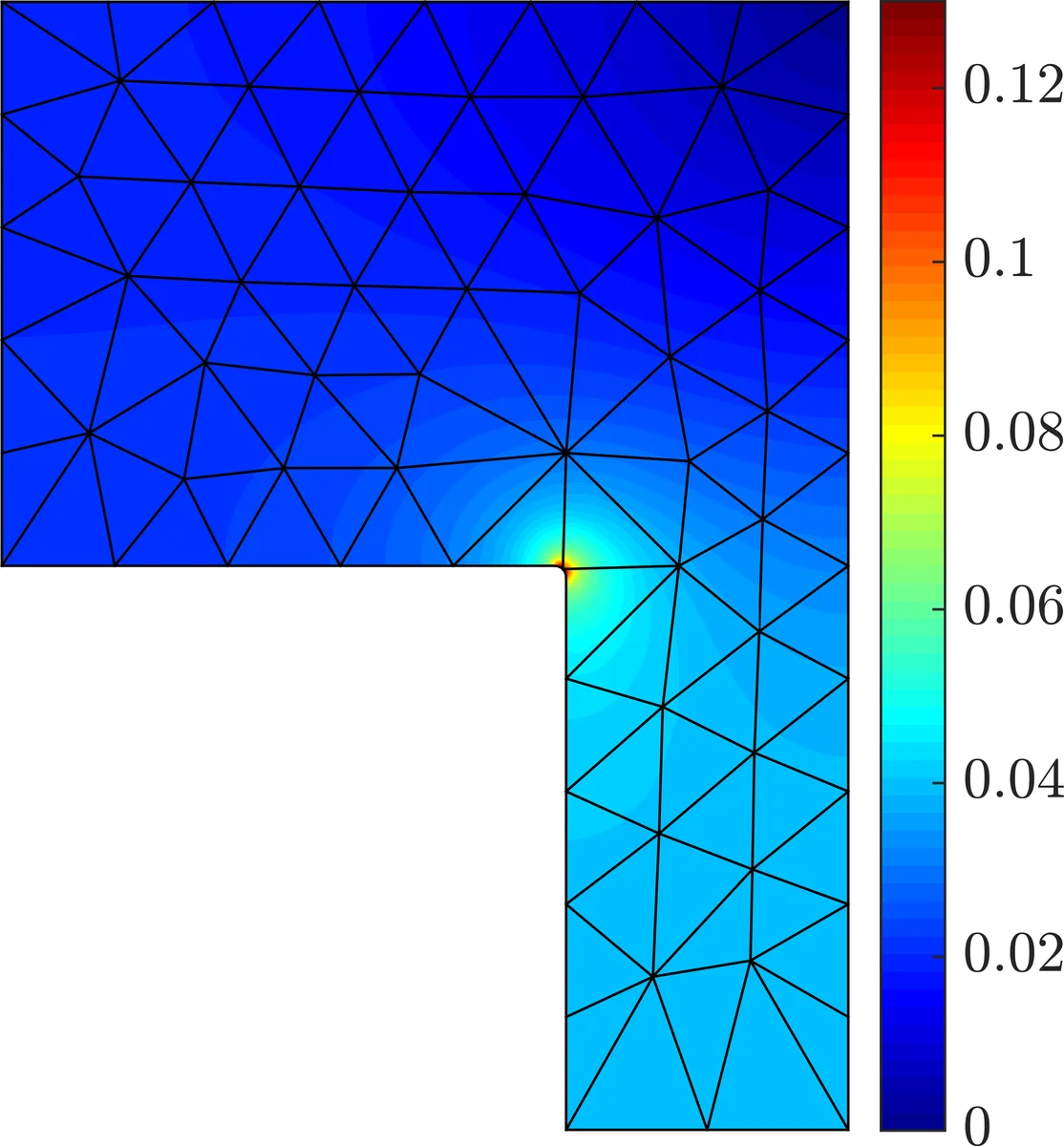
Discontinuous Galerkin (DG) discretizations with exact representation of the geometry and local polynomial degree adaptivity are revisited. Hybridization techniques are employed to reduce the computational cost of DG approximations and devise the hybridizable discontinuous Galerkin (HDG) method. Exact geometry described by non-uniform rational B-splines (NURBS) is integrated into HDG using the framework of the NURBS-enhanced finite element method (NEFEM). Moreover, optimal convergence and superconvergence properties of HDG-Voigt formulation in presence of symmetric second-order tensors are exploited to construct inexpensive error indicators and drive degree adaptive procedures. Applications involving the numerical simulation of problems in electrostatics, linear elasticity and incompressible viscous flows are presented. Moreover, this is done for both high-order HDG approximations and the lowest-order framework of face-centered finite volumes (FCFV).
💡 Research Summary
**
This paper revisits discontinuous Galerkin (DG) discretizations with two major enhancements: hybridization and exact geometry representation, and explores their synergy for efficient, high‑order computational mechanics. Hybridization transforms the classical DG formulation by introducing a mixed variable (the flux or stress) and a hybrid trace variable defined on mesh faces. Each element solves a local problem with Dirichlet data, while global coupling is restricted to the face unknowns only. This “static condensation” dramatically reduces the size of the global linear system, cutting both memory consumption and floating‑point operations compared with standard DG, especially in three‑dimensional large‑scale simulations.
Exact geometry is achieved by embedding the NURBS‑Enhanced Finite Element Method (NEFEM) into the hybridizable DG (HDG) framework. Instead of approximating curved boundaries with low‑order isoparametric polynomials, the true CAD NURBS description is retained for the domain boundary. Consequently, during degree‑adaptivity cycles no mesh regeneration or CAD‑mesh communication is required, and geometric error is eliminated. The functional approximation can be refined independently of the geometric representation, allowing pure p‑adaptivity without compromising geometric fidelity.
A particular HDG variant, the HDG‑Voigt formulation, is employed for problems involving symmetric second‑order tensors (e.g., stress, strain). By casting the mixed variable in Voigt notation, symmetry is enforced strongly, which yields optimal convergence of order k + 1 for both primal and mixed fields even for nearly incompressible materials. Moreover, the method exhibits a super‑convergent post‑processing: solving a local higher‑order problem on each element produces a reconstructed solution (u^{}) that converges with order k + 2. The difference (|u^{}-u_h|_{L^2}) serves as an inexpensive, element‑wise error indicator.
The adaptive algorithm proceeds as follows: (1) solve the global HDG‑NEFEM system for the face trace (\hat u) using a chosen polynomial degree k; (2) recover element‑wise primal and flux fields via the local HDG problems; (3) apply the super‑convergent post‑processing to obtain (u^{}); (4) compute the element error (E_e = |u^{}e - u_h|{L^2(\Omega_e)}); (5) compare (E_e) with a prescribed tolerance and, using the theoretical rate (O(h^{k+1+n/2})), decide whether to increase, decrease, or keep the local polynomial degree. Because the geometry is exact, the adaptation influences only the functional error, leading to robust and efficient p‑adaptivity.
Three application domains illustrate the methodology. In electrostatics, the HDG‑NEFEM approach accurately captures electric field intensities around inclusions with highly localized charge, and the adaptive strategy refines only regions with steep field gradients. In linear elasticity, the HDG‑Voigt formulation provides LBB‑stable, optimally convergent stresses and displacements; the super‑convergent error estimator drives degree adaptation that concentrates higher‑order elements near stress concentrations while keeping low order elsewhere. In incompressible viscous flow, a lowest‑order variant called the face‑centered finite volume (FCFV) method is presented. FCFV inherits the hybridization benefits, yields first‑order accurate fluxes without reconstruction, and remains insensitive to mesh distortion, making it suitable for large‑scale Stokes or Navier‑Stokes simulations.
The paper also surveys solver strategies tailored to hybridized systems: iterative Schwarz methods, multigrid preconditioners, Gauss‑Seidel‑type smoothers, and specialized preconditioners for Stokes problems. These techniques ensure rapid convergence of the reduced global system and facilitate parallel scalability.
In summary, the work demonstrates that (i) hybridization dramatically reduces the computational burden of DG; (ii) NEFEM eliminates geometric errors, enabling pure polynomial‑degree adaptivity; (iii) the HDG‑Voigt formulation’s super‑convergence yields cheap, reliable error indicators; (iv) degree‑adaptive HDG achieves high accuracy with minimal extra cost; and (v) the framework is validated across electrostatics, elasticity, and incompressible flow, including a low‑order FCFV variant for massive problems. Future directions include extension to complex multiphysics, non‑linear material models, and exploitation of modern GPU/heterogeneous architectures.
Comments & Academic Discussion
Loading comments...
Leave a Comment