Understanding Cyber Athletes Behaviour Through a Smart Chair: CS:GO and Monolith Team Scenario
eSports is the rapidly developing multidisciplinary domain. However, research and experimentation in eSports are in the infancy. In this work, we propose a smart chair platform - an unobtrusive approach to the collection of data on the eSports athletes and data further processing with machine learning methods. The use case scenario involves three groups of players: `cyber athletes’ (Monolith team), semi-professional players and newbies all playing CS:GO discipline. In particular, we collect data from the accelerometer and gyroscope integrated in the chair and apply machine learning algorithms for the data analysis. Our results demonstrate that the professional athletes can be identified by their behaviour on the chair while playing the game.
💡 Research Summary
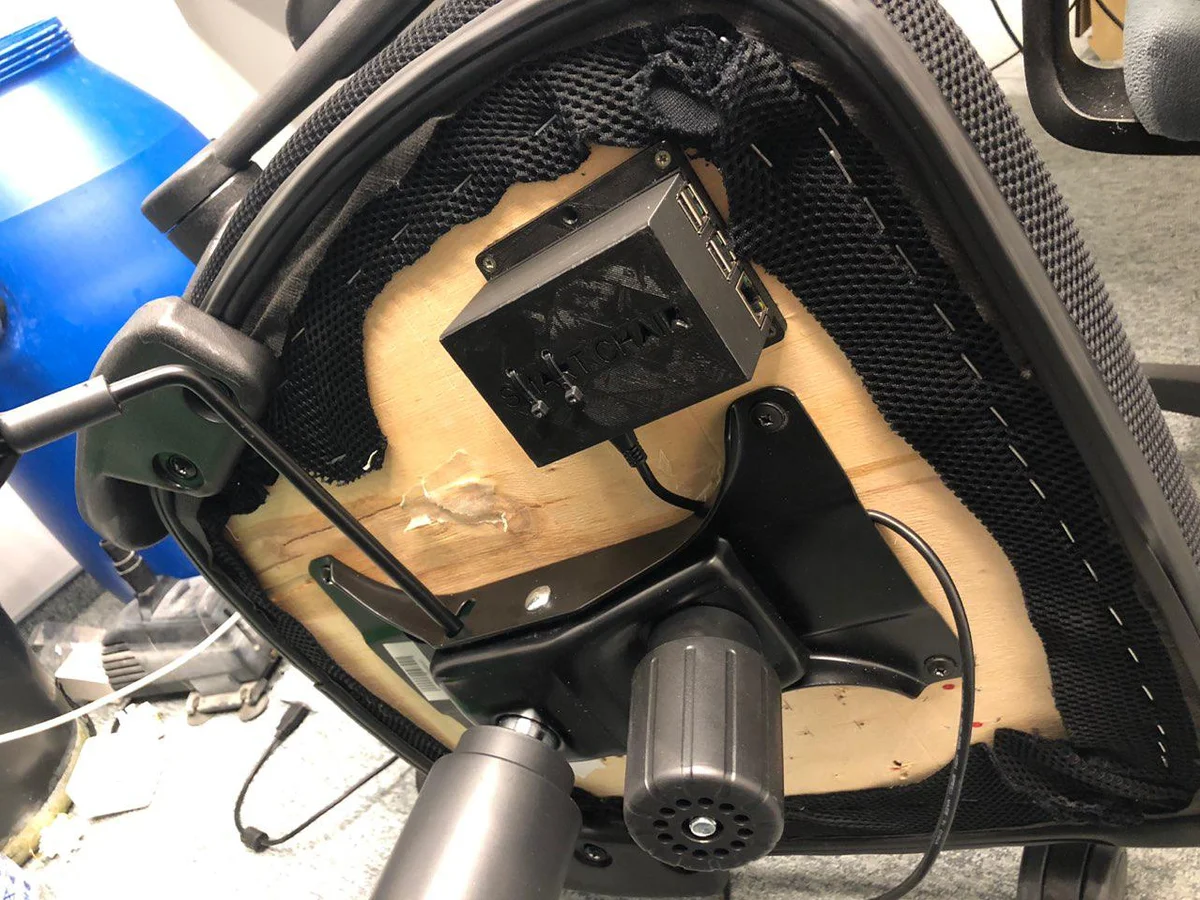
The paper presents an IoT‑based “smart chair” system for unobtrusive collection of physiological motion data from e‑sports athletes and demonstrates its utility in distinguishing professional from amateur CS:GO players. The authors equipped a standard gaming chair with a Raspberry Pi 3 and an MPU‑9250 motion processing unit, which records three‑axis accelerometer, gyroscope, and magnetometer data at 100 Hz. Data are transmitted via Wi‑Fi in JSON format to a cloud server where Python‑based machine‑learning pipelines process them.
Nineteen participants were recruited: nine professional players from the Monolith team and ten amateurs (including beginners). All subjects played a standardized “Retake” scenario in CS:GO—a 12‑round match where a terrorist side (2 players) defends a planted bomb and a counter‑terrorist side (3 players) attempts to defuse it. Each session lasted roughly 35 minutes, and the continuous sensor stream was segmented into 3‑minute windows, yielding 154 labeled samples.
Feature engineering focused on two complementary aspects of motion. First, the proportion of time each sensor axis deviated more than three standard deviations from its mean was computed, representing “active movement.” This produced six features (x, y, z for both accelerometer and gyroscope). Second, the mean dispersion during periods of relative stillness captured subtle oscillations (e.g., foot tremor, micro‑adjustments), adding another six features. An additional binary‑like feature measured the fraction of time the player leaned back, derived from the vertical accelerometer component. In total, 13 features described each window.
Four classifiers were evaluated: Logistic Regression, Support Vector Machine (soft‑margin), k‑Nearest Neighbors (k = 5), and Random Forest (max depth = 4). To avoid data leakage, a leave‑several‑participants‑out scheme was used: models were trained on all but 4–5 subjects and tested on the held‑out group, repeated 100 times for stability. Performance was assessed with ROC‑AUC, a metric well‑suited for binary discrimination. Logistic Regression achieved an average AUC of 0.85 ± 0.14, SVM 0.86 ± 0.13, KNN 0.80 ± 0.13, and Random Forest 0.82 ± 0.16. The linear models outperformed the more complex ones, suggesting that the relationship between motion features and skill level is approximately linear and that the limited dataset penalizes high‑capacity models.
Interpretability was examined via the logistic‑regression coefficients. Positive coefficients (e.g., right‑left sway) were associated with high‑skill players, whereas negative coefficients (e.g., active rotations) correlated with lower‑skill participants. This aligns with the heat‑map analysis showing that professionals exhibit fewer large‑scale movements but display distinctive micro‑rotations, possibly reflecting heightened focus and fine‑grained posture control.
The study acknowledges several limitations: a small, homogeneous sample; reliance on a single game mode; and the absence of additional physiological signals such as heart rate, respiration, or pressure distribution. Future work is planned to integrate pressure and temperature sensors, expand the participant pool, explore diverse game scenarios, and apply advanced time‑series segmentation (e.g., hidden Markov models) and online anomaly detection to improve real‑time feedback.
In conclusion, the research demonstrates that low‑cost inertial sensors embedded in a gaming chair can capture behavioral signatures sufficient to predict e‑sports player expertise with ROC‑AUC scores above 0.8. This proof‑of‑concept opens avenues for data‑driven coaching, automated performance monitoring, and the broader incorporation of physical‑state analytics into competitive gaming.
Comments & Academic Discussion
Loading comments...
Leave a Comment