Relational flexibility of network elements based on inconsistent community detection
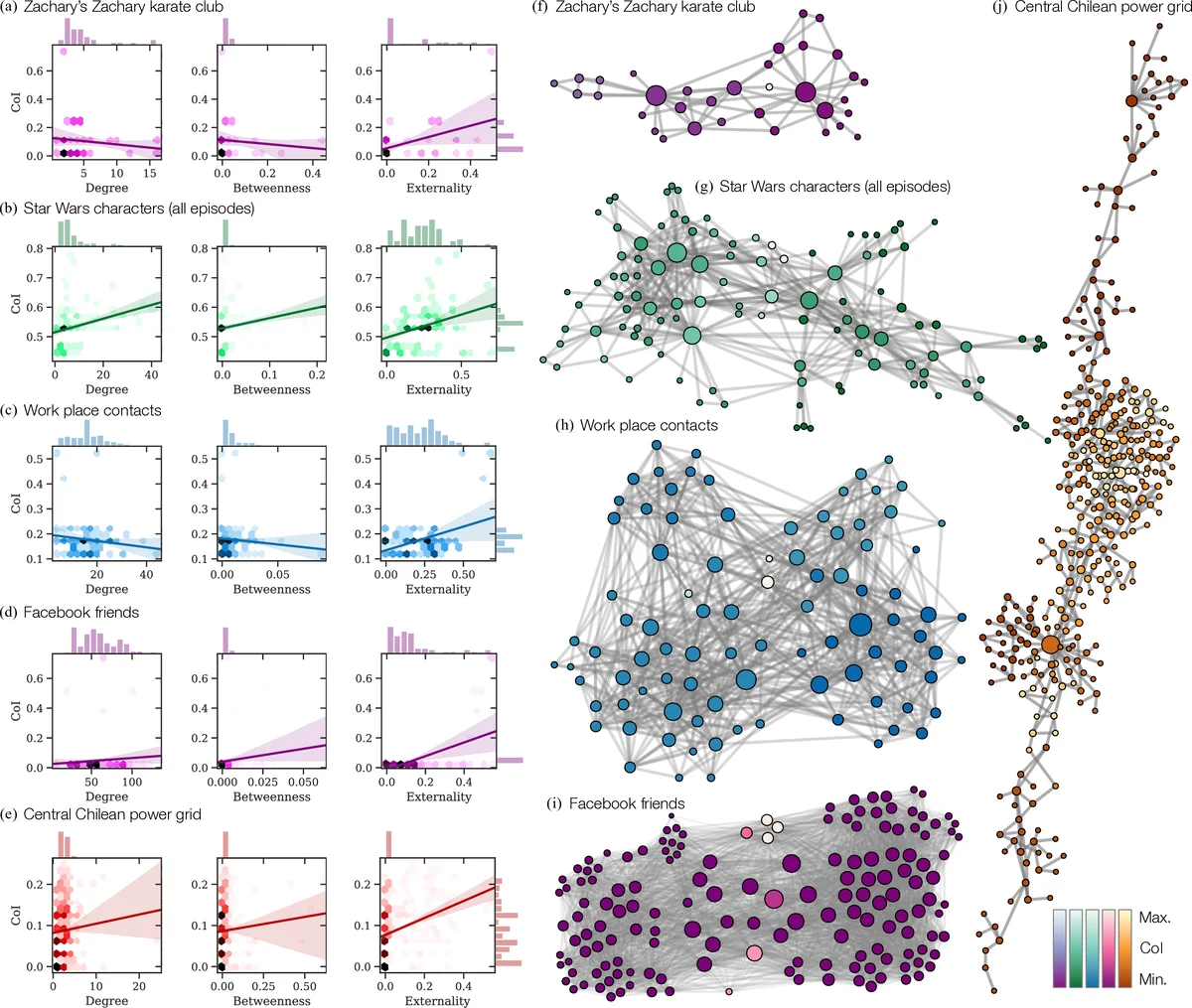
Community identification of network components enables us to understand the mesoscale clustering structure of networks. A number of algorithms have been developed to determine the most likely community structures in networks. Such a probabilistic or stochastic nature of this problem can naturally involve the ambiguity in resultant community structures. More specifically, stochastic algorithms can result in different community structures for each realization in principle. In this study, instead of trying to “solve” this community degeneracy problem, we turn the tables by taking the degeneracy as a chance to quantify how strong companionship each node has with other nodes. For that purpose, we define the concept of companionship inconsistency that indicates how inconsistently a node is identified as a member of a community regarding the other nodes. Analyzing model and real networks, we show that companionship inconsistency discloses unique characteristics of nodes, thus we suggest it as a new type of node centrality. In social networks, for example, companionship inconsistency can classify outsider nodes without firm community membership and promiscuous nodes with multiple connections to several communities. In infrastructure networks such as power grids, it can diagnose how the connection structure is evenly balanced in terms of power transmission. Companionship inconsistency, therefore, abstracts individual nodes’ intrinsic property on its relationship to a higher-order organization of the network.
💡 Research Summary
The paper tackles the inherent ambiguity of stochastic community‑detection algorithms and turns it into a source of information about node‑level relational flexibility. By repeatedly applying a stochastic modularity‑maximization method (GenLouvain) to the same network, the authors construct a co‑occurrence matrix φij that records the fraction of runs in which nodes i and j belong to the same community. From this matrix they define a node‑centric metric called Companionship Inconsistency (CoI):
Φi = 1 – (1/(N–1)) Σj (1 – 2φij)².
Φi = 0 indicates that node i always shares the same set of companions across all runs, whereas Φi → 1 means that i’s community membership is maximally uncertain, i.e., it is equally likely to be paired with any other node, a situation that typically corresponds to a bridge between two latent groups.
The authors emphasize that CoI differs fundamentally from existing measures. Flexibility and promiscuity count only the number of community changes or the number of distinct communities a node ever joins, ignoring which specific partners are involved. Externality measures the proportion of a node’s immediate neighbors that lie outside its current community, but it does not capture the global pattern of partner switching. The Rand index evaluates similarity between whole partitions and is cluster‑centric, whereas CoI is explicitly node‑centric and incorporates the absence of co‑membership as a source of inconsistency.
Methodologically, the study uses the GenLouvain algorithm with a resolution parameter γ to generate ensembles of partitions. The choice of γ is heuristic; the authors acknowledge that CoI values depend on this parameter because it controls the granularity of detected communities. For each network they run the algorithm many times (typically 100–200 realizations) to obtain stable estimates of φij.
Empirical validation proceeds in three stages. First, synthetic clustered networks are built by embedding ten Erdős–Rényi subgraphs (dense internally, sparsely connected externally) and rewiring edges to control each node’s externality. Correlation analysis shows that CoI is only weakly related to degree (r≈0.15), betweenness centrality (r≈0.46), and mean externality (r≈0.55), confirming that it captures a distinct aspect of node behavior. Second, a small illustrative network demonstrates that three bridge nodes (6, 7, 8) all receive high CoI values, while betweenness centrality highlights only the most central bridge (node 8). This highlights CoI’s ability to detect functional “bridge‑ness” that is not reflected in shortest‑path based metrics. Third, real‑world datasets are examined: a social network of university affiliations and a power‑grid network. In the social case, nodes with high CoI correspond to individuals who belong to multiple clubs or act as connectors between otherwise separate groups—so‑called “promiscuous” or “outsider” actors. In the power‑grid, high‑CoI substations are those that link distinct transmission zones, suggesting a role in load balancing and resilience.
The paper also discusses limitations. CoI assumes, implicitly, that a node’s maximum uncertainty corresponds to being equally likely to belong to two communities; in networks with more than two overlapping groups the interpretation of Φi≈1 becomes ambiguous. The metric is sensitive to the resolution parameter γ, and different stochastic algorithms may produce different φij distributions. Moreover, obtaining reliable φij estimates requires a large number of runs, which can be computationally demanding for very large graphs.
Future directions suggested include extending CoI to weighted and directed graphs, applying it to temporal networks to track evolving relational flexibility, integrating it with multilayer network frameworks, and comparing its performance across a broader set of stochastic community‑detection methods (e.g., Infomap, stochastic block models). The authors also propose analytical approximations or bootstrap techniques to reduce computational overhead while preserving statistical robustness.
In summary, the study introduces Companionship Inconsistency as a novel, node‑centric centrality that quantifies how inconsistently a node is grouped with others across multiple stochastic community detections. By focusing on pairwise co‑membership variability, CoI reveals functional roles—such as bridges, outsiders, and flexible connectors—that are invisible to traditional degree‑, path‑, or community‑size based metrics. The approach offers a promising new lens for analyzing social, infrastructural, and biological networks where the fluidity of group affiliation carries important functional implications.
Comments & Academic Discussion
Loading comments...
Leave a Comment