HST/COS Observations of the Ly alpha Forest toward the BL Lac Object 1ES1553+113
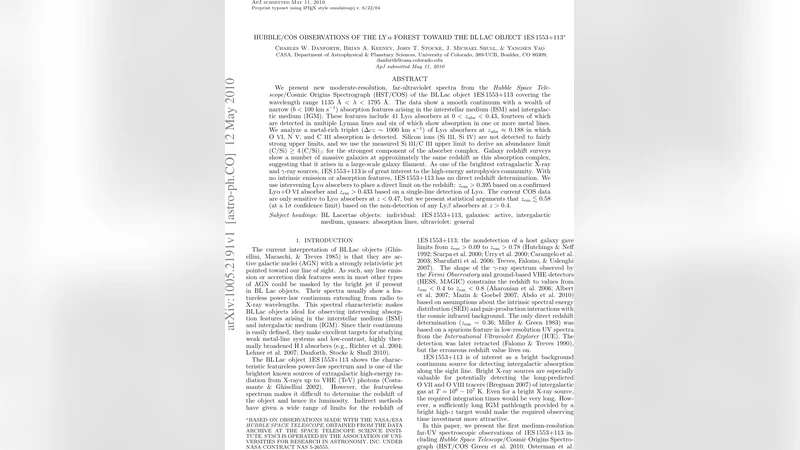
We present new far-ultraviolet spectra from the Cosmic Origins Spectrograph (HST/COS) of the BL Lac object 1ES1553+113 covering the wavelength range 1135-1795 A. The data show a smooth continuum with a wealth of narrow absorption features arising in the ISM and IGM. These features include 41 Lya absorbers at 0<z<0.43, fourteen of which are detected in multiple Lyman lines and six in one or more metal lines. We analyze a metal-rich triplet of Lya absorbers at z=0.188 in which OVI, NV, and CIII absorption is detected. Silicon ions (SiIII/IV) are not detected to fairly strong upper limits, and we use the measured SiIII/CIII upper limit to derive an abundance limit [C/Si]>0.6 for the strongest component of the absorber complex. Galaxy redshift surveys show a number of massive galaxies at approximately the same redshift as this absorption complex, suggesting that it arises in a large-scale galaxy filament. As one of the brightest extragalactic X-ray and gamma-ray sources, 1ES1553+113 is of great interest to the high-energy astrophysics community. With no intrinsic emission or absorption features, 1ES1553+113 has no direct redshift determination. We use intervening Lya absorbers to place a direct limit on the redshift: z_em>0.395 based on a confirmed Lya+OVI absorber and z_em>0.433 based on a single-line detection of Lya. COS/FUV data are only sensitive to Lya absorbers at z<0.47, but we present statistical arguments that z_em<0.58 based on the non-detection of any Lyb absorbers at z>0.4.
💡 Research Summary
This paper presents a comprehensive analysis of far‑ultraviolet (FUV) spectra of the BL Lac object 1ES 1553+113 obtained with the Cosmic Origins Spectrograph (COS) on board the Hubble Space Telescope. The observations cover the wavelength interval 1135–1795 Å using the G130M and G160M gratings, delivering a typical signal‑to‑noise ratio of 15–20 per resolution element and a spectral resolution of R ≈ 18,000 (≈17 km s⁻¹). Because BL Lac objects lack strong intrinsic emission or absorption features, 1ES 1553+113 provides an exceptionally clean continuum against which interstellar and intergalactic absorption lines can be identified with minimal confusion.
A total of 41 Ly α absorbers are detected in the redshift range 0 < z < 0.43. Fourteen of these systems are confirmed by the presence of higher‑order Lyman lines (Ly β, Ly γ, etc.), allowing robust measurements of neutral hydrogen column densities (N(H I) ≈ 10¹³–10¹⁴ cm⁻²) and Doppler parameters. Six absorbers also show metal lines, most notably O VI λ1032,1038, N V λ1238,1242, and C III λ977. The most intriguing metal‑rich complex lies at z = 0.188, where three closely spaced Ly α components exhibit O VI, N V, and C III absorption. Silicon ions (Si III λ1206 and Si IV λ1393,1402) are not detected; the resulting Si III/C III upper limit translates into an abundance constraint of
Comments & Academic Discussion
Loading comments...
Leave a Comment