Blind Identification of SFBC-OFDM Signals Based on the Central Limit Theorem
Previous approaches for blind identification of space-frequency block codes (SFBC) do not perform well for short observation periods due to their inefficient utilization of frequency-domain redundancy. This paper proposes a hypothesis test (HT)-based…
Authors: Mingjun Gao, Yongzhao Li, Octavia A. Dobre
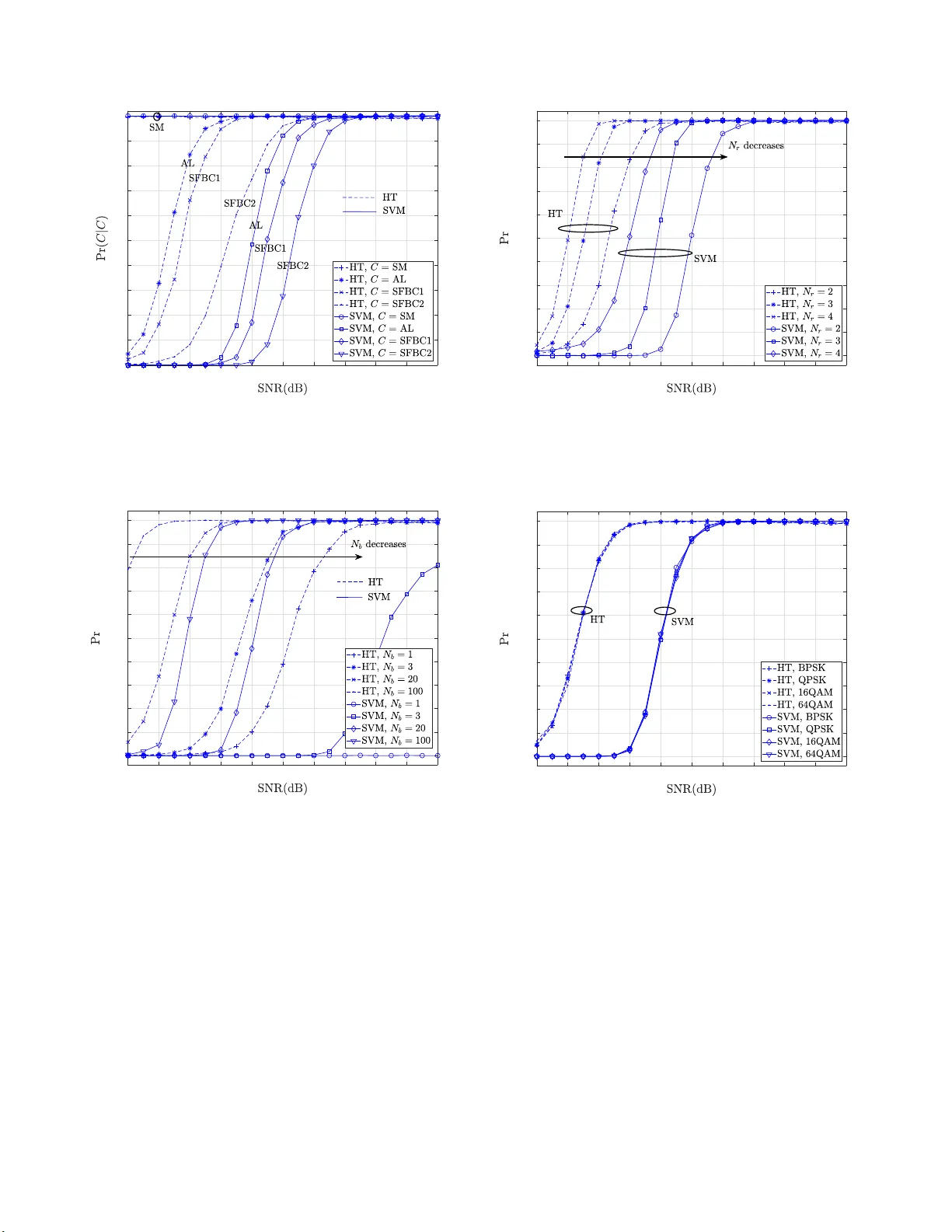
1 Blind Identificati on of SFB C-OFD M Signals Based on the Central Limit Theorem Mingjun Gao, Student Membe r , IEEE, Y ongzhao Li, Senior Memb e r , IEEE, Octavia A. Do b re, S enior Me mber , IEEE, and Na ofal Al-Dhah ir , F ellow , IEEE Abstract —Pre vious approaches f or b lind identification of space-frequency block codes (SFBC) do not perform well f or short observation periods due to th eir inefficien t utilization of frequency-domain redund an cy . T his paper proposes a hypoth- esis test (HT)-b ased algorithm and a support vector machine (SVM)-based algorithm for SFBC signals identification ove r frequency-selectiv e fading channels to exploit two-dimensional space-frequency doma in redundancy . Based on the central limit theorem, space-domain redundancy is u sed to construct th e cross-co rrelation function of the estimator and frequency-domain redundancy is incorpor ated in the construction of the statistics. The difference between the two p roposed algorithms is that the HT -based algo rithm constructs a chi- sq uare statistic and employs an HT to make the decision, wh ile the SVM -based a lgorithm constructs a non-central chi-squ are statistic with unk nown mean as a strongly-distinguishable statistical feature and uses SVM to make th e decision. Both algorithms do not require knowledge of the channel coefficients, modulation type or noise power , and the SVM-based algorithm does not require timing synchronization. Simulation results verify the superior perfo rmance of the pro- posed algorithms for short observation periods with comparable computational complexity to conv en tional algorithms, as well as their acceptable id entification perfo rmance in the presence of transmission impairments. Index T erms —Blind identification, mu l tiple-inpu t multiple- output, orthogonal fr equency division multiplexing, space - frequency block code, support vector machine (SVM ). I . I N T RO D U C T I O N B LIND identification of co mmunicatio n signals’ param e- ters of a tr ansmitter f rom recei ved signals without refer- ence signals plays a vital ro le in m a ny military and civilian applications. In military com munication systems, the identified parameters are extremely imp ortant to carry ou t electronic warfare oper ations inclu ding surveillanc e, inform ation decod- ing, and jamm ing signal design. In addition, so f tware-defined and co gnitive rad ios which are adopted in civilian applica- tions also emp loy blind identification to sen se sign als and automatically ad just the de sign parameters of the tran sm itter [1]. Recently , blind identification of mu ltip le-input multiple- output (MIMO) o r MIMO-or thogon a l frequency d ivision mul- tiplexing ( OFDM ) signals has received consider a ble interest including enum eration of the nu mber of transmit antenn as [2]–[5] and id e ntification of space-time/f r equency block codes (STBC/SFBC) [5]–[18]. Previous works on the identification of STBCs/S FBCs include referenc es [5]–[12] for single-carrier systems an d referenc e s [ 5], [13]–[18] for OFDM systems. Regarding the identification of STBCs f or sin g le-carrier systems, the r eported algorithm s can be divided into two types: likelihood- based [ 6] and f eature-based [5], [7]– [12] algo rithms. T he fo r mer u ses the likelihood fun ctions o f th e r eceiv ed signals to classify STBCs with different code r ates. Reference [5] q u antifies the space-time/fre q uency redund ancies as features an d employs an artificial neural n etwork to distinguish between the features to jointly id entify the number of tran sm it antenn as and STBCs for b oth sing le-carrier an d O FDM systems. The other feature- based metho ds detect th e presence of the space-time redu n- dancy at some specific time-lag locations by examining signal statistics or cyclic statistics. Most of these algorithms can not identify STBC/SFBC-OFDM signals sin c e they do not work in the frequ ency-selective fading en vironmen t. As for STBC- OFDM systems, such a s WiFi [19], re f erences [13]–[1 5] utilize the time- domain cro ss-correlation between adjacent OFDM symbols, i.e., the spac e - time redund ancy , as a discriminating feature. Specifically , r eferences [13], [14] u se different cross- correlation functions, while reference [ 15] e m ploys a cyclic cross-corre lation functio n with a specific time-lag over ad- jacent OFDM sym bols. Howe ver, SF BC-OFDM, where the SFBC is employed over co nsecutive sub-carr iers o f an OFDM symbol, is p r eferable over STBC-OFDM for higher m obility applications, such as L TE [20] and W iMAX [2 1], [ 22], since implementin g the STBC over consecutive OFDM symbo ls is not effecti ve due to the time-varying ch a n nels [23]. Hence, the time-do main cro ss-co rrelation b etween c onsecutive OFDM symbols does not exist any longe r for SFBC-OFDM signals and the peaks of the cross-co rrelation function proposed in [13]–[15] are difficult to detect. Th erefore, blind identification algorithm s of STBC-OFDM signals cann ot be d irectly applied to SFBC-OFDM signals. References [5 ], [ 1 6]–[18] a r e the previous r elev an t work s on the identification of SFBC-OFDM signals. Reference [16] extends the idea of detecting the peak of th e cross-corre lation function with specific time lag s between two receive antennas to the identification o f SFBC-OFDM sign als which only takes advantage of the sp ace-domain redund ancy . Howe ver , the frequen cy-domain red u ndancy is not utilized effecti vely which results in a negligible imp rovement of the perfo rmance when increasing the number of OFDM su b -carriers. Add itionally , N cr oss-correlation values are still calculated to de ter mine the location o f the peak ( N is the number of OFDM sub- carriers). T o make use of the freq uency-do m ain redun dancy , we prop osed to identify SFBC-OFDM signals by quanti- fying and disting uishing the fr equency-do main redu ndancy of adjacent OFDM sub-car riers in [ 5], [18]. However , the perfor mance improvemen t is small since the p r obability of correctly identifyin g the SFBC sign als conv erges rapidly with 2 increasing N . Ou r prior work in [1 7] does not consider multiple r eceiv e antenna pa ir s to improve the perfor mance, and lack s the theo retical perfor mance an alysis of id entifying SFBC signals. In this paper, by exploiting the two-dimensional spa c e- frequen cy domain redundancy , a hyp o thesis test (HT)-based blind identification algorithm and a support vector machine (SVM)-based blind iden tification algorithm for SFBC signals are propo sed to improve the perfo r mance when increasin g N or for a small observation period over freq uency-selective fading channels. Specifically , the space-d omain red undancy is used for d esigning an estimator w h ich is a cross-correlation function between antenn a p a ir s. Fur thermore, b ased on the central limit the o rem (CL T ), the fre q uency-do m ain redund ancy is utilized by c o nstructing the statistical featu res f rom the received signals on multiple OFDM sub-carriers. Re garding the utilization of the frequen cy-domain redu ndancy , 1 ) the first a lg orithm constru cts a test statistic fro m multiple OFDM sub-carrier s which follows a chi- square distribution for sp a tial multiplexing (SM) signa ls but no t f or SFBC signals. Then, a n HT is p roposed to make the dec ision ; 2) the second alg orithm is based on a stron g ly-distingu ishable statistic which f ollows a n on-cen tr al chi-square d istribution with u n known mean for SM signals. Then , a train ed SVM is used to identif y SFBC sig- nals. Both proposed algorithms can im p rove the iden tificatio n perfor mance as the nu mber of OFDM sub-carrier s increases, as well as p rovide satisfactory identification pe r forman c e under freque n cy-selecti ve fading with a sho rtened observation period, due to efficient utilization of the freq u ency-doma in redund ancy . In ad dition, both alg o rithms do n ot re q uire a priori knowledge o f the signal parameters, such as channel coefficients, mod ulation type or n oise p ower, and the SVM- based alg orithm does no t req uire timing synchro nization. Fur- thermor e , both algorithms h av e a satisfactory computatio nal complexity and can be efficiently implemen ted with a parallel architecture . The main contributions o f this pap er are th e following: • The cross-cor relation statistics between receive antenna pairs for SFBC signals are derived by utilizing the space- domain redund ancy for signal type identification. Then, an HT -b ased identificatio n algor ithm of SFBC-OFDM signals is prop osed to efficiently utilize the fr equency- domain redu ndancy by constru cting the test statistic fro m the received signals at consecutive OFDM sub-carrier s. • W e de riv e analytica l expressions for the probability o f correctly id entifying the SM and Alamouti (AL)-SFBC signals for the HT -based algorith m at any signal-to- noise ratio (SNR). • An SVM- based id entification alg o rithm fo r SFBC-OFDM signals is pro p osed to improve th e distingu ishability of the discriminatin g featu re between SM and SFBC signals and r e la x the requ irement of a priori knowledge of the timing synchronizatio n by rec onstructing the test statistic. Then, a trained SVM is used to make th e d ecision. • The computatio n al c o mplexity is analyzed and shown to be satisfactory in comparison with the algorithm s in [16], [18]. • Simulation results are presented to demo nstrate the v ia- bility of the proposed a lgorithms with different desig n parameters and also in the p r esence o f transmission impairmen ts, inclu ding timing and f r equency offsets, as well as Doppler effects. This paper is organized as follows. In Section II, th e signal model is introd uced. The n, the HT -b ased algo rithm and its theoretical per forman c e a n alysis ar e presen te d in Section I II. Next, the SVM- based algorithm is describ ed in Section IV . The simulation resu lts are presented in Section V . Finally , conclu- sions are drawn in Section VI. The summa r y of notations is presented in T able I. I I . S Y S T E M M O D E L W e c onsider a MIMO-OFDM system with N t transmit antennas, N r ( N r ≥ 2 ) receive an tennas, N sub-car riers an d ν cyclic p r efix samples. At th e tran smitter , the data symb o ls are drawn f rom an M -Phase Shif t Keying (PSK) or M -Quadr a ture Amplitude Modu lation ( QAM) signal constellation and parsed into d ata b locks, wh e re e ach blo ck x b = [ x b, 0 , · · · , x b,N s − 1 ] T ( b ∈ N ) co nsists of N s symbols. The SFBC encoder takes an N t × L co dew ord matrix, deno ted by C ( x b ) , to span L consecutive sub-carrie s in an OFDM symb ol. In th is paper, the codewords include SM, AL a nd two SFBCs with different code rates [24] whose codeword matrices are giv en b y C SM ( x b ) = [ x b, 0 , · · · , x b,N t − 1 ] T (1) C AL ( x b ) = x b, 0 − x ∗ b, 1 x b, 1 x ∗ b, 0 (2) C SFBC1 ( x b ) = x b, 0 x b, 1 x b, 2 − x b, 1 x b, 0 − x b, 3 − x b, 2 x b, 3 x b, 0 − x b, 3 − x b, 2 x b, 1 x ∗ b, 0 x ∗ b, 1 x ∗ b, 2 − x ∗ b, 1 x ∗ b, 0 − x ∗ b, 3 − x ∗ b, 2 x ∗ b, 3 x ∗ b, 0 − x ∗ b, 3 − x ∗ b, 2 x ∗ b, 1 T (3) C SFBC2 ( x b ) = x b, 0 x b, 1 x b, 2 √ 2 − x ∗ b, 1 x ∗ b, 0 x b, 2 √ 2 x ∗ b, 2 √ 2 x ∗ b, 2 √ 2 − x b, 0 − x ∗ b, 0 + x b, 1 − x ∗ b, 1 2 x ∗ b, 2 √ 2 − x ∗ b, 2 √ 2 x b, 1 + x ∗ b, 1 + x b, 0 − x ∗ b, 0 2 T . (4) The symbol in the i -th row of C ( x b ) is tran smitted f rom the i - th antenna. The symb ols are inp ut to N consecutive OFDM sub -carriers of one blo ck. Thus, the OFDM block is represented as S x b , · · · , x b + N L − 1 = h C ( x b ) , · · · , C x b + N L − 1 i . (5) Then, an N -point inverse fast Four ier transfo rm (I FFT) con - verts this blo ck into a time-do main b lock, and the last ν samples are append e d as a cyclic p refix (CP). At th e receiver side, to simplify the deriv ations, we as- sume a per fect sync h ronizer at the beginning; howev er , we will an alyze th e sen siti vity to mode l mismatches in Section 3 T ABLE I N O TA T I O N S . Notatio ns Descripti ons Notatio ns Descripti ons [ · ] T Tra nsposition ( · ) ∗ Comple x conjugate |·| Absolute v alue of a number card( · ) Cardina lity for a set k·k F Frobenius norm 6 = Not equal sign Pr ( B ) Probabil ity of the ev ent B E [ · ] Statistic al expe ctati on δ ( · ) Kroneck er delta function where I m m × m ident ity m atrix δ (0) = 1 and is zero otherwi se tr ( · ) Tra ce of a matrix diag ( · ) Diagonal matrix e Euler’ s consta nt exp ( · ) Exponenti al function log ( · ) Logarithmic function N Set of natural numbers N ( 0 , I ) Standard normal distri butio n χ 2 t Central chi-square d distrib ution with t degre es of freedo m d ( i ) The symbol d at the i -th trans- d ( i 1 ,i 2 ) The v ariabl e d is dependent on the i 1 -th mit or recei ve antenna and i 2 -th transmit or recei ve antenna V . 1 Then, the re c e i ved OFDM symbol is con verted to th e frequen cy-domain v ia an N -poin t FFT after removing the CP . W e can co n struct an N t -dimension al transmitted sign al vec- tor which c onsists of one colum n of S x b , · · · , x b + N/L − 1 , denoted by s k ( n ) = [ s (1) k ( n ) , · · · , s ( N t ) k ( n )] T , and an N r - dimensiona l received sig n al vector, denoted by y k ( n ) = [ y (1) k ( n ) , · · · , y ( N r ) k ( n )] T at the k -th ( 1 ≤ k ≤ N ) su b -carrier of th e n -th ( n ∈ N ) OFDM symbol. The channel is assumed to be fr equency-selective fadin g and the k - th subch annel is characterized by an N r × N t full-colum n r a n k ma trix of fading coefficients den oted by H k = H (1 , 1) k · · · H ( N t , 1) k . . . . . . . . . H (1 ,N r ) k · · · H ( N t ,N r ) k (6) where H ( i 1 ,i 2 ) k represents the channel coefficient between the i 1 -th transmit and the i 2 -th receive anten n a. Then, th e n - th received signal at the k -th OFDM sub-carrier is expressed as y k ( n ) = H k s k ( n ) + w k ( n ) (7) where the N r -dimension al vector w k = [ w (1) k ( n ) , · · · , w ( N r ) k ( n )] T represents the ad ditiv e white Gaussian noise (A WGN) with zero m ean and cov ariance σ 2 w I N r at the k -th OFDM sub-carrier . I I I . P RO P O S E D H T - B A S E D B L I N D I D E N T I FI C A T I O N A L G O R I T H M The correlatio n function for the single-anten na system has been inv estigated in [2 7], [ 28]. In this section , we design a cross-corr e la tio n functio n for multiple rec e i ve antenn as to exploit the spac e - domain red undancy and prop ose an HT - based alg orithm to take a dvantage of the freq uency-dom ain redund ancy . T he frequ e n cy-domain red undan cy amon g mu l- tiple con secu ti ve OFDM sub-carrier s can b e formu lated as a chi-square statistic for SM signals usin g the cr oss-correlation and the CL T . In ad dition, a threshold is employed to check the test statistic and make the de c ision. Mo reover , the the o retical 1 Blind synchroniza tion can be achie ved by utilizi ng the cyclost ationa rity of the recei ved OFDM sym bols [25], [26]. In addition, the SVM-based algori thm relax es this assumption. expressions of th e pro bability of correctly iden tif ying the SM and AL-SFBC signals are derived and analyzed. Furthermo re, a decision tree is proposed to identify other SFBC signals. A. Cr oss-Corr elation Fun ction at the Re c eiver First, we define the cross-corre latio n function R ( i 1 ,i 2 ) ( k 1 , k 2 ) between the k 1 -th OFDM sub-carrier at the i 1 -th receive antenna and k 2 -th OFDM sub- carrier at the i 2 -th receiv e an te n na as R ( i 1 ,i 2 ) C ( k 1 , k 2 ) = E h y ( i 1 ) k 1 ( n ) y ( i 2 ) k 2 ( n ) i (8) where i 1 6 = i 2 and C denotes the SFBC, i.e., C ∈ { SM , AL , SFBC1 , SFBC2 } . W e can write the f ollowing ex- pressions for the SFBC signals. 1) SM-SF BC: Assum e that the data and n oise are uncorrelated with E[ s ( i ) k ( n ) w ( i ′ ) k ′ ( n ′ )] = 0 , the noises are indepen dent with E[ w ( i ) k ( n ) w ( i ′ ) k ′ ( n ′ )] = σ 2 w δ ( k − k ′ ) δ ( i − i ′ ) δ ( n − n ′ ) , and the data symbols are uncorr elated with E[ x b,m x b ′ ,m ′ ] = 0 an d E[ x b,m x ∗ b ′ ,m ′ ] = σ 2 s δ ( b − b ′ ) δ ( m − m ′ ) , where σ 2 s is the tran smit sign al variance. W ithout loss of gene r ality , the index n is omitted. Assume that th e samples at the k 1 -th and k 2 -th ( k 1 6 = k 2 ) OFDM sub-carr iers over o ne transmission are x b 1 , 0 , x b 1 , 1 and x b 2 , 0 , x b 2 , 1 , respectively . Based o n (7) and (8), we hav e R ( i 1 ,i 2 ) SM ( k 1 , k 2 ) = E h H (1 ,i 1 ) k 1 H (1 ,i 2 ) k 2 s (1) k 1 s (1) k 2 i + E h H (1 ,i 1 ) k 1 H (2 ,i 2 ) k 2 s (1) k 1 s (2) k 2 i + E h H (2 ,i 1 ) k 1 H (1 ,i 2 ) k 2 s (2) k 1 s (1) k 2 i + E h H (2 ,i 1 ) k 1 H (2 ,i 2 ) k 2 s (2) k 1 s (2) k 2 i = E h H (1 ,i 1 ) k 1 H (1 ,i 2 ) k 2 x b 1 , 0 x b 2 , 0 i + E h H (1 ,i 1 ) k 1 H (2 ,i 2 ) k 2 x b 1 , 0 x b 2 , 1 i + E h H (2 ,i 1 ) k 1 H (1 ,i 2 ) k 2 x b 1 , 1 x b 2 , 0 i + E h H (2 ,i 1 ) k 1 H (2 ,i 2 ) k 2 x b 1 , 1 x b 2 , 1 i = 0 . (9) 4 2) AL-SFB C: Th e samples at the k -th and ( k + 1) -th OFDM sub-carriers ar e denoted b y x b, 0 , − x ∗ b, 1 and x b, 1 , x ∗ b, 0 , respectively . Fro m (2), (7) an d (8), the cross-correlation function o f the re c ei ved signals at two consecu tive OFDM sub-carrier s is R ( i 1 ,i 2 ) AL ( k , k + 1) = E h H (1 ,i 1 ) k H (1 ,i 2 ) k +1 x b, 0 x b, 1 i + E h H (1 ,i 1 ) k H (2 ,i 2 ) k +1 x b, 0 x ∗ b, 0 i − E h H (2 ,i 1 ) k H (1 ,i 2 ) k +1 x b, 1 x ∗ b, 1 i − E h H (2 ,i 1 ) k H (2 ,i 2 ) k +1 x ∗ b, 0 x ∗ b, 1 i = H (1 ,i 1 ) k H (2 ,i 2 ) k +1 − H (2 ,i 1 ) k H (1 ,i 2 ) k +1 σ 2 s . (10) Equation (10) shows that the c ross-correlatio n is nonzero because each ch annel is statistically ind e pendent o f the o ther channels. 3) SFBC1: Fr om the codeword matrix of SFBC1, we h ave R ( i 1 ,i 2 ) SFBC1 ( k , k + 4) = ( H (1 ,i 1 ) k H (2 ,i 2 ) k +4 + H (2 ,i 1 ) k H (1 ,i 2 ) k +4 + H (3 ,i 1 ) k H (3 ,i 2 ) k +4 ) σ 2 s . (11) 4) SFBC2: Analogou sly , we ha ve R ( i 1 ,i 2 ) SFBC2 ( k , k + 2) = ( H (3 ,i 1 ) k H (1 ,i 2 ) k +2 + H (3 ,i 1 ) k H (2 ,i 2 ) k +2 − H (1 ,i 1 ) k H (3 ,i 2 ) k +2 − H (2 ,i 1 ) k H (3 ,i 2 ) k +2 ) σ 2 s 2 . (12) B. HT -Ba sed Identification Algo rithm o f SM and AL-SFBC Signals W itho ut loss of gener ality , we an alyze the identification of AL versus SM sign als in this section and the an alysis of the other SFBCs is presented later, in Section II I.D. Define a set of receive antenna p airs with the card inality D = N r ( N r − 1 ) as Ω = { ( i 1 , i 2 ) : i 1 6 = i 2 , 1 ≤ i 1 ≤ N r , 1 ≤ i 2 ≤ N r } . (13) For convenience, we simplif y the form X ( i 1 ,i 2 ) ( k 1 , k 2 ) as X ( k 1 , k 2 ) u n less otherwise stated. T h en, the cro ss-correlation function estimator of th e i 1 -th an d i 2 -th receive an tennas is giv en b y ˆ R ( i 1 ,i 2 ) ( k 1 , k 2 ) = 1 N b N b X n =1 y ( i 1 ) k 1 ( n ) y ( i 2 ) k 2 ( n ) = R C ( k 1 , k 2 ) + ǫ ( k 1 , k 2 ) (14) where N b is the num b er of received OFDM sym bols, ǫ rep- resents the estimation er ror which vanishes a sy mptotically as N b → ∞ . Due to the error ǫ ( k 1 , k 2 ) , the estimato rs ˆ R ( k 1 , k 2 ) are seld om exactly zero in practice fo r SM. T o identify wh ether the re c ei ved signals are AL or SM, we f ormulate th e following HT proble m H 0 : ˆ R ( k , k + 1 ) = ǫ ( k , k + 1) H 1 : ˆ R ( k , k + 1 ) = R AL ( k , k + 1) + ǫ ( k , k + 1 ) . (15) The estimator makes the decision that the sign al ty pe is SM under H 0 and AL under H 1 . In this test, the distributions of ǫ ( k , k + 1) and R AL ( k , k + 1) are requ ired for d e cision. Howe ver, the statistical distributions are unkn own at the r e- ceiv er . There f ore, an alyzing these d istributions is the key to solve th e problem, which we discuss next. First, we ob tain the 2 D × 1 vectors r ( k 1 , k 2 ) an d ǫ ( k 1 , k 2 ) by stacking all the real and im a ginary parts of the estimators and err o rs betwee n the receive antenna pa irs in Ω as follows r ( k 1 , k 2 ) = ℜ n ˆ R (1 , 2) ( k 1 , k 2 ) o . . . ℜ n ˆ R ( i 1 ,i 2 ) ( k 1 , k 2 ) o . . . ℑ n ˆ R ( i 1 ,i 2 ) ( k 1 , k 2 ) o . . . (16a) ǫ ( k 1 , k 2 ) = ℜ ǫ (1 , 2) ( k 1 , k 2 ) . . . ℜ ǫ ( i 1 ,i 2 ) ( k 1 , k 2 ) . . . ℑ ǫ ( i 1 ,i 2 ) ( k 1 , k 2 ) . . . . (1 6b) It is unn ecessary to know the distribution of ǫ ( k 1 , k 2 ) . Here, we assume tha t th e errors of different estimators, i.e. , ǫ ( k 1 , k 2 ) , are in d ependen t an d identically distributed r andom variables for d ifferent sub-carr ier pairs. Th is is a reason able assumption since the inpu ts of e stima to rs ar e indep endent and the same type of signals. Therefo re, ǫ ( k 1 , k 2 ) can be m odeled as an in d ependen t z e r o-mean rando m vector with covariance matrix Ψ . For SM ( u nder hypo thesis H 0 ), acco rding to the CL T , a group of vectors den oted by u i = Ψ − 1 2 v i , i = 0 , · · · , G − 1 (17) follows an asymptotically standa r d normal distribution, i.e., u i → N ( 0 , I 2 D ) , for SM sign als if N ′ = N /G is a large number, whe re G is the nu mber of the vectors in the group and the vector v i is giv en by v i = 1 p N ′ / 2 ( i +1) N ′ / 2 X j = iN ′ / 2+1 r (2 j − 1 , 2 j ) . (18) Moreover , the covariance matrix of th e erro r vector ǫ can be estimated as follows ˆ Ψ = 1 N − 3 N − 2 X k =1 I 2 D · [ r ( k , k + 2 ) ◦ r ( k , k + 2)] (19) where · den otes the matrix mu ltip lication and ◦ deno tes the Hadamard product operation [29]. The Hadamard product guaran tee s a po siti ve-definite ˆ Ψ . I t is worth noting that we do no t know wh ich typ e of signal is received, and thus, use r ( k, k + 2) to estimate ˆ Ψ . This is because r ( k, k + 2) has the same distribution as ǫ ( k , k + 1) regardless o f the hyp othesis. 5 Fig. 1. Cross-co rrelati on between consecut i ve OFDM sub-carriers at the recei ver . From (8), we can easily show that R AL ( k , k + 2) = 0 . Hence , each element of r ( k , k + 2) can be expressed as follows Under H 0 : ˆ R ( k , k + 2) = ǫ ( k , k + 2) (20a) Under H 1 : ˆ R ( k , k + 2) = R AL ( k , k + 2) + ǫ ( k , k + 2 ) = ǫ ( k , k + 2) . (20b) The erro r ǫ ( k , k + 2 ) has the same distribution as ǫ ( k , k + 1) as we discussed p reviously . Then, we constru ct the following test statistic U = G − 1 X i =0 v T i ˆ Ψ − 1 v i . (21) Hence, the test statistic U = P G − 1 i =0 u T i u i asymptotically follows a chi-squ are distribution with q = 2 D G degrees of freedom , i.e., U → χ 2 q . For AL-SFBC (und e r hypothesis H 1 ), as shown in Fig. 1, since the signals at th e k and ( k + 2) OFDM sub- carriers are unco r related and different fro m those at the (2 j − 1 ) and 2 j OFDM sub-carrie r s, ˆ Ψ is no t the cov ariance matrix of the vector r (2 j − 1 , 2 j ) b a sed on (1 5) and (19). Theref o re, U does not follow the standard chi- sq uare d istribution. According ly , th is ob ser vation allows us to d esign a detecto r threshold η which yields the desired p robability of false alarm , Pr f , i.e., P r f = Pr ( H 1 | H 0 ) = Pr ( U ≥ η ) . T hen, using th e cumulative d istribution func tio n (CDF) expression of the chi- square distribution, we fin d that Pr ( U < η ) = γ ( q / 2 , η / 2) Γ ( q / 2) (22) where Γ ( · ) is the Gamma function giv en b y Γ ( m ) = ( m − 1)! (23) and γ ( · ) is the lower in complete Gam ma fu nction [3 0] given by γ ( α, β ) = Z β 0 t α − 1 e − t d t. (24) Since Pr f = 1 − Pr ( U < η ) , th e threshold η is calcu lated for a given Pr f using the expression γ ( q / 2 , η / 2) = ( q / 2 − 1)! (1 − Pr f ) . (25) The threshold η canno t be expre ssed in a clo sed -form since (25) is a n o nlinear equation but can be numerically calcu lated by th e bisection metho d [31]. T h en, if U ≥ η , the received signals are e stima te d as AL sign als; other wise, they are estimated as SM signals. For clar ity , the main steps of th e prop osed alg orithm are summarized as follows . Algorithm 1 Input: The o bserved synch r onized seq u ence y . Output: SFBC. 1: Construct the stacked vectors r (2 j − 1 , 2 j ) , j = 1 , 2 , · · · , N / 2 , and r ( k , k + 2) , k = 1 , 2 , · · · , N − 1 , using (16). 2: Compute the vectors v i using (18). 3: Compute the covariance matrix ˆ Ψ ′ using (19). 4: Construct the test statistic U using (2 1). 5: Compute the thre sh old η by calculating (25) via the bisection method. 6: if U ≥ η then 7: the AL-OFDM sig n al is declared present ( H 1 true). 8: else 9: the SM-OFDM sign al is declared present ( H 0 true). 10: return SFBC. C. Theor etical P e rformance A nalysis for Identification of SM and AL-SFBC Signals Under hypothesis H 0 , as described previously , if U < η , the SM signals ar e declared present. For a certain thresho ld η , the pro bability of co rrectly identifyin g the SM sign als is determined as [30] Pr(SM | SM) = 1 − Pr f = 1 − ex p − η 2 q/ 2 X m =1 1 ( m − 1 )! η 2 m − 1 . (26) Under hypothesis H 1 , the prob ability o f correctly identify- ing the AL signals is P r(AL | AL) = Pr( U ≥ η |H 1 ) . W ithout loss o f ge n erality , we analyze th e simplest case here, namely , Ω = { (1 , 2) } and G = 1 . From ( 16)-(18), the vector u is giv en b y u = Ψ − 1 / 2 1 p N / 2 N/ 2 X j =1 ℜ n ˆ R (2 j − 1 , 2 j ) o ℑ n ˆ R (2 j − 1 , 2 j ) o . (27) Pr opo sition 1: Given the channel coefficients and denoting the vector H ( i ) k as the i - th row of H k at the k -th OFDM su b - 6 carrier, the covariance matrix Ψ = σ 2 ǫ I 2 , wh ere σ 2 ǫ is giv en by σ 2 ǫ = σ 4 s 2 N b H (1) k 1 2 F H (2) k 2 2 F + σ 2 s σ 2 w 2 N b H (1) k 1 2 F + H (2) k 2 2 F + σ 4 w 2 N b . (28) Pr oof: See App e n dix A. Then, usin g (14) and (28), u can be decom posed as follows u = 1 p N / 2 · σ ǫ N/ 2 X j =1 ℜ { R AL (2 j − 1 , 2 j ) } ℑ { R AL (2 j − 1 , 2 j ) } + 1 p N / 2 · σ ǫ N/ 2 X j =1 ℜ { ǫ (2 j − 1 , 2 j ) } ℑ { ǫ (2 j − 1 , 2 j ) } . (29) U is given by U = u T u = a 2 1 + a 2 2 + a 1 X 1 + a 2 X 2 + X 2 1 + X 2 2 (30) where the two independen t ra ndom variables X 1 and X 2 are, respectively , given by X 1 = 1 p N / 2 · σ ǫ N/ 2 X j =1 ℜ { ǫ (2 j − 1 , 2 j ) } (31a) X 2 = 1 p N / 2 · σ ǫ N/ 2 X j =1 ℑ { ǫ (2 j − 1 , 2 j ) } (31b) and th ey bo th asymptotically follow a standar d norma l dis- tribution accordin g to ( 1 7), i.e., X 1 → N (0 , 1) and X 2 → N (0 , 1) . Furthermor e , the co efficients a 1 and a 2 are, respec- ti vely , given by a 1 = 1 p N / 2 · σ ǫ N/ 2 X j =1 ℜ { R AL (2 j − 1 , 2 j ) } (32a) a 2 = 1 p N / 2 · σ ǫ N/ 2 X j =1 ℑ { R AL (2 j − 1 , 2 j ) } . (3 2b) Pr opo sition 2: Gi ven a real con stant β and a n ormally distributed r andom variable X with CDF [3 0] F X ( x ) = 1 − 1 2 erfc x √ 2 (33) where erfc( · ) is the compleme n tary erro r fu nction defined as erfc ( α ) = 2 √ π Z ∞ x e − t 2 d t (34) the CDF of th e random variable Y = β X + X 2 is as provided in (35) Pr oof: See App e n dix B. Subsequen tly , two rand om variables Y 1 = a 1 X 1 + X 2 1 and Y 2 = a 2 X 2 + X 2 2 have the CDFs given as in (36), respectiv ely . Denote Z = Y 1 + Y 2 , the CDF of Z is F Z ( z ) = Z ∞ − a 2 2 / 4 F Y 1 ( z − y 2 ) d F Y 2 ( y 2 ) . ( 3 7) Finally , th e p robability o f co rrectly identif y ing the AL signals is Pr(AL | AL) = 1 − Z ∞ − a 2 2 / 4 F Y 1 η − a 2 1 − a 2 2 − y 2 d F Y 2 ( y 2 ) . (38) Unfortu n ately , a closed-for m expr ession for Pr(AL | AL) does not exist. Howev er , we compu te Pr(AL | AL) by u sin g a nu - merical integration meth od such as the Riemann sum [31]. Re- garding the infinite upper limit of the integra l in (38), we ca n choose a big nu m ber as the upp er limit since d F Y 2 ( y 2 ) / d y 2 quickly conv erges to zero when increasing y 2 . For a gene r al r having a large Ω , U h as th e fo llowing mo r e complicated expression U = a 2 1 + a 2 2 + · · · + a 2 q + a 1 X 1 + a 2 X 2 + · · · + a q X q + X 2 1 + X 2 2 + · · · + X 2 q . (39) The probab ility of co rrectly identifyin g the AL sig n al can be expressed as a multiple integral which can be numerica lly eval- uated using a numerica l method as we previously described. D. Decision T ree for Identifica tion of Thr ee -Antenna SFBCs T o id e n tify the SFBC C ∈ { SM , AL , SFBC1 , SFBC2 } , the previously describ ed d iscriminating featur es are used with a decision tree classification alg orithm, which is pr esented in Fig. 2. At the top- le vel n o de, the cross-corr elation fu nction estimator ˆ R ( k , k + 4 ) is used to discriminate between SFBC1 and the code C 1 ∈ { SM , AL , SFBC2 } based on the test statistic U C 1 and the thr e shold η since the signals at the k and ( k + 4) sub- carriers are uncor related f or C 1 , i.e. , R C 1 ( k , k + 4) = 0 . Similarly at th e middle level node, ˆ R ( k , k + 2 ) is used to discrimin ate between SFBC2 and the code C 2 ∈ { SM , AL } b a sed on the test statistic U C 2 and the same η . Her e, the sign als at the k and ( k + 2) sub -carriers are uncorr elated for C 2 , i.e., R C 2 ( k , k + 2) = 0 . Finally , at th e b ottom level no de, ˆ R ( k , k + 1 ) is u sed a s described previously . Her e, the deriv ation of U C 1 and U C 2 are som e h ow tedious and are giv en in Ap pendix C. In particu la r, we can fix th e pro babilities of false alarm P r f for all the nodes of th e decision tr ee in Fig. 2. He nce, the three n odes in the d ecision tree have identical η , which is calculated b y solvin g (25). This is becau se the test statistics U C 1 , U C 2 and U follow the same distribution, namely , a chi- square distribution with q degrees of free dom, for C 1 , C 2 and SM, respectively . Different η caused by different probab ilities of false alarm indeed affect the performa nce. At th e top - lev el node, a smaller η leads to improved perfo rmance of identif y ing SFBC1 but degrades the iden tificatio n per forman c e o f C 1 . A similar situation happ ens a t the middle-level and bottom- level nodes. I V . P RO P O S E D S V M - B A S E D B L I N D I D E N T I FI C AT I O N A L G O R I T H M Since the synchroniz a tio n err or in the time domain incurs a phase ro tatio n in the freq uency domain for OFDM signals [32], we pr opose an SVM-based algor ithm to relax ou r assumption of p erfect sync h ronization . After restructuring th e statistic 7 F Y ( y ) = 1 2 erfc − √ y +( β / 2) 2 − β / 2 √ 2 − erfc √ y +( β / 2) 2 − β / 2 √ 2 , y ≥ − β 2 4 0 , y < − β 2 4 . (35) F Y 1 ( y 1 ) = 1 2 erfc − √ y 1 +( a 1 / 2) 2 − a 1 / 2 √ 2 − erfc √ y 1 +( a 1 / 2) 2 − a 1 / 2 √ 2 , y 1 ≥ − a 2 1 4 0 , y 1 < − a 2 1 4 (36a) F Y 2 ( y 2 ) = 1 2 erfc − √ y 2 +( a 2 / 2) 2 − a 2 / 2 √ 2 − erfc √ y 2 +( a 2 / 2) 2 − a 2 / 2 √ 2 , y 2 ≥ − a 2 2 4 0 , y 2 < − a 2 2 4 . (36b) Recei ved Signals ˆ R ( k , k + 4) U C 1 > η SFBC1 ˆ R ( k , k + 2) U C 2 > η SFBC2 ˆ R ( k , k + 1) U > η AL SM YES NO YES NO YES NO Fig. 2. Decision tree for the identificat ion of SFBC signals. which follows a non-cen tral chi-sq u are distribution with an unknown mean for SM signals as a strong ly-distingu ishable statistical fea ture, a trained SVM is em p loyed to classify different SFBC sig nals. W itho ut loss of gener ality , we analyze the SM and AL signals in this section. The o ther SFBCs can be id entified b y using the same dec isio n tree described in the previous section. W e con struct new vectors t ( k 1 , k 2 ) and | ǫ ( k 1 , k 2 ) | by calculating the ab solute value of each e le m ent of r ( k 1 , k 2 ) and ǫ ( k 1 , k 2 ) , respectively , as f ollows t ( k 1 , k 2 ) = . . . ℜ n ˆ R ( i 1 ,i 2 ) ( k 1 , k 2 ) o . . . ℑ n ˆ R ( i 1 ,i 2 ) ( k 1 , k 2 ) o . . . , (40a) | ǫ ( k 1 , k 2 ) | = . . . ℜ ǫ ( i 1 ,i 2 ) ( k 1 , k 2 ) . . . ℑ ǫ ( i 1 ,i 2 ) ( k 1 , k 2 ) . . . (40b) which are not affected b y a phase rota tio n. Assume th at µ and Φ a re the mean vector a n d covariance matr ix of th e vector | ǫ ( k 1 , k 2 ) | , respectively . For SM , accordin g to the CL T , a vector defined as p = Φ − 1 2 q (41) follows an asymptotically standa r d normal distribution, i.e., p → N ( 0 , I 2 D ) , for SM signals, where the vector q is given by q = 1 p N / 2 N/ 2 X j =1 [ t (2 j − 1 , 2 j ) − µ ] . (42) Furthermo re, the mean vector µ and covariance matrix Φ of | ǫ | can be estimated as ˆ µ = 1 N − 2 N − 2 X k =1 t ( k, k + 2) (43) and ˆ Φ = 1 N − 3 N − 2 X k =1 I 2 D · { [ t ( k , k + 2) − ˆ µ ] ◦ [ t ( k , k + 2) − ˆ µ ] } (44) respectively . The n, we co nstruct a test statistic as follows T = q T ˆ Φ − 1 q . (45) Theoretically , the test statistic T = p T p asymp totically follows a ch i-square distribution with 2 D degree s o f fr eedom, i.e., T → χ 2 2 D . Howe ver, since µ 6 = 0 and is unk nown, (43) suffers from a certain err or between µ an d ˆ µ for a limited observation period even though ˆ µ is an asymptotica lly unbiased estimator , which impa c ts the distribution of T in practice. Let µ = ˆ µ + ∆ µ with a small deviation ∆ µ . Then, T app roximately f ollows a non- central ch i-square distribution with 2 D d egrees of f reedom an d its CDF is giv en b y [30] Pr ( T < λ ) = 1 − Q D k ∆ µ k F , √ λ , λ ≥ 0 (46) 8 Fig. 3. Histogram of the test statistics, where N = 256 , Ω = { (1 , 2 ) , (2 , 1) } , N b = 100 and S N R = 10 dB. In addition, G = 1 for HT -based algorithm. The simulation was run for 1000 trials. where Q ( · ) is the gener alized ( m - order) Marcu m Q - function defined as Q m ( α, β ) = 1 α m − 1 Z ∞ β t m exp − t 2 + α 2 2 J m ( αt ) d t (47) with the modified Bessel function J m ( · ) of order m [30]. For AL-SFBC , it is complica te d to calcu late T due to th e absolute value operatio n s. Ho wev er , we can still conclude that we ha ve T > U in the high-SNR regime or under a large N b as discussed next. Pr opo sition 3: W e define that A ≥ B if any eleme nt of A , denoted by A ij , is greater than or equal to the elemen t at the correspo n ding loc a tio n of B , denoted by B ij , i.e., A ij ≥ B ij . Then, we hav e Ψ ≥ Φ . Pr oof: See App e n dix D. From the pr oo f of Pr opo sition 3 , Ψ ≥ I 2 D µ . In the high- SNR regime or under a large N b , t (2 j − 1 , 2 j ) ≫ t ( k, k + 2) ≈ µ , and hence, we can regard µ as an ap proximate z e r o vector compare d with a large t (2 j − 1 , 2 j ) . Then , we h a ve q ≥ v i since each te r m at the righ t hand side of (42) is the absolu te value of the correspo nding term o f (18). Theref o re, we have T > U in the high -SNR r egime o r und er a large N b . Fig. 3 shows that T is more d istinguishable than U betwee n SM an d AL signals. The histogram s of T and U almost overlap f or SM signals but differ significantly for AL signals. The hyp othesis test approach is not suitable fo r m aking the decision on T due to the unknown ∆ µ . After calculating T , the discrim inating problem can be considered as a two- class classification pr oblem. G iven that SVM is a p ower - ful classification alg orithm, since the optimality criter ion is conv ex and it is ro bust over different training samples [ 33], we employ the SVM algorithm to make the decision. The SVM con structs an o ptimal h yperplan e in a high- dimensional space which can be used for classification b ased o n the test statistic T . The hype r plane h as the la rgest distance to the nearest train ing data p o int of any class. Generally , th e SVM processing has two main steps: training and testing. The first step is to deter mine the optimal hyperplan e separa ting SM and AL signals by using the training da ta obtain ed from known sources. In this p aper, the kernel and soft margin p arameter are set to linear kernel an d 1, respectively , since T is strong ly distinguishab le and linearly separable. I n addition, the SVM should be retrain ed whe n changing the num ber of r eceiv e antennas beca use the degree o f f reedom of the d istribution for T chan ges. In th e seco nd step, th e test d ata is compar e d with the trained hyperp lane and then classified according ly . For clar ity , the main steps of th e prop osed alg orithm are summarized below . Algorithm 2 Input: The o bserved sequen ce y and trained SVM. Output: SFBC. 1: Construct the stacked vectors t (2 j − 1 , 2 j ) , j = 1 , 2 , · · · , N / 2 , and t ( k, k + 2) , k = 1 , 2 , · · · , N − 1 , using (40). 2: Compute the mean vector ˆ µ using (43) and then q using (42). 3: Compute the covariance matrix ˆ Φ using (44). 4: Construct the test statistic T u sin g (45). 5: The SVM makes th e decision. 6: return SFBC. V . S I M U L AT I O N R E S U LT S A. Simulatio n Setup Monte Carlo simulations are co nducted to ev alu ate the perfor mance o f the prop osed algorithm s. Unless o th erwise stated, we co n sider a MIMO-OFDM system with N r = 2 receive an tennas, the set of r eceiv e an tenna pa ir s Ω = { (1 , 2) , (2 , 1) } , N = 512 sub- carriers, cyclic prefix leng th ν = 10 , and QPSK m odulation . For th e HT -based algo rithm, the default value o f G was set to 8. In addition, we assum e two transmit antenn as tra n smitting both SM and AL- SFBC signals. The chan nel is assume d to be fr equency-selective and co nsists of L h = 4 statistically indep endent taps with an expon ential power delay profile [1 4], σ 2 τ = e − τ / 5 , where τ = 0 , · · · , L h − 1 . Th e probab ility o f false alarm Pr f was set to 10 − 3 and the nu mber of obser ved OFDM symbols N b was 2 0. Th e SNR is defined as 10 log 10 P /σ 2 n with P = 1 and σ 2 n being the total transmit power an d the A WGN variance, respecti vely . The pro bability of co rrect identification Pr = 0 . 5Pr (SM | SM ) + 0 . 5Pr (AL | AL ) , was used as a perfor mance measur e . Simulation of each SFBC ty pe was run f or 1000 tr ials. For the training o f the SVM, we set the system para m eters as we men tioned previously and g enerate the d atasets from 0 dB to 15 dB, where each SNR repeats 50 Monte Carlo trials for both codes. B. P erformance Evalu ation Fig. 4 shows the perform ance of the propo sed HT - and SVM-based algo rithms in comp arison with those in [16] and [18] for d ifferent numb ers of OFDM sub-car riers under the same cond itions. The set of time lags Υ in [1 6] was set to { 0 , 1 , 2 , 3 , 4 , 5 , 6 } with cardinality ca rd (Υ) = 7 . The 9 -14 -12 -10 -8 -6 -4 -2 0 2 4 6 0.5 0.55 0.6 0.65 0.7 0.75 0.8 0.85 0.9 0.95 1 Fig. 4. Performance comparison of the propose d algorithms and the algo- rithms in [16], [18] for dif ferent N based on the av erage probabil ity of correct identi fication Pr under the same conditi ons. -14 -12 -10 -8 -6 -4 -2 0 2 4 0 0.1 0.2 0.3 0.4 0.5 0.6 0.7 0.8 0.9 1 Fig. 5. Simulation and theoretic al result s for v arious false alarm probabilit ies, P f , on the ave rage probability of correct ident ificati on Pr( C | C ) for the HT - based algorithm. simulation results demon strate that our pr oposed algorith m s significantly outp erform the algo rithms in [1 6] and [18], while the pro b ability o f corr e ctly id entifying SFBC signals employing the algorithm in [16] is indepen dent of N . This is beca u se th e conver gence of a norm alized ran dom variable depend s on the numbe r of OFDM su b -carriers N as shown in (18) and (42), and the cross-co rrelation fu nction in [16] does not depen d on N . Moreover, th e a lgorithm in [16] req uires a larger numb e r o f OFDM symbols or r eceiv e antenn as to achieve the same perf ormance. T he algorith m in [18] fails to identify the SFBC signals when the n umber o f receiv e antennas is equal to the number of transmit antennas. From a pra ctical point of view , we an alyze the com - putational co mplexity between the pro posed algor ithms and the alg orithms in [16], [ 1 8], as summar ized in T a b le II. Based on the n umber of floating p oint operation s (flops) definitions in [34], the main comp utational complexity of the HT - and SVM-b ased algorithm s is given by 8 N b N D . Here, the n umber of flops for a complex m ultiplica- tion and addition are 6 and 2, respecti vely . Meanwhile, the m ain co m putational com p lexities of the algo rithms in [16], [ 18] a r e given by 4 N b ( N + ν ) D (car d (Υ ) + 1) and 0 . 75 N 64 N 3 r + 32 N 2 r N b , respectively . In the pr e vious case, i.e., N = 51 2 , ν = 10 , N b = 20 , D = 2 , the proposed algorithm s re q uire approx imately 0.2 Mega-flops. Employin g a low-power TM S320C674 2 processor with 1.2 Giga-flo ps [35], th e pro posed algorithm s require an execution tim e o f 140 µ s, while the L TE standard r e quires ab out 1 .43 ms for transmitting 20 OFDM symb ols with one block dura tio n of 71.4 µ s [2 0]. W e can also see that the propo sed alg orithms have lower compu ta tio nal complexity althou g h they achieve significantly better perfor mance as shown in Fig. 4. T ABLE II F L O P S C O M PA R I S O N A M O N G T H E P RO P O S E D A L G O R I T H M S A N D T H O S E I N [ 1 6 ] A N D [ 1 8 ] F O R N = 512 , N b = 20 , N r = 2 Algorith m Main computatio nal cost Number of flops HT 8 N b N D 163,840 SVM 8 N b N D 163,840 [16] 4 N b ( N + ν ) D (card(Υ) + 1) 668,160 [18] 0 . 75 N 64 N 3 r + 32 N 2 r N b 1,179,684 Fig. 5 shows the th e oretical and simulation r esults o f the HT - based alg orithm for the pro bability of corr ectly iden tifying SM a n d AL signals f or various pro babilities of false alarm, Pr f . Here, we used th e simplest set of receive antenna pairs Ω = { (1 , 2) } , N b = 100 an d G = 1 . In general, the theoretical expressions and th e simulation r esults are in goo d agreement. The SM id e n tification perfo rmance d ecreases with an increase in Pr f , as P r(SM | SM) = 1 − Pr f . On the other han d, the AL identification per formanc e improves as P r f increases. This results from the reduction in the threshold v alue η . C. Identifica tion of 3-a ntenna S FBCs Fig. 6 shows the results o f the propo sed algorithms for the pro bability of cor rectly ide ntifying SM, AL, SFBC1 an d SFBC2 signals using th e d ecision tree id e ntification. W e can see th at the perfo r mance o f iden tif ying AL signals is better than that of 3-antenn a SFBC signals. D. Effect o f the Number of Pr ocessed OFDM Symbols Fig. 7 illustrates the per f ormance of the p roposed algorithm s for d ifferent nu mbers o f OFDM symb o ls. W e can see th at the perfo rmance of th ese two algo rithms imp roves with the number o f OFDM sym bols since ǫ vanishes. It can also be seen that the HT -ba sed algorithm can identify SM and AL signals ev en using one OFDM symbol and the SVM - based algorithm only r equires three OFDM symb ols owing to its effectiv e utilization of th e redund ant info rmation among the OFDM 10 -14 -12 -10 -8 -6 -4 -2 0 2 4 6 0 0.1 0.2 0.3 0.4 0.5 0.6 0.7 0.8 0.9 1 Fig. 6. Simulation for dif ferent SFBCs on the avera ge probability of correct identi fication Pr( C | C ) . -14 -12 -10 -8 -6 -4 -2 0 2 4 6 0.5 0.55 0.6 0.65 0.7 0.75 0.8 0.85 0.9 0.95 1 Fig. 7. Effect of the number of observe d OFDM symbols, N b , on the avera ge probabil ity of correc t ident ificatio n P r . sub-carrier s. In su c h case, the HT - b ased alg orithm req uires ap- proxim a tely 0 .01 Mega-flops while the SVM-based algo r ithm requires app roximately 0.0 3 Mega-flops. This indicates that our pro posed algor ith ms ca n implemen t re al-time processing after receiving a very small number of OFDM symb ols an d satisfy the req uirement of delay-sensitive ser vices, which are importan t in next generation networks. E. Effect o f the Number of Receive Antennas Fig. 8 shows that the prob ability o f cor r ect id entification improves with the nu m ber o f r eceiv e anten nas ( the number of elements in Ω is max imized here). In fact, U an d T inc rease significantly with N r when the received signa ls are estimated -16 -14 -12 -10 -8 -6 -4 -2 0 2 4 0.5 0.55 0.6 0.65 0.7 0.75 0.8 0.85 0.9 0.95 1 Fig. 8. Effect of the number of recei ve antennas, N r , on the probability of correct ident ificati on Pr . -14 -12 -10 -8 -6 -4 -2 0 2 4 6 0.5 0.55 0.6 0.65 0.7 0.75 0.8 0.85 0.9 0.95 1 Fig. 9. Effec t of the modulat ion type on the averag e probability of correct identi fication Pr . as AL since the sum of the c o nstant terms on th e right hand of (39) increases, which in turn results in a higher Pr(AL | AL) . F . Effect of th e Modulation T ype Fig. 9 illu stra tes th e effect o f the mo dulation type on the identification p erforma nce. Th e per f ormance does not depe nd on the modulation type. T h is can b e explained by the fact that th e cross-cor relation f unction describ ed in (8) applies to both M -Q AM and M -PSK mo dulations regard less of the modulatio n order . This feature p rovides th e design er with the ability to imp lement the m o dulation classifier either before or after the proposed SFBC identification algorithms. 11 0 0.1 0.2 0.3 0.4 0.5 0.6 0.7 0.8 0.9 0.5 0.55 0.6 0.65 0.7 0.75 0.8 0.85 0.9 0.95 1 HT SVM Fig. 10. Effe ct of the sampling clo ck off set, ς , on the a vera ge probabil ity of correct identific ation Pr . -15 -10 -5 0 5 10 15 0.5 0.55 0.6 0.65 0.7 0.75 0.8 0.85 0.9 0.95 1 Correct point Forward offset Backward offset Fig. 11. Effe ct of STO, δ , on the avera ge proba bility of correct ident ificati on Pr . G. Effect o f the T imin g Offs et The simu lation r esults presen ted so far have b een u nder per- fect tim in g synchr onization. No w , we ev alu ate the p erform a nce of the p roposed alg orithms u n der timin g o ffsets. The timing offset has two compon ents, nam ely , sampling clo ck offset and symbol timing o ffset (STO). The effect of th e sampling clock offset can b e m o deled as a two-path channel [1 − ς , ς ] [36], where 0 ≤ ς < 1 is the norm alized samp ling cloc k offset when the w h ole sampling period is one . The STO is modeled as in [32], which dep ends on the locatio n of the estimated FFT window starting point of OFDM sy m bols, d enoted by δ . Figs. 10 an d 11 sh ow the p e rforman ce of th e prop osed algor ith ms for d ifferent samp ling clock offsets and STOs, respectively . The SNR was set to 6 dB in th ese figu res. W e can see that 10 -3 10 -2 10 -1 0.5 0.55 0.6 0.65 0.7 0.75 0.8 0.85 0.9 0.95 1 Fig. 12. E f fect of the frequenc y of fset, ∆ f , on the av erage probability of correct ident ificati on Pr . 10 -4 10 -3 10 -2 0.5 0.55 0.6 0.65 0.7 0.75 0.8 0.85 0.9 0.95 1 Fig. 13. The effe ct of the Dopple r frequenc y , f d , on the ave rage probabi lity of correc t ident ificatio n P r . the proposed algor ithms are essentially not affected by th e sampling clo ck o ffset while the HT -based algorith m fails u nder a large STO. For th e HT - based algor ithm, th e STO of δ in time domain incurs the pha se ro tation of 2 π k δ / N in the fre q uency domain, w h ich is propor tional to th e OFDM sub -carrier ind ex k as well as to the STO δ . After these phase rotations, the values o f ˆ R ( i 1 ,i 2 ) ( k 1 , k 2 ) are distributed unifo rmly o n the complex plane an d have zero mean wh ich results in the fir st term on the right h a nd of (29) approach ing zero. As for the SVM-based algor ithm, the effect of the phase ro ta tio ns is eliminated by the absolute value op e rations. 12 H. Effect o f the F r eq uency Offs et Fig. 12 illustrates the effect of th e freq uency offset nor- malized to the OFDM sub -carrier spacing, ∆ f , on th e p er- forman ce o f th e pro p osed algorith ms at SNR = 6 dB and for different v alues of N and N b . The freq uency offset undou btedly destroys the ortho gonality of AL-SFBC signals [23] and d egrades the per formance . It is worth n oting that a smaller numb er o f OFDM symb ols is req uired to achieve a good perform ance for a large number of OFDM sub-carrie r s, which r esults in a lower sensitivity to the frequ ency offset. The results in Fig. 12 show a gene rally good robustness for ∆ f < 10 − 2 for th e pro p osed alg orithms. Furth e r , the HT - based algor ithm h a s a good robustness for ∆ f < 10 − 1 when N = 20 4 8 and N b ≤ 3 . Furthe rmore, we can u se a b lin d frequen cy offset compensation tech nique [37] by utilizing the kurtosis-typ e criterio n before OFDM do m odulation to reduce the effect of the freq u ency offset. I. Effect o f the Doppler F requency The previous analysis assumed static channels over the observation period. The typical pa r ameters of the L TE standard with the chann el bandwith of 10 MHz ( N = 512 ) and samping rate of 15.36 MHz are assumed here to ev alua te the impact of the Doppler freq uency on the pe rforman ce of the propo sed algorithm s. Fig . 13 shows the a verage prob ability of correct iden tification versus th e maximu m Dop p er freque n cy normalized to the samp ling rate, f d , at SNR = 6 dB. T he results f or the HT - and the SVM-ba sed algorithm s show a good robustness f or f d < 10 − 3 and f d < 10 − 4 , i.e., 1 5360 Hz an d 1536 Hz, respectively . I n other words, the HT -based algorithm is robust to the highest Doppler shift fo r mob ile speeds up to 8290 k m/h (5 150 MPH), while the SVM- b ased algorithm is up to 829 km/h (515 M PH) for an L TE system at a carrier freque ncy o f 2 GHz. V I . C O N C L U S I O N Based on the CL T , we pro posed two novel algorithm s, namely HT -based and SVM-ba sed algo rithms, to blindly iden- tify SFBC signals over f r equency-selective fadin g chan nels. The two algor ithms use th e cro ss-correlation func tio n of the received signals fr om anten na pairs at consecutive OFDM sub-carrier s to exploit the space-do main redun dancy . T he HT - based algo r ithm utilizes the frequency-d omain redundan cy by constructing a chi-square test statistic that is used to ma ke the decision. I n addition , th e th eoretical expre ssions of the probab ility o f corr ectly identifying th e SM and AL-SFBC signals for the HT -based algorithm are de riv ed. Th e SVM- based algorith m uses a strongly-d istinguishable non-cen tral chi-square statistical featu re to explo it the frequen cy-domain redund ancy and emp loys a trained SVM to make the decision . The pro posed algo rithms c an improve the ide ntification perfor- mance since they exploit additional redun dancy in th e sign al structure. Further more, th ey hav e a low compu tational com - plexity and do not require apriori k nowledge about the chan nel coefficients, mo dulation ty p e or noise power . More over, the SVM-based algorithm doe s no t req uire timin g synchro niza- tion. Simulation resu lts demon strated that a goo d id entifica- tion p erforman ce is achieved under freq uency-selective fadin g with a shor t ob servation period . Furthermo re, th e HT -based algorithm h as a good robustness to small STOs, and the two propo sed alg o rithms show a relativ ely g ood ro bustness to frequen cy offsets and D o ppler effects. Based o n the f eatures of the two p roposed algor ithms, we con clude that the HT -based algorithm can b e used in a r elati vely low SNR-regime with timing synchro nization, while the SVM- based algorithm can be used in the so-called “totally-blin d” applications, such as military comm unications. I n add ition, b lind identification in multi-user cases is still unexplored , and rep resents a direction for future work. A P P E N D I X A P RO O F O F P RO P O S I T I O N 1 From (7) and (14), the mean of ǫ (1 , 2) ( k 1 , k 2 ) is given by E h ǫ (1 , 2) ( k 1 , k 2 ) i = lim N b →∞ 1 N b N b X n =1 ( H (1) k 1 s k 1 ( n ) H (2) k 2 s k 2 ( n ) + w (2) k 2 ( n ) H (1) k 1 s k 1 ( n ) + w (1) k 1 ( n ) H (2) k 2 s k 2 ( n ) + w (1) k 1 ( n ) w (2) k 2 ( n )) = 0 . (48) The covariance matrix is a diagonal matr ix since the elements ǫ ( k 1 , k 2 ) are indepen dent of each other . For co n venience, we simplify ǫ (1 , 2) ( k 1 , k 2 ) as ǫ ( k 1 , k 2 ) . Suppose that the covariance matrix is a d iagonal matrix and given b y Ψ = diag σ 2 ǫ 1 , σ 2 ǫ 2 . Accor ding to our assump tions, for a large N b , we have the deriv ation expr essed as in (49) Similarly , σ 2 ǫ 2 = E h ( ℑ { ǫ ( k 1 , k 2 ) } ) 2 i = ℜ 1 2 E [ ǫ ( k 1 , k 2 ) ǫ ∗ ( k 1 , k 2 ) − ǫ ( k 1 , k 2 ) ǫ ( k 1 , k 2 )] = ℜ 1 2 E [ ǫ ( k 1 , k 2 ) ǫ ∗ ( k 1 , k 2 )] = σ 2 ǫ 1 . (50) Q.E.D. A P P E N D I X B P RO O F O F P RO P O S I T I O N 2 Clearly Y = X 2 + β X + β 2 / 4 − β 2 / 4 = ( X + β / 2) 2 − β 2 / 4 ≥ − β 2 / 4 . (51) Hence, the CDF of Y is F Y ( y ) = 0 , if y < − β 2 / 4 . Then , if y ≥ − β 2 / 4 , the CDF of Y is a s in (52). Since X → N (0 , 1) , the CDF is obtained as in (53). Finally , we con clude th at the CDF of Y is g i ven as in (5 4). Q.E.D. 13 σ 2 ǫ 1 = E h ( ℜ { ǫ ( k 1 , k 2 ) } ) 2 i − E [ ℜ { ǫ ( k 1 , k 2 ) } ] 2 = ℜ 1 2 E h ( ℜ { ǫ ( k 1 , k 2 ) } ) 2 + ( ℑ { ǫ ( k 1 , k 2 ) } ) 2 + ( ℜ { ǫ ( k 1 , k 2 ) } ) 2 − ( ℑ { ǫ ( k 1 , k 2 ) } ) 2 i = ℜ 1 2 E [ ǫ ( k 1 , k 2 ) ǫ ∗ ( k 1 , k 2 ) + ǫ ( k 1 , k 2 ) ǫ ( k 1 , k 2 )] = ℜ 1 2 E [ ǫ ( k 1 , k 2 ) ǫ ∗ ( k 1 , k 2 )] = ℜ{ 1 2 ( lim N b →∞ 1 N b N b X n =1 ( H (1) k 1 s k 1 ( n ) H (2) k 2 s k 2 ( n ) + w (2) k 2 ( n ) H (1) k 1 s k 1 ( n ) + w (1) k 1 ( n ) H (2) k 2 s k 2 ( n ) + w (1) k 1 ( n ) w (2) k 2 ( n ))) · ( lim N b →∞ 1 N b N b X n =1 ( H (1) ∗ k 1 s ∗ k 1 ( n ) H (2) ∗ k 2 s ∗ k 2 ( n ) + w (2) ∗ k 2 ( n ) H (1) ∗ k 1 s ∗ k 1 ( n ) + w (1) ∗ k 1 ( n ) H (2) ∗ k 2 s ∗ k 2 ( n ) + w (1) ∗ k 1 ( n ) w (2) ∗ k 2 ( n ))) } = 1 2 N b ( H (1) k 1 E s k 1 ( n ) s H k 1 ( n ) H (1) H k 1 H (2) k 2 E s k 2 ( n ) s H k 2 ( n ) H (2) H k 2 + E h w (2) k 2 ( n ) w (2) ∗ k 2 ( n ) i H (1) k 1 E s k 1 ( n ) s H k 1 ( n ) H (1) H k 1 + E h w (1) k 1 ( n ) w (1) ∗ k 1 ( n ) i H (2) k 2 E s k 2 ( n ) s H k 2 ( n ) H (2) H k 2 + E h w (1) k 1 ( n ) w (1) ∗ k 1 ( n ) i E h w (2) k 2 ( n ) w (2) ∗ k 2 ( n ) i ) = σ 4 s 2 N b H (1) k 1 2 F H (2) k 2 2 F + σ 2 s σ 2 w 2 N b H (1) k 1 2 F + H (2) k 2 2 F + σ 4 w 2 N b . (49) F Y ( y ) = Pr ( Y ≤ y ) = Pr X 2 + β X ≤ y = Pr ( X + β / 2) 2 ≤ y + ( β / 2) 2 = Pr − q y + ( β / 2 ) 2 − β / 2 ≤ X ≤ q y + ( β / 2 ) 2 − β / 2 . (52) F Y ( y ) = 1 − 1 2 erfc q y + ( β / 2 ) 2 − β / 2 √ 2 − 1 − 1 2 erfc − q y + ( β / 2 ) 2 − β / 2 √ 2 = 1 2 erfc − q y + ( β / 2 ) 2 − β / 2 √ 2 − erfc q y + ( β / 2) 2 − β / 2 √ 2 . (53) F Y ( y ) = 1 2 erfc − √ y +( β / 2) 2 − β / 2 √ 2 − erfc √ y +( β / 2) 2 − β / 2 √ 2 , y ≥ − β 2 4 0 , y < − β 2 4 . (54) A P P E N D I X C D E R I V AT I O N O F T E S T S TA T I S T I C S F O R D E C I S I O N T R E E At the top-level node, the vector v i is giv en as v C 1 i = 1 p N ′ / 8 ( i +1) N ′ / 8 X j = iN ′ / 8+1 r (8 j − 7 , 8 j − 3) + 1 p N ′ / 8 ( i +1) N ′ / 8 X j = iN ′ / 8+1 r (8 j − 6 , 8 j − 2) + 1 p N ′ / 8 ( i +1) N ′ / 8 X j = iN ′ / 8+1 r (8 j − 5 , 8 j − 1) + 1 p N ′ / 8 ( i +1) N ′ / 8 X j = iN ′ / 8+1 r (8 j − 4 , 8 j ) (55) and the estimated covariance m atrix of th e error is rewritten as ˆ Ψ C 1 = 1 N − 10 N − 9 X k =1 I 2 D · [ r ( k , k + 9 ) ◦ r ( k , k + 9)] . (56) Then, the test statistic is constructed as follows U C 1 = G − 1 X i =0 v C 1 i T ˆ Ψ C 1 − 1 v C 1 i . (57) At the middle-level node, the vector v i is giv en by v C 2 i = 1 p N ′ / 4 ( i +1) N ′ / 4 X j = iN ′ / 4+1 r (4 j − 3 , 4 j − 1) + 1 p N ′ / 4 ( i +1) N ′ / 4 X j = iN ′ / 4+1 r (4 j − 2 , 4 j ) (58) 14 and the estimated covariance matrix of the error is as follows ˆ Ψ C 2 = 1 N − 6 N − 5 X k =1 I 2 D · [ r ( k , k + 5) ◦ r ( k , k + 5 )] . (59) The test statistic is constructed as follows U C 2 = G − 1 X i =0 v C 2 i T ˆ Ψ C 2 − 1 v C 2 i . (60) At the bo ttom-level n ode, the vector v i , the estimated covariance matrix o f the erro r , and the test statistic ha ve b e en defined in (18), (19) and (21) respectively . A P P E N D I X D P RO O F O F P RO P O S I T I O N 3 Suppose that the mean of | ǫ ( k 1 , k 2 ) | is µ = E [ | ǫ ( k 1 , k 2 ) | ] = [ µ 1 , · · · , µ 2 D ] T , and the covariance matrices Ψ and Φ ar e Ψ = diag σ 2 ǫ 1 , · · · , σ 2 ǫ 2 D and Φ = diag σ 2 | ǫ | 1 , · · · , σ 2 | ǫ | 2 D , respectively . From the Pr oof of Pr op osition 1 , σ 2 | ǫ | 1 = E h ( ℜ { ǫ ( k 1 , k 2 ) } ) 2 i − (E [ |ℜ { ǫ ( k 1 , k 2 ) }| ]) 2 = σ 2 ǫ 1 − µ 2 1 . (61) Clearly , we have µ 2 1 ≥ 0 , σ 2 ǫ 1 ≥ 0 , σ 2 | ǫ | 1 ≥ 0 and it follows that σ 2 ǫ 1 ≥ µ 2 1 , σ 2 ǫ 1 ≥ σ 2 | ǫ | 1 . Similarly , all other elem e nts in Ψ are g reater than or eq ual to the co rrespond ing elem ents in Φ . Therefo re, we have Ψ ≥ Φ . Q.E. D. R E F E R E N C E S [1] Y . A. E ldemerda sh, O. A. Dobre, and M. Öner , “Signal iden tificat ion for multipl e-ante nna wireless systems: Achie vements and challeng es, ” IEEE Commun. Surve ys T uts. , vol. 18, no. 3, pp. 1524–15 51, 3rd Quart 2016. [2] O. Somekh, O. Simeone, Y . Bar-Ness, and W . Su, “Detect ing the number of transmit antenn as with unauthorized or cogniti ve recei vers in MIMO systems, ” in P r oc. IEEE Mil. Commun. Conf . (MILCOM) , Oct. 2007, pp. 1–5. [3] M. Mohammadkarimi, E. Karami, O. A. Dobre, and M. Z . W in, “Number of transmit antennas detecti on using time-di versi ty of the fadi ng channel, ” IEEE T rans. Signal P rocess. , vol . 65, no. 15, pp. 4031– 4046, Aug. 2017. [4] T . Li, Y . Li, L. Cimini, and H. Zhang, “Hypothesis testi ng based fast-c on verge d bli nd estimati on of transmit-ante nna number for MIMO systems, ” IEEE T rans. V eh. T echnol. , vol. 67, no. 6, pp. 5084–5095, Jun. 2018. [5] M. Gao, Y . Li, O. A. Dobre, and N. Al-Dha hir , “Joint blind ide ntifi- catio n of the number of transmit ante nnas and MIMO schemes using Gerschgori n radii and FNN, ” IEEE T rans. on W ire less Commun. , v ol. 18, no. 1, pp. 373–387, Jan. 2019. [6] V . Choqueuse, M. Marazin, L. Colli n, K. C. Y ao, and G. Burel, “Blind recogni tion of linear space time block codes: A lik elihood-based approac h, ” IEE E T rans. Signal Pr ocess. , vol. 58, no. 3, pp. 1290–1299, Mar . 2010. [7] M. Shi, Y . Bar-Ness, and W . Su, “STC and BLAST MIMO modulatio n recogni tion, ” in Pr oc. IEE E GLOBECOM , Nov . 2007, pp. 3034–3039. [8] Y . A. Eldemerdash, M. Marey , O. A. Dobre, G. K. Karagiannidi s, and R. Ink ol, “Fourth-or der statisti cs for blind cl assificati on of spati al multiple xing and Alamouti space-time bloc k code signals, ” IEEE T rans. Commun. , vol. 61, no. 6, pp. 2420–2431, Jun. 2013. [9] M. Marey , O . A . Dobre, and R. Inkol, “Classific ation of space-ti me block codes based on second-orde r cyc lostati onarity with transmission impairment s, ” IEEE T rans. W irel ess Commun. , vol. 11, no. 7, pp. 2574– 2584, Jul. 2012. [10] M. Mohammadkarimi and O. A. Dobre, “Blind identificati on of spatial multiple xing and Alamouti space-ti me block code via Kolmogorov - Smirnov (K-S) test, ” IEEE Commun. Lett. , vol. 18, no. 10, pp. 1711– 1714, Oct. 2014. [11] M. Mare y , O. A. Dobre, and B. Liao, “Cl assificati on of STBC systems ov er frequenc y-selecti ve channels, ” IEEE T rans. V eh. T echno l. , vol. 64, no. 5, pp. 2159–2164, May 2015. [12] M. T uran, M. Oner , and H. Cirpan, “Spac e time block code classification for MIMO s ignals exploi ting cyclostat ionari ty , ” in Proc . IEEE Int. Conf. Commun. (ICC) , Jun. 2015, pp. 4996–5001. [13] M. Mare y , O. A. Dobre, and R. Inkol, “Blind STBC identific ation for multiple -antenn a OFDM systems, ” IEEE T rans. Commun. , vol . 62, no. 5, pp. 1554–1567, May 2014. [14] Y . A. Eldemerdash, O. A. Dobre, and B. J. Liao, “Bli nd identifica tion of SM and Alamouti STBC-OFDM signals, ” IE EE T rans. W ire less Commun. , vol. 14, no. 2, pp. 972–982, Feb . 2015. [15] E. Karami and O. A. Dobre, “Identificat ion of SM-OFDM and AL- OFDM signals based on their second-order cyclostat ionarit y , ” IEE E T rans. V eh. T echnol. , vol. 64, no. 3, pp. 942–953, Mar . 2015. [16] M. Marey and O. A. Dobre, “ Automatic identificati on of space-fre quenc y block coding for OF D M systems, ” IEEE T rans. W irel ess Commun. , vol. 16, no. 1, pp. 117–128, Jan. 2017. [17] M. Gao, Y . Li, L. Mao, H. Zhang, and N . Al-Dhahir , “Bli nd identifi- catio n of SFBC-OFDM signals using two-dimensio nal space-fre quenc y redundan cy , ” in P r oc. IEE E GLOBE COM , Dec. 2017, pp. 1–6. [18] M. Gao, Y . Li, O. A. Dobre, and N. Al-Dhahi r , “Blind identificati on of SFBC-OFDM signals using subspace decompositi ons and random matrix theory , ” IEEE T rans. V eh. T echnol. , vol. 67, no. 10, pp. 9619– 9630, Oct. 2018. [19] A. Stamoulis and N. Al-Dhahir , “Impact of space-time block codes on 802.11 netw ork throughput, ” IEE E T rans. W irele ss Commun. , vol. 2, no. 5, pp. 1029–1039, Sept. 2003. [20] S. Sesia , I. T oufik, and M. Baker , LTE: The UMTS Long Term Evolution . W ile y Online Library , 2009. [21] “IEEE standard for wirel essman-adv anced air inte rfac e for broadband wireless access systems, ” IEEE Std 802.16.1-2012 , pp. 1–1090, Sept. 2012. [22] R. Calderba nk, S. Das, N. Al-Dhahir , and S. Diggavi, “Construc tion and analysi s of a ne w quaternioni c space-time code for 4 transmit antenna s, ” Communicat ions in Informati on & Syste ms , vol. 5, no. 1, pp. 97–122, Jan. 2005. [23] S. Lu, B. Narasimhan, and N. Al-Dhahir , “ A novel SFBC-OFDM scheme for doubly selec ti ve channel s, ” IEEE T rans. V eh. T echnol. , vol. 58, no. 5, pp. 2573–2578, Jun. 2009. [24] V . T arokh, H. Jafark hani, and A. R. Calderban k, “Space-t ime block codes from orthogonal designs, ” IEEE T rans. on Inf. Theory , vol . 45, no. 5, pp. 1456–1467, Jul 1999. [25] A. Punchihe wa, Q. Zhang, O. A. Dobre, C. Spooner , S. Raja n, and R. Inkol, “On the cyclo stationa rity of OFDM and single carr ier lin early digita lly modulated signals in time dispersi ve channels: Theoretical de vel opments and applicati on, ” IE E E T rans. W ir eless Commun. , vol. 9, no. 8, pp. 2588–2599, Aug. 2010. [26] A. Punchihe wa, V . K. Bharga va , and C. Despins, “Bli nd estimation of OFDM paramete rs in cogniti ve radio networks, ” IEEE Tr ans. W ir eless Commun. , vol. 10, no. 3, pp. 733–738, Mar . 2011. [27] M. Naraghi-Pour and T . Ikuma, “ Autocorrelat ion-based spectrum sensing for cogniti ve radios, ” IEE E T rans. V eh. T echno l. , vol. 59, no. 2, pp. 718– 733, Feb . 2010. [28] F . F . Digham, M. Aloui ni, and M. K. Simon, “On the ener gy detect ion of unkno wn signals over fading channels, ” IEEE T rans. Commun. , vol. 55, no. 1, pp. 21–24, Jan. 2007. [29] R. A. Horn, “The Hadamard product, ” in P r oc. Symp. Appl. Math , vol. 40, 1990, pp. 87–169. [30] M. K. Simon, Proba bility Distribut ions In volving Gaussian Random V ariables: A Handbook for Enginee rs and Scientists . Springer Science & Business Media, 2007. [31] J. Stoer and R. Bulirsch, Intr oduction to Numerical A nalysis . Sprin ger Science & Business Media, 2013. [32] Y . S. Cho, J. Kim, W . Y . Y ang, and C. G. Kang, MIMO-OFDM Wire less Communicat ions with MA TLAB . Wi ley Publi shing, 2010. [33] C. M. Bishop, Pattern R ecognitio n and Machi ne Learning . S pringer , 2006. [34] D. S. W atkins, Fundamentals of Matrix Computati ons . Springe r , 2002. [35] TI. TMS320C6742 fixe d/floati ng point digital signal processor . [Online]. A v ailabl e: http:/ /www .ti.com/product/ tms320c6742 15 [36] A. Swami and B. M. Sadler , “Hierar chical digital modulati on classi- fication using cumulants, ” IEEE T rans. Commun. , vol. 48, no. 3, pp. 416–429, Mar . 2000. [37] Y . Y ao and G. B. Gian nakis, “Blind carrier frequency offset estimation in SISO, MIMO, and multiuser OFDM systems, ” IEEE Tr ans. Commun. , vol. 53, no. 1, pp. 173–183, Jan. 2005.
Original Paper
Loading high-quality paper...
Comments & Academic Discussion
Loading comments...
Leave a Comment