Cherenkov and Jansky: Our Understanding of AGN at the Highest Energies
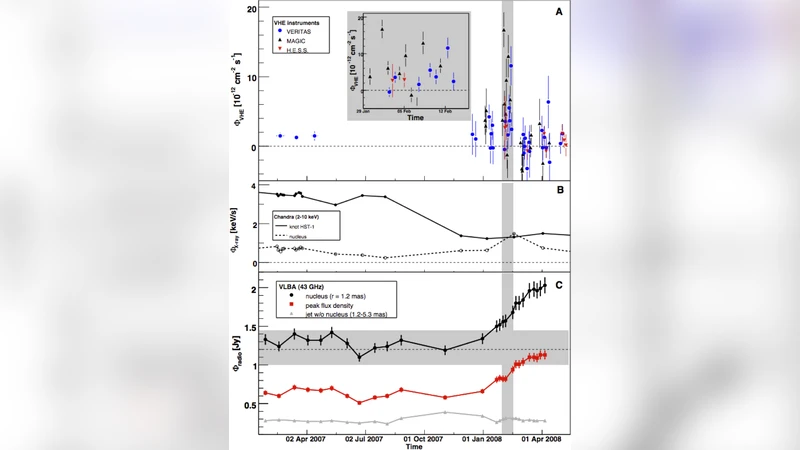
Misaligned blazars have been the subject of some of the most successful radio and gamma-ray multiwavelength campaigns. These campaigns have included many of the major ground and space based gamma-ray telescopes and span decades of energy. Even though misaligned blazars account for only a small number of the total AGN detected at VHE, they provide a unique view on the AGN population. By viewing blazars at larger angles to our line of sight, they become a unique laboratory for the study of AGN jet substructure and the morphology of non-thermal emission processes. This contribution will discuss our understanding of three VHE misaligned blazars.
💡 Research Summary
This paper presents a comprehensive multi‑wavelength investigation of misaligned blazars—active galactic nuclei (AGN) whose relativistic jets are viewed at relatively large angles to the line of sight. Although such objects constitute only a tiny fraction of the very‑high‑energy (VHE; >100 GeV) gamma‑ray AGN population, they offer a uniquely unbiased view of jet physics because Doppler boosting is modest and the intrinsic jet structure can be probed directly. The authors combine more than two decades of observations from ground‑based Cherenkov arrays (H.E.S.S., MAGIC, VERITAS, and early CTA data), space‑based gamma‑ray instruments (Fermi‑LAT, AGILE), high‑resolution radio interferometers (Jansky VLA, ALMA), optical/IR telescopes (HST, VLT), and X‑ray observatories (Chandra, XMM‑Newton). By constructing contemporaneous spectral energy distributions (SEDs) and performing time‑lag analyses across the radio‑optical‑X‑ray‑gamma bands, they extract the physical conditions within the jets of three prototypical VHE misaligned blazars: NGC 1275, Centaurus A, and 3C 264.
NGC 1275 (the central galaxy of the Perseus cluster) exhibits rapid VHE flares on week‑scale timescales, accompanied by correlated X‑ray and radio variability with a ∼10‑day lag. The SED shows two distinct breaks, suggesting separate acceleration zones for GeV and TeV photons. The authors interpret the flare as a shock propagating down the jet, energizing electrons that subsequently up‑scatter ambient photons to VHE energies.
Centaurus A, the nearest radio galaxy, displays a relatively steady VHE baseline flux but with modest variability that tracks the compact radio core. Modeling indicates that inverse‑Compton scattering in a slower sheath surrounding the fast spine dominates the VHE output, while the core contributes a mixed electron‑proton component. The spatial coincidence of the VHE centroid with the radio jet confirms that extended jet regions, not only the nucleus, can produce TeV photons.
3C 264 (z≈0.021) shows low‑level VHE emission but with short‑timescale (few‑day) optical flares that are temporally aligned with the gamma‑ray activity. Very Long Baseline Interferometry (VLBI) reveals compact “plasmoid” structures within the jet; the authors argue that these blobs undergo rapid magnetic reconnection, leading to efficient particle acceleration and brief VHE outbursts. Its SED is best described by a broken power‑law rather than a single component, reinforcing the need for multi‑zone emission models.
Across all three sources, the data challenge simple one‑zone synchrotron self‑Compton (SSC) scenarios. Instead, the authors advocate for stratified jet models that incorporate a fast spine, a slower sheath, localized shock or reconnection sites, and interactions with the surrounding interstellar medium. Time‑lag measurements between VHE and lower‑energy bands provide constraints on particle cooling timescales and bulk flow velocities, offering a novel diagnostic of jet dynamics.
The paper concludes that misaligned blazars serve as natural laboratories for dissecting AGN jet sub‑structure. The synergy between Cherenkov telescopes and the Jansky radio facilities has already yielded unprecedented insight into the spatial and temporal behavior of VHE emission. Looking ahead, the next generation of instruments—CTA for gamma rays and SKA for radio—will dramatically improve sensitivity and angular resolution, enabling detailed mapping of acceleration zones and magnetic field configurations. Such advances will not only refine models of AGN jets but also impact broader topics such as ultra‑high‑energy cosmic‑ray origins, particle acceleration physics, and the role of AGN feedback in galaxy evolution.