High resolution radio observations of gamma-ray emitting Narrow-Line Seyfert 1s
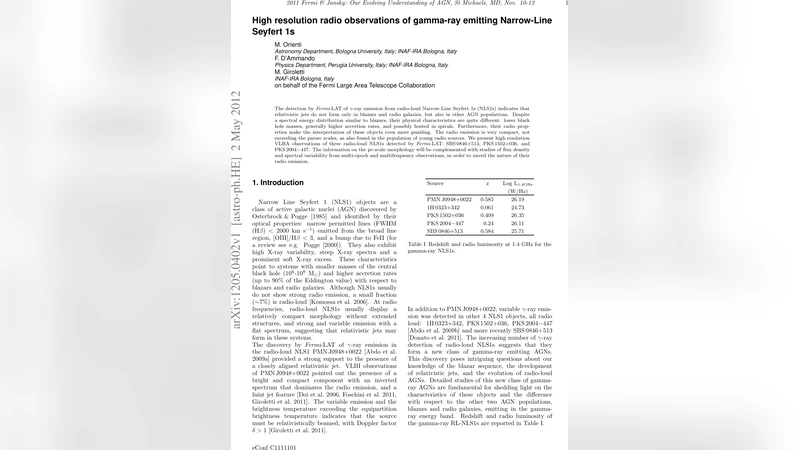
The detection by Fermi-LAT of gamma-ray emission from radio-loud Narrow-Line Seyfert 1s (NLS1s) indicates that relativistic jets do not form only in blazars and radio galaxies, but also in other AGN populations. Despite a spectral energy distribution similar to blazars, their physical characteristics are quite different: lower black hole masses, generally higher accretion rates, and possibly hosted in spirals. Furthermore, their radio properties make the interpretation of these objects even more puzzling. The radio emission is very compact, not exceeding the parsec scales, as also found in the population of young radio sources. We present high resolution VLBA observations of three radio-loud NLS1s detected by Fermi-LAT: SBS 0846+513, PKS 1502+036, and PKS 2004-447. The information on the pc-scale morphology will be complemented with studies of flux density and spectral variability from multi-epoch and multifrequency observations, in order to unveil the nature of their radio emission.
💡 Research Summary
The paper presents a detailed very‑long‑baseline interferometry (VLBA) study of three gamma‑ray‑emitting, radio‑loud Narrow‑Line Seyfert 1 galaxies (NLS1s): SBS 0846+513, PKS 1502+036, and PKS 2004‑447. These objects were selected because they have been detected by the Fermi Large Area Telescope (LAT) as sources of high‑energy photons, indicating the presence of relativistic jets in a class of active galactic nuclei (AGN) that traditionally was not associated with powerful jet activity.
Observations were carried out at multiple frequencies (1.7, 5, 8.4, and 15 GHz) with milliarcsecond resolution, allowing the authors to resolve structures on parsec scales. All three sources display a compact core that dominates the radio emission, with additional low‑level jet‑like extensions in some cases. SBS 0846+513 shows a symmetric, two‑sided jet extending roughly 3 mas (∼10 pc) at 5 GHz, while PKS 1502+036 exhibits a one‑sided jet visible at 8 GHz. PKS 2004‑447 is largely core‑dominated with only marginal evidence for extended emission. The morphology resembles that of young radio sources such as gigahertz‑peaked spectrum (GPS) or compact steep‑spectrum (CSS) objects, yet the spectral indices and variability patterns are more akin to blazars.
Multi‑epoch monitoring reveals significant flux density changes, especially in SBS 0846+513 where the core brightened by more than 30 % over a six‑month interval and the spectrum flattened, a behaviour consistent with the emergence of a new jet component or an internal shock. PKS 1502+036 shows relatively stable flux but a modest increase at 15 GHz, whereas PKS 2004‑447 displays low‑level variability with a gradual long‑term rise in core brightness. These variations are interpreted as signatures of ongoing jet activity that can be linked to the gamma‑ray flares observed by Fermi‑LAT.
Black‑hole mass estimates place the three NLS1s in the 10⁶–10⁸ M⊙ range, considerably lower than the typical masses of blazars (10⁸–10⁹ M⊙). Despite the lower masses, the inferred jet powers and apparent speeds (β ≈ 0.9 c or higher) are comparable to those of classical blazars. The authors argue that high accretion rates (Eddington ratios ≳0.1) and strong magnetic fields in the inner accretion disc can compensate for the lower black‑hole mass, enabling efficient jet launching.
An additional point of discussion is the host‑galaxy environment. While most powerful radio galaxies reside in massive ellipticals, several studies suggest that gamma‑ray‑emitting NLS1s may be hosted by spiral galaxies. The presence of abundant cold gas in spirals could sustain the high accretion rates required for jet formation and may also explain the rapid variability observed on parsec scales.
In summary, the VLBA imaging combined with multi‑frequency, multi‑epoch flux monitoring demonstrates that gamma‑ray‑emitting NLS1s possess compact, relativistic jets that share many characteristics with blazars, yet they occupy a distinct region of parameter space defined by lower black‑hole masses, higher accretion rates, and possibly different host morphologies. The authors conclude that these objects represent a youthful or transitional phase of radio‑loud AGN, bridging the gap between classical blazars and young compact radio sources. They advocate for future high‑resolution, broadband campaigns—including millimeter VLBI, simultaneous X‑ray/γ‑ray monitoring, and polarimetric studies—to unravel the detailed physics of jet launching and high‑energy emission in this intriguing class of AGN.