Real dimension groups
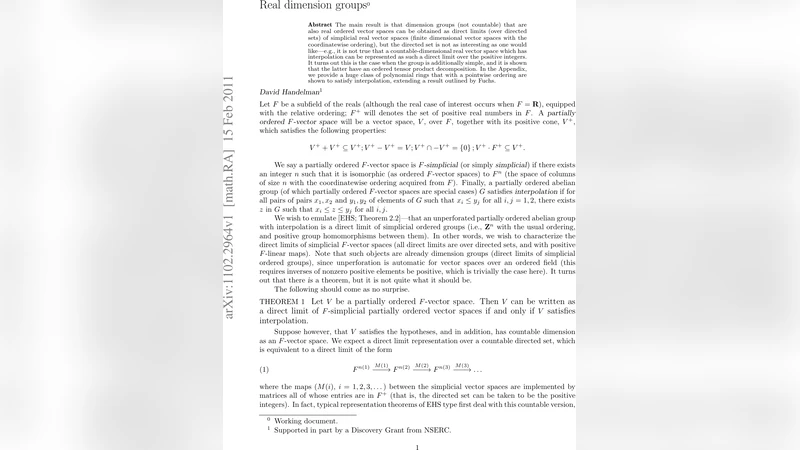
We show the characterization analogous to dimension groups of partially ordered real vector spaces with interpolation works, but sequential direct limits of simplicial vector spaces only under strong assumptions. We also provide and generalize a proof of a result of Fuchs asserting that the real polynomial algebra with pointwise ordering coming from an interval satisfies Riesz interpolation
💡 Research Summary
The paper investigates the interplay between partially ordered real (or more generally, sub‑field‑of‑the‑reals) vector spaces and the theory of dimension groups, focusing on the Riesz interpolation property. A partially ordered F‑vector space V is defined by a positive cone V⁺ that is closed under addition, scalar multiplication by positive elements of the ordered field F, and satisfies V⁺ – V⁺ = V and V⁺ ∩ (–V⁺) = {0}. The space is called simplicial if it is order‑isomorphic to Fⁿ with the coordinatewise order.
The central question is: when can such a V be expressed as a direct limit of simplicial F‑vector spaces? The authors prove two main theorems.
Theorem 1 states that any partially ordered F‑vector space V that satisfies Riesz interpolation can be written as a direct limit of simplicial F‑vector spaces. However, this representation may require an arbitrary directed set; a countable sequential direct limit (indexed by ℕ) is not guaranteed in general.
Theorem 2 adds a necessary extra hypothesis: if V has countable dimension and its positive cone V⁺ is generated by a countable subset under the action of F⁺ (i.e., V⁺ is countably F⁺‑generated), then V admits a sequential direct‑limit representation over the positive integers. The proof relies on two lemmas. Lemma 3 shows how to “kill” a given element of the kernel of a positive linear map by factoring through a new simplicial space; Lemma 4 iterates this construction to eliminate the entire kernel, thereby producing a system of simplicial spaces whose limit is V.
The paper also explores the structure of simple ordered F‑vector spaces. Proposition 5 demonstrates that any simple partially ordered F‑vector space V with interpolation is order‑isomorphic to a tensor product W ⊗_ℤ F, where W is a (rational) dimension group. The tensor product inherits the natural ordered structure, and the isomorphism respects both the vector‑space and order structures. Consequently, simple real dimension groups can be viewed as scalar extensions of rational dimension groups.
A crucial observation is that the extra countable‑generation condition is not vacuous. Example 8 presents the real polynomial ring R = ℝ
Comments & Academic Discussion
Loading comments...
Leave a Comment