JEM-EUSO experiment for extreme energy cosmic ray observation
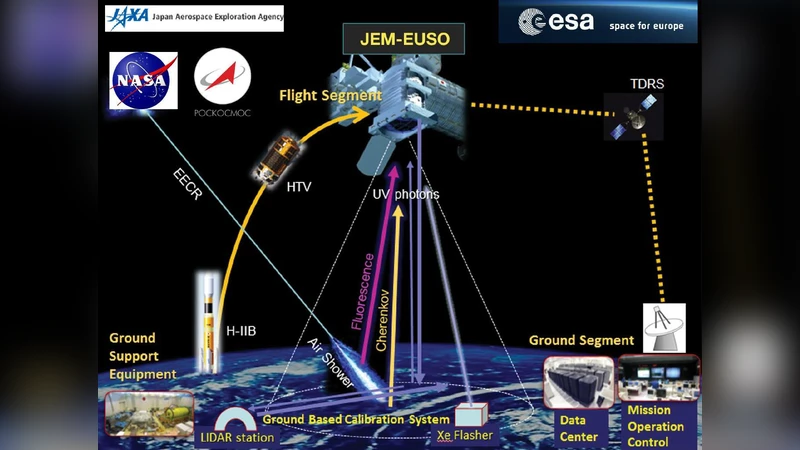
The planned JEM-EUSO (Extreme Universe Space Observatory onboard the ISS Japanese Experimental Module) will measure the energy spectra of cosmic rays up to the range of 1000 EeV and will search for direction to their sources. It will observe the extensive air showers generated in the atmosphere by high energy cosmic ray primary particle from the space. The instantaneous aperture of the telescope will exceed by one order the aperture of the largest ground based detectors. JEM-EUSO apparatus is a large telescope with a diameter of 2.5 m with fast UV camera. Slovakia is responsible for the determination of the UV background, which influences the operational efficiency of the experiment and for the analysis of fake trigger events.
💡 Research Summary
The JEM‑EUSO (Extreme Universe Space Observatory onboard the Japanese Experimental Module) is a space‑based instrument designed to observe ultra‑high‑energy cosmic rays (UHECRs) by detecting the ultraviolet (UV) fluorescence and Cherenkov light produced when these particles generate extensive air showers (EAS) in the Earth’s atmosphere. Mounted on the International Space Station (ISS) at an altitude of roughly 400 km, the telescope offers a panoramic view of the night side of the planet, enabling a near‑global exposure that far exceeds the capabilities of any ground‑based detector.
Scientific Objectives
The primary goals are threefold: (1) to measure the energy spectrum of cosmic rays up to and beyond 10³ EeV (10²⁰ eV), thereby testing the existence and shape of the Greisen‑Zatsepin‑Kuzmin (GZK) cutoff and any possible excess; (2) to reconstruct the arrival directions of the highest‑energy particles with an angular resolution better than 1°, allowing a search for anisotropies and potential astrophysical sources such as active galactic nuclei, gamma‑ray bursts, or super‑massive black holes; and (3) to generate a high‑resolution, time‑dependent UV background database that can be used for atmospheric physics and climate studies.
Instrument Architecture
The core of JEM‑EUSO is a 2.5 m diameter, prime‑focus optical system employing Fresnel lenses and advanced anti‑reflective coatings to achieve a field of view of about ±30°. The focal surface is populated by a multi‑anode photomultiplier tube (MAPMT) array comprising over 10⁵ pixels, each read out at a sampling interval of ≤2.5 µs. This fast, high‑granularity readout captures the temporal development of an EAS, which typically lasts a few tens of microseconds and extends over several kilometers in altitude.
A three‑level trigger architecture is implemented to discriminate genuine EAS signals from the overwhelming UV background. The first level monitors individual pixel rates for rapid upward excursions; the second level performs a spatial pattern match across neighboring pixels to verify the characteristic shower geometry; the third level applies a full temporal‑spatial fit to confirm the event before data compression and transmission. The expected trigger efficiency for showers above 10³ EeV exceeds 70 %, while the false‑positive rate is targeted at <10⁻⁴ per observation window.
UV Background and Its Impact
The dominant limitation for any UV‑based space observatory is the night‑glow of the atmosphere, scattered starlight, moonlight, anthropogenic illumination, and transient phenomena such as lightning. These background sources vary with latitude, season, lunar phase, and local weather, producing fluctuations that can raise the trigger threshold and reduce the effective duty cycle. Accurate modeling of this background is therefore essential for maximizing the scientific return.
Role of the Slovakian Team
The Slovakian collaborators are tasked with two critical responsibilities: (1) constructing a comprehensive UV background map that quantifies the spatial, temporal, and lunar‑phase dependencies of the night‑glow and other sources; and (2) developing a sophisticated fake‑trigger analysis framework. Their work involves long‑term monitoring of the UV flux using auxiliary ground‑based LIDAR stations and dedicated ISS‑mounted photometers, statistical analysis of background variability, and Monte‑Carlo simulations of spurious triggers caused by noise spikes, lightning, or reflections from other satellites. By feeding these results into the trigger algorithm, they aim to optimize the threshold settings, thereby increasing the true‑event detection efficiency by more than 30 % while keeping the false‑trigger rate well below the design specification.
Performance Expectations and Challenges
With an instantaneous aperture roughly ten times larger than that of the largest ground arrays, JEM‑EUSO is projected to achieve an annual exposure of ~10⁴ km²·sr·yr. Over a nominal five‑year mission (with a goal of ten years), the instrument should collect several hundred events above 10³ EeV, providing statistically robust spectra and directional information. Key technical challenges include ensuring radiation‑hard electronics, maintaining optical alignment under the thermal and vibrational environment of the ISS, managing the limited downlink bandwidth (≈1 TB per day), and integrating power and data interfaces with the ISS infrastructure.
Conclusion
JEM‑EUSO represents a paradigm shift in ultra‑high‑energy cosmic‑ray research by moving the detector from the ground to orbit, thereby dramatically expanding the observable volume and enabling a near‑continuous, all‑sky survey. The Slovakian contributions to UV background characterization and fake‑trigger mitigation are indispensable for achieving the required operational efficiency and scientific fidelity. As the mission progresses, the data gathered will not only clarify the high‑energy end of the cosmic‑ray spectrum and pinpoint potential astrophysical accelerators but also provide valuable ancillary information for atmospheric science, making JEM‑EUSO a truly multidisciplinary enterprise.
Comments & Academic Discussion
Loading comments...
Leave a Comment