Surveys with the Cherenkov Telescope Array
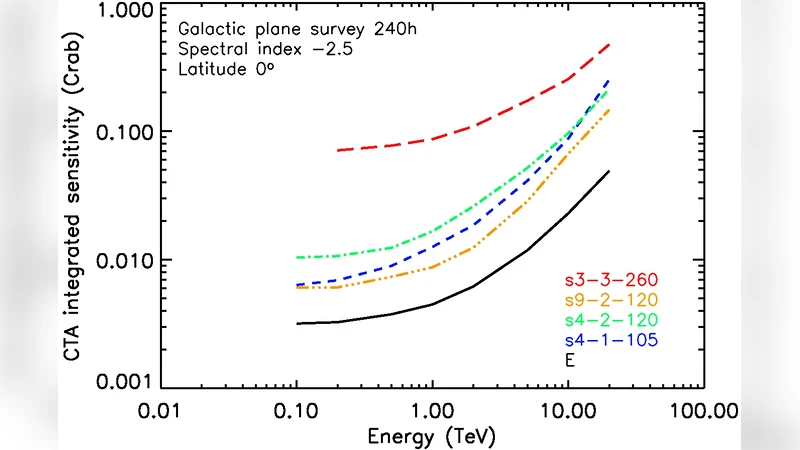
Surveys open up unbiased discovery space and generate legacy datasets of long-lasting value. One of the goals of imaging arrays of Cherenkov telescopes like CTA is to survey areas of the sky for faint very high energy gamma-ray (VHE) sources, especially sources that would not have drawn attention were it not for their VHE emission (e.g. the Galactic “dark accelerators”). More than half the currently known VHE sources are to be found in the Galactic plane. Using standard techniques, CTA can carry out a survey of the region |l|<60 degrees, |b|<2 degrees in 250 hr (1/4th the available time per year at one location) down to a uniform sensitivity of 3 mCrab (a “Galactic Plane survey”). CTA could also survey 1/4th of the sky down to a sensitivity of 20 mCrab in 370 hr of observing time (an “all-sky survey”), which complements well the surveys by the Fermi/LAT at lower energies and extended air shower arrays at higher energies. Observations in (non-standard) divergent pointing mode may shorten the “all-sky survey” time to about 100 hr with no loss in survey sensitivity. We present the scientific rationale for these surveys, their place in the multi-wavelength context, their possible impact and their feasibility. We find that the Galactic Plane survey has the potential to detect hundreds of sources. Implementing such a survey should be a major goal of CTA. Additionally, about a dozen blazars, or counterparts to Fermi/LAT sources, are expected to be detected by the all-sky survey, whose prime motivation is the search for extragalactic “dark accelerators”.
💡 Research Summary
The paper presents a thorough feasibility study of two large‑scale survey programs that could be carried out with the Cherenkov Telescope Array (CTA), outlining their scientific motivations, technical designs, expected yields, and operational considerations. The authors begin by emphasizing that very‑high‑energy (VHE) gamma‑ray astronomy to date has been heavily biased toward sources that were already known from radio, X‑ray, or GeV observations, especially those located in the Galactic plane. This bias limits the discovery of “dark accelerators” – objects that emit strongly at TeV energies but are faint or invisible at lower wavelengths. To open an unbiased discovery space and to create a legacy dataset for the community, CTA must conduct wide‑field, uniform‑sensitivity surveys.
Two complementary survey strategies are examined. The first, the Galactic Plane Survey, targets the region |l| < 60°, |b| < 2° in Galactic coordinates. Using standard (co‑pointed) observation mode, the authors show that a total exposure of 250 hours – roughly one quarter of the annual observing time available at a single site – can achieve a uniform sensitivity of 3 mCrab (≈ 7 × 10⁻¹³ erg cm⁻² s⁻¹ at 1 TeV). This depth is about a factor of two better than the current capabilities of H.E.S.S. and MAGIC and would enable the detection of several hundred new VHE sources, many of which are expected to be previously unknown dark accelerators. The survey design includes a tiling pattern with ~30 min dwell time per pointing, optimized overlap to minimise gaps, and a robust background‑modeling pipeline to handle the complex diffuse emission near the Galactic centre.
The second program, the All‑Sky Survey, aims to cover one quarter of the celestial sphere down to a sensitivity of 20 mCrab. Here the authors propose using a divergent pointing mode, in which each telescope in the array points slightly offset from the others, thereby expanding the instantaneous field of view by roughly a factor of three while preserving the overall array performance. Simulations indicate that, with this mode, the same 20 mCrab sensitivity can be reached in only about 100 hours of total exposure, compared with 370 hours required in the conventional co‑pointed mode. This dramatic reduction in required time makes an all‑sky survey a realistic component of CTA’s early science programme. The expected scientific return includes the detection of about a dozen new extragalactic blazars and the identification of VHE counterparts to many Fermi‑LAT sources, providing a crucial bridge between GeV and PeV observations.
The paper places both surveys in a multi‑wavelength context. The Galactic Plane Survey will complement the Fermi‑LAT Galactic plane maps at GeV energies and the high‑energy coverage of extensive air‑shower arrays such as HAWC and LHAASO, enabling spectral continuity from a few hundred MeV up to hundreds of TeV. The All‑Sky Survey will similarly dovetail with the LAT all‑sky catalogue and with future MeV‑GeV missions, while also feeding targets for follow‑up observations with optical, radio, and X‑ray facilities.
Operational challenges are discussed in detail. The authors identify three main risk areas: (1) the massive data volume generated by wide‑field observations, requiring high‑throughput computing and automated pipelines; (2) systematic uncertainties introduced by divergent pointing, especially in the reconstruction of event direction and energy; and (3) the need for accurate, spatially varying background models in regions of strong diffuse emission. To mitigate these issues, the paper proposes a suite of software tools, real‑time quality monitoring, and a schedule‑optimization algorithm that balances sky coverage, weather constraints, and array configuration.
In conclusion, the authors argue that implementing both the Galactic Plane Survey and the All‑Sky Survey should be a priority for CTA’s early science phase. The Galactic Plane Survey promises to increase the known Galactic VHE source population by a factor of several, dramatically enhancing our understanding of particle acceleration in supernova remnants, pulsar wind nebulae, and other exotic objects. The All‑Sky Survey, especially when executed in divergent pointing mode, offers a cost‑effective pathway to discover new extragalactic VHE emitters and to complete the high‑energy picture of the gamma‑ray sky. By allocating a modest fraction of the total available observing time, CTA can generate legacy datasets that will serve the broader astrophysical community for decades.