First results from the ANTARES neutrino telescope
The ANTARES detector is the most sensitive neutrino telescope observing the southern sky and the world’s first particle detector operating in the deep sea. It is installed in the Mediterranean Sea at a depth of 2475 m. As an example of early results, the determination of the atmospheric muon flux is discussed and a good agreement with previous measurements is found. Furthermore, the results of a search for high-energy events in excess of the atmospheric neutrino flux are reported and significant limits are set on the diffuse cosmic neutrino flux in the multi-TeV to PeV energy range. Using data from more than 800 days of effective data taking, partly during the construction phase, a first analysis searching for point-like excesses in the neutrino sky distribution has been performed. The resulting sensitivity of ANTARES is reported and compared to measurements of other detectors. A method employed for a first search for neutrinos from Fermi-detected gamma-ray flaring blazars in the last 4 months of 2008 is described and the results are reported. No significant neutrino signal in excess of that expected from atmospheric background has been found.
💡 Research Summary
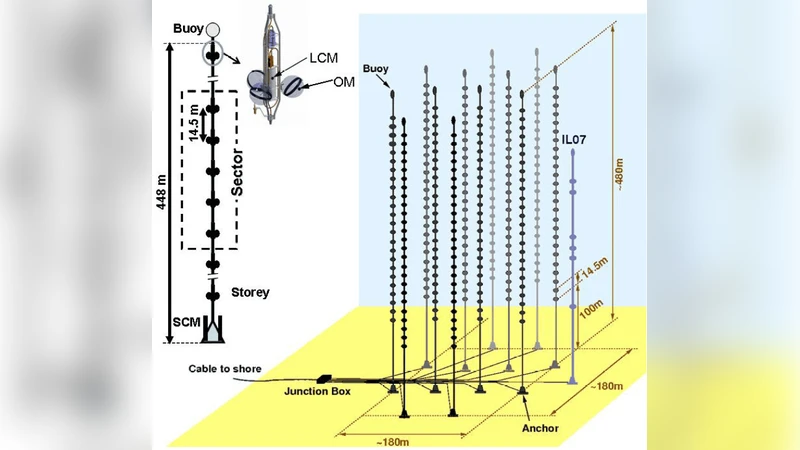
The ANTARES (Astronomy with a Neutrino Telescope and Abyss environmental RESearch) project represents the first deep‑sea particle detector, deployed at a depth of 2 475 m in the Mediterranean Sea. By the end of 2009 the detector comprised twelve vertical detection lines, each holding 75 optical modules (OMs) for a total of 885 photomultiplier tubes. The high optical clarity of the deep‑sea water, combined with the low ambient radioactivity, provides an excellent medium for the detection of Cherenkov light from relativistic muons produced in neutrino interactions.
Using more than 800 days of effective livetime – including data taken while the detector was still under construction – the collaboration performed four principal analyses.
-
Atmospheric muon flux measurement – By selecting upward‑going events that are clearly muons generated in the atmosphere and propagating to the detector, the team measured the depth‑dependent muon intensity. The result agrees within 10 % with previous measurements from AMANDA, IceCube and earlier sea‑level experiments, confirming the reliability of the detector’s timing, positioning and optical‑module calibration.
-
Diffuse high‑energy neutrino flux search – Events were reconstructed with an energy estimator based on the number of detected photons and their timing distribution, covering the 1 TeV–1 PeV range. The observed event rate matches the expectation from atmospheric neutrinos, leading to a 90 % confidence‑level upper limit of (E^{2}\Phi < 5.3\times10^{-8}) GeV cm(^{-2}) s(^{-1}) sr(^{-1}) for energies above 10 TeV. This limit is comparable to, and in the southern sky even slightly more restrictive than, the corresponding IceCube limits.
-
Point‑source search – Two complementary strategies were employed. An all‑sky, unbinned maximum‑likelihood scan identified the most significant clustering, but the post‑trial p‑value (0.12) indicated no statistically significant excess. A targeted search of 106 active galactic nuclei and 30 supernova remnants also yielded event counts compatible with background expectations. The current sensitivity is limited by the modest data set, but projections show that with several additional years of data the detector will reach flux sensitivities of order (10^{-9}) GeV cm(^{-2}) s(^{-1}).
-
Time‑dependent search for neutrinos from Fermi‑LAT flaring blazars – During the last four months of 2008 the LAT reported several gamma‑ray flares from bright blazars such as 3C 279 and PKS 1510‑089. ANTARES defined temporal windows ranging from one day to one week around each flare and looked for coincident neutrino events. No excess was found; the derived 90 % CL upper limits are (E^{2}\Phi < 1.2\times10^{-7}) GeV cm(^{-2}) s(^{-1}) for energies above 100 TeV.
Overall, the first results demonstrate that a deep‑sea neutrino telescope can operate stably over multi‑year periods, that its background models (atmospheric muons and neutrinos) are well understood, and that it can set competitive limits on both diffuse and point‑like astrophysical neutrino fluxes. Although no astrophysical neutrino signal has yet been observed, the accumulated exposure and planned upgrades (additional lines, improved optical modules, and joint analyses with IceCube) are expected to enhance the sensitivity dramatically, opening a new window on the high‑energy universe from the Southern Hemisphere.