A Feasibility Study for the Detection of Supernova Explosions with an Undersea Neutrino Telescope
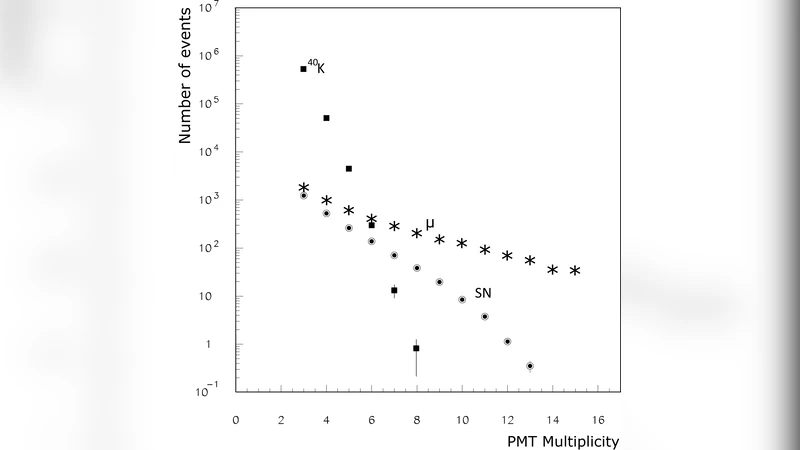
We study the potential of a very large volume underwater Mediterranean neutrino telescope to observe neutrinos from supernova (SN) explosions within our galaxy. The intense neutrino burst emitted in a SN explosion results in a large number of MeV neutrinos inside the instrumented volume of the neutrino telescope that can be detected (mainly) via the reaction \nu_e-bar + p -> e^+ + n . In this study we simulated the response of the underwater neutrino telescope to the electron antineutrino flux predicted by the Garching model for SN explosions. We assumed that the neutrino telescope comprises 6160 direction sensitive optical modules, each containing 31 small photomultiplier tubes. Multiple coincidences between the photomultiplier tubes of the same optical module are utilized to suppress the noise produced by $^{40}K$ radioactive decays and to establish a statistical significant signature of the SN explosion.
💡 Research Summary
The paper investigates whether a very large underwater neutrino telescope deployed in the Mediterranean Sea can detect the burst of MeV‑scale electron‑antineutrinos emitted by a core‑collapse supernova (SN) within our Galaxy. The authors model a detector consisting of 6 160 optical modules (OMs), each housing 31 small photomultiplier tubes (PMTs) arranged in a compact geometry. The detection channel of interest is the inverse beta‑decay reaction (\bar\nu_e + p \rightarrow e^+ + n). The positron generates Cherenkov light, which is recorded by the PMTs.
A major challenge for low‑energy neutrino detection in seawater is the background from the natural radioactivity of (^{40})K, which produces single‑photon hits at a rate of several kilohertz per PMT. To suppress this background, the study exploits intra‑module coincidences: a genuine neutrino event is expected to produce photons that hit multiple PMTs within the same OM within a few tens of nanoseconds, whereas random (^{40})K hits are unlikely to generate such multi‑hit coincidences. The authors evaluate 2‑fold, 3‑fold, and 4‑fold coincidence criteria.
The neutrino flux is taken from the state‑of‑the‑art Garching SN model, assuming a typical core‑collapse at a distance of 10 kpc. The simulated (\bar\nu_e) spectrum yields, after inverse beta‑decay, an average of 5–10 Cherenkov photons per event inside an OM. With realistic PMT quantum efficiencies, timing resolutions, and water optical properties, the simulation predicts that a 3‑fold coincidence reduces the accidental background rate to below 0.01 Hz while preserving most of the signal.
During the ~10 s neutrino burst, the detector would record several hundred multi‑PMT coincidences. Using Poisson statistics, the authors calculate a signal‑to‑noise ratio that exceeds the 5σ discovery threshold for supernovae out to ~15 kpc, effectively covering the entire Milky Way. The total instrumented volume, about 0.5 km³, is comparable to existing high‑energy sea‑water telescopes (e.g., ANTARES, KM3NeT), demonstrating that a single infrastructure can serve both high‑energy astrophysics and low‑energy SN monitoring.
Technical considerations identified include: (1) minimizing electronic cross‑talk among the 31 PMTs in each OM, (2) achieving sub‑5 ns timing synchronization to reliably form coincidences, (3) developing real‑time trigger algorithms capable of handling the high data throughput while flagging burst‑like excesses, and (4) integrating an alert system that can disseminate a supernova warning to the global astronomy community within seconds.
In summary, the feasibility study shows that an undersea neutrino telescope with densely packed, multi‑PMT optical modules can statistically identify a galactic supernova via the inverse beta‑decay channel, despite the pervasive (^{40})K background. The proposed coincidence‑based background rejection, combined with the large instrumented volume, yields a detection sensitivity that meets the requirements for a reliable early‑warning network. The work therefore supports the inclusion of low‑energy supernova monitoring as a core scientific objective for future Mediterranean neutrino observatories.