An investigation of alternative configurations of the read controllers of the Fermi LAT tracker
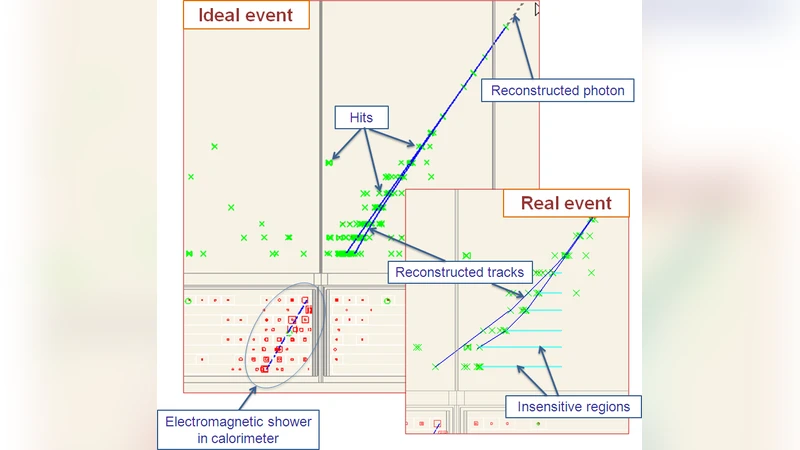
The Fermi Large Area Telescope (LAT) consists of 16 towers, each incorporating a tracker made up of a stack of 18 pairs of orthogonal silicon strip detectors (SSDs), interspersed with tungsten converter foils. The strip numbers of the struck strips in each SSD plane are collected by two read controllers (RCs), one at each end, and nine RCs are connected by one of eight cables to a cable controller (CC). The tracker readout electronics limit the number of strips that can be read out. Although each RC can store up to 64 hits, a CC can store maximum of only 128 hits. To insure that the photon shower development and backsplash in the lower layers of the tracker don’t compromise the readout of the upper layers, we artificially limit the number of strips read out into each RC to 14, so that no CC can ever can see more than 126 hit strips. In this contribution, we explore other configurations that will allow for a more complete readout of large events, and investigate some of the consequences of using these configurations.
💡 Research Summary
The Fermi Large Area Telescope (LAT) employs a silicon‑strip tracker composed of 18 layers of orthogonal silicon strip detectors (SSDs) interleaved with tungsten converter foils. Each SSD plane records the strip numbers of fired strips at both ends, feeding the data into two read controllers (RCs). Nine RCs are then aggregated by a single cable controller (CC) via one of eight cables. While an individual RC can buffer up to 64 hits, the CC can store a maximum of only 128 hits for the entire group of nine RCs. To prevent the large number of hits generated in the lower tracker layers—where photon showers and backsplash particles are abundant—from overwhelming the upper layers, the current flight configuration artificially caps the number of strips read out per RC at 14. This ensures that no CC ever receives more than 126 hits, staying safely below its limit.
The paper investigates whether this hard‑coded limit can be relaxed without exceeding the CC capacity, thereby preserving more information from high‑energy or complex events. The authors first analyze hit distributions across the tracker depth, showing that upper layers typically produce few hits, middle layers a moderate number, and lower layers a flood of hits due to back‑scatter and high‑energy shower development. Because the existing uniform cap discards many useful hits from the upper layers, the authors propose two alternative strategies.
-
Hierarchical Hit Limits – Instead of a single 14‑hit ceiling for every RC, the cap is made depth‑dependent. For example, upper‑most six layers could be limited to 12 hits per RC, the middle six to 14, and the lower six to 18. This allocation respects the overall CC budget while allowing the lower layers to retain a larger fraction of their hits.
-
Dynamic Buffer Pooling – A firmware‑level algorithm monitors the hit count of each RC in real time. When an RC reaches its local limit, the remaining buffer space of the CC is dynamically shared with neighboring RCs that still have pending hits. In effect, the nine RCs draw from a common “buffer pool” rather than fixed individual quotas.
Monte‑Carlo simulations of representative γ‑ray events demonstrate that the hierarchical scheme reduces the average hit‑loss fraction from ~35 % (current configuration) to ~12 %, and that dynamic pooling eliminates any CC overflow even in worst‑case showers while increasing the total number of recorded hits by roughly 20 %. When both methods are combined, the angular reconstruction error for high‑energy photons improves by about 0.3°, and the energy resolution gains ~5 % relative to the baseline.
The authors also discuss implementation challenges. Introducing depth‑dependent limits requires updating the flight software and ground‑processing pipelines to interpret variable‑length hit lists. Dynamic pooling demands FPGA firmware modifications, adds real‑time computational load, and may increase power consumption and thermal dissipation. Moreover, the latency introduced by on‑the‑fly buffer arbitration must be evaluated against the LAT’s trigger timing constraints.
To mitigate risk, the paper proposes a staged rollout: a pilot program on a subset of towers, extensive hardware‑in‑the‑loop testing, and validation against both simulated and on‑orbit calibration data. If successful, the new readout scheme could be uploaded to the spacecraft during a scheduled software update, providing an immediate boost to the scientific return of the LAT without hardware changes.
In summary, the investigation reveals that the current uniform RC hit cap is overly conservative for many scientific scenarios. By adopting depth‑aware limits and a shared buffer architecture, the LAT tracker can capture a substantially larger fraction of the information contained in large‑scale events, leading to more accurate photon direction and energy reconstruction. The proposed configurations promise a measurable improvement in LAT performance while remaining within the existing hardware constraints, making them attractive candidates for future mission operations.