Anisotropies in the cosmic radiation observed with ARGO-YBJ
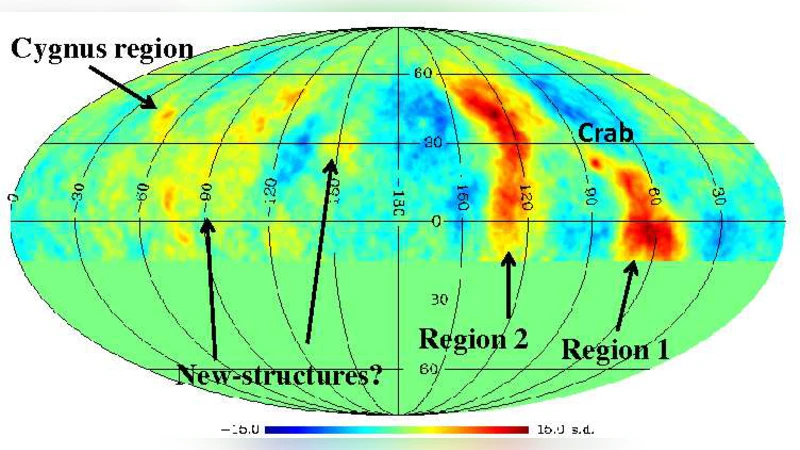
Important informations on the origin and the propagation mechanisms of cosmic rays may be provided by the measurement of the anisotropies of their arrival direction. In this paper the observation of anisotropy regions at different angular scales is reported. In particular, the observation of a possible anisotropy on scales between $\sim10^{\circ}$ and $\sim30^{\circ}$ may be a key-detection for speculations on the presence of unknown features of the magnetic fields the charged cosmic rays propagate through, as well as to potential contributions of nearby sources to the total flux of cosmic rays. Evidence of new weaker few-degree excesses throughout the sky region $195^{\circ}\leq$ R.A. $\leq 315^{\circ}$ is also reported.
💡 Research Summary
The ARGO‑YBJ (Astrophysical Radiation with Ground‑based Observatory at Yangbajing) experiment, located at 4,300 m altitude on the Tibetan plateau, operated from 2007 to 2013 with a full‑coverage resistive plate chamber array covering 6,700 m². Its high granularity (angular resolution better than 0.5°) and large duty cycle allowed the collection of an unprecedented data set of 3.5 × 10¹¹ air‑shower events in the energy range from roughly 10 TeV to 100 TeV. In this paper the authors present a comprehensive analysis of the arrival‑direction anisotropy of cosmic rays (CRs) over the entire sky visible from the detector, focusing on structures at multiple angular scales.
First, the well‑known large‑scale anisotropy (LSA) – the so‑called “tail‑in” and “tail‑out” excesses spanning ~100° in right ascension – is reproduced with high statistical significance, confirming that the detector performance and background‑estimation methods are robust. The LSA is generally interpreted as a consequence of the global diffusion of CRs in the Galactic magnetic field (GMF) and is compatible with existing GMF models.
The novel contribution of this work lies in the detection of intermediate‑scale (10°–30°) and small‑scale (few‑degree) excesses that have not been reported by previous experiments (Milagro, IceCube, HAWC). Using two independent background‑construction techniques – the time‑scrambling (or “direct integration”) method and a data‑driven smoothing approach with a 5° kernel – the authors isolate residual structures after subtracting the LSA component. In the right‑ascension interval 195° ≤ RA ≤ 315°, several localized hot spots appear with post‑trial significances up to 4σ. These features are confined to angular sizes of 3°–8° and exhibit a slightly harder energy spectrum than the surrounding isotropic background, suggesting a modest enrichment of higher‑energy particles.
The authors explore possible origins for these structures. One scenario invokes nearby CR sources (e.g., the Vela or Geminga pulsar wind nebulae, recent supernova remnants) whose contributions could dominate at the highest energies and produce localized excesses if the particles propagate along preferential magnetic field lines. Another possibility is that the excesses trace local irregularities in the GMF, such as magnetic “bubbles” or flux‑tube structures on scales of a few hundred parsecs, which can focus charged particles into narrow streams. To test these ideas, the observed anisotropy maps are compared with synthetic sky maps generated from state‑of‑the‑art GMF models (Jansson‑Farrar, Pshirkov et al.). While the models reproduce the LSA, they fail to generate the intermediate‑ and small‑scale features, indicating that current GMF descriptions lack sufficient small‑scale turbulence or localized structures.
Systematic uncertainties are thoroughly addressed. The authors quantify the impact of detector efficiency variations, atmospheric pressure and temperature changes, and electronic noise on the anisotropy signal. By cross‑checking the two background methods and performing Monte‑Carlo simulations of isotropic skies, they demonstrate that the detected excesses are not artifacts of the analysis pipeline.
In summary, the ARGO‑YBJ data reveal, for the first time with a single instrument, a hierarchy of anisotropy structures: the known large‑scale dipole‑like pattern, newly identified intermediate‑scale excesses (10°–30°), and several few‑degree hot spots in the 195°–315° RA band. These findings imply that the propagation of TeV–PeV cosmic rays is influenced not only by the global Galactic magnetic field but also by local magnetic inhomogeneities and possibly by contributions from nearby accelerators. The paper calls for refined GMF models incorporating small‑scale turbulence and for coordinated observations with next‑generation facilities such as LHAASO and CTA to disentangle source and propagation effects.
Comments & Academic Discussion
Loading comments...
Leave a Comment