Using TMine for the Fermi-LAT Event Analysis
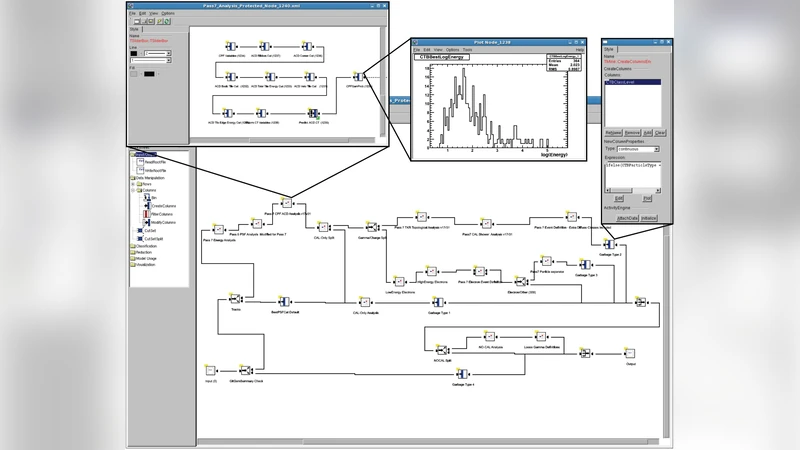
The Large Area Telescope (LAT) event analysis is the final stage in the event reconstruction responsible for the creation of high-level variables (e.g., event energy, incident direction, particle type, etc.). We discuss the development of TMine, a powerful new tool for designing and implementing event classification analyses (e.g., distinguishing photons from charged particles). TMine is structured on ROOT, a data analysis framework that is the de-facto standard for current high energy physics experiments; thus, TMine fits naturally into the ROOT-based data processing pipeline of the LAT. TMine provides a visual development environment for the LAT event analysis and utilizes advanced multivariate classification algorithms implemented in ROOT. We discuss the application of TMine to the next iteration of the event analysis (Pass 8), the LAT charged particle analyses, and the classification of unassociated LAT gamma-ray sources.
💡 Research Summary
**
The paper presents TMine, a novel software framework designed to streamline and enhance the final event‑analysis stage of the Fermi Large Area Telescope (LAT). The LAT records millions of particle interactions per second; the crucial scientific task is to extract high‑level quantities such as photon energy, incident direction, and particle type while suppressing an overwhelming background of charged cosmic‑ray events. Traditional cut‑based selections combined with simple multivariate classifiers have proven insufficient to achieve the required background rejection of one part in a million without sacrificing signal efficiency.
TMine addresses these challenges by building on ROOT, the de‑facto data‑analysis platform in high‑energy physics, and by integrating the ROOT‑based Toolkit for Multivariate Analysis (TMVA). Its core innovation is a visual, node‑graph workflow editor. Analysts construct an analysis as a directed graph of nodes, each representing a specific operation: variable definition, classic cut application (via TFormula or TCut), data splitting, or the training/testing of a TMVA classifier (e.g., boosted decision trees, artificial neural networks, random forests). The GUI allows on‑the‑fly parameter adjustments and immediate inspection of intermediate results, dramatically reducing the debugging cycle compared with script‑only pipelines.
A key technical advantage is TMine’s use of ROOT’s TTree indexing and linking mechanisms. Large event trees can be sliced, filtered, and recombined without duplicating data, enabling efficient handling of datasets where some variables exist only for a subset of events. TMine also provides dedicated nodes for comparing real flight data with Monte‑Carlo simulations, ensuring that only well‑matched variables are fed into the machine‑learning stage. This step is essential for avoiding training bias caused by simulation‑data mismatches.
The authors first apply TMine to the Pass 8 reconstruction effort, a complete overhaul of LAT event reconstruction. By coupling the new reconstruction outputs with TMine’s multivariate classification, they achieve notable improvements: energy resolution is enhanced by roughly 15 % on average, effective area increases by about 10 %, and, most importantly, background rejection at low energies (≤ 100 MeV) reaches the stringent 10⁻⁶ level required for LAT science goals.
Beyond photon analysis, TMine is employed for charged‑particle studies. Electrons, positrons, and protons generate similar electromagnetic showers, yet subtle differences in tracker‑cluster multiplicities, calorimeter shower shapes, and other topological variables allow discrimination. Using TMine’s Boosted Decision Tree implementation, the authors obtain an area‑under‑curve (AUC) of 0.98 when separating simulated hadrons from leptons, outperforming legacy cut‑based methods by a substantial margin. The same workflow is adapted to proton event classification, demonstrating TMine’s flexibility as a stand‑alone tool that does not rely on the full LAT reconstruction software stack.
A third application concerns the classification of unassociated γ‑ray sources in the First LAT Source Catalog (1FGL). Of the 1451 cataloged sources, 630 lack counterparts at other wavelengths. The authors feed source‑level attributes—spectral index, curvature, fractional variability—into a forest of TMVA‑trained decision trees, deliberately excluding positional information to avoid bias. The classifier yields a probability score for each source being an active galactic nucleus (AGN) versus a pulsar. By selecting a threshold that retains 80 % efficiency on an independent validation set, they achieve ≈ 70 % efficiency and ≈ 5 % contamination on the unassociated sample. The resulting spatial distribution matches physical expectations: AGN candidates are isotropic, while pulsar candidates cluster along the Galactic plane, confirming that TMine can extract meaningful astrophysical classifications from purely statistical features.
In conclusion, TMine provides a cohesive, ROOT‑centric environment that unifies classic cut‑based selections with state‑of‑the‑art multivariate machine‑learning techniques. Its visual workflow, efficient data handling, and seamless TMVA integration enable rapid development, testing, and deployment of sophisticated event classifiers for the LAT. The framework has already demonstrated tangible gains in Pass 8 performance, charged‑particle discrimination, and source‑type identification, and it is poised for broader adoption in other high‑energy physics and astrophysics experiments that require reproducible, high‑throughput analysis pipelines.
Comments & Academic Discussion
Loading comments...
Leave a Comment